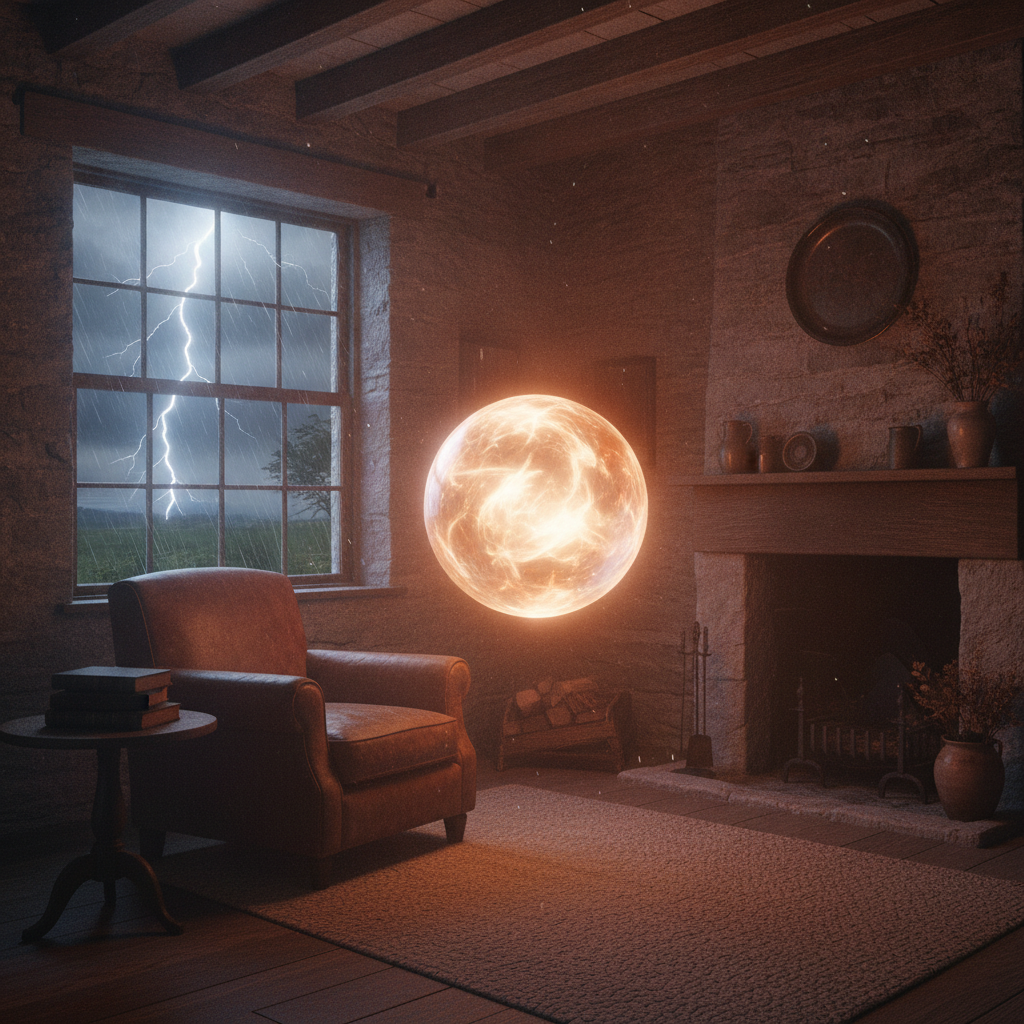
Caught on Camera After 400 Years: The Enduring Riddle of Ball Lightning
Five minutes past midnight - 0005 Eastern Standard Time, March 19, 1963. Eastern Airlines Flight 539, flying from New York to Washington, was bucking through an electrical storm when a blinding, deafening discharge enveloped the whole aircraft. A few seconds later, out of the direction of the cockpit, something emerged: a glowing sphere a little over twenty centimetres across - about twenty-two, the witness would later judge - shining a soft blue-white, roughly as bright as a ten-watt bulb.
The sphere floated down the aisle at the height of a seatback, some seventy-five centimetres above the floor, holding an even course and an unhurried pace of about one and a half metres a second. It passed within half a metre of a seated passenger, radiated not a trace of heat, and drifted on toward the tail of the plane before it was gone.
The passenger it glided past could hardly have been better chosen. Roger Jennison was a physicist - a radio astronomer who had worked at Jodrell Bank and would soon hold a chair in physical electronics at the University of Kent - and he did exactly what a physicist does: he watched, he estimated size and brightness and speed, and he fixed the thing in memory as data rather than wonder. In 1969 he published the account in the journal Nature, sober and quantified, a few careful sentences that remain among the cleanest eyewitness records the phenomenon possesses.
Jennison's was not the only such report. Pilots and crew have described luminous balls rolling through cabins and cockpits often enough that researchers have catalogued the aircraft cases on their own, and the pattern is oddly consistent: a bright discharge outside the fuselage, then a slow, self-possessed sphere within, gone in a few seconds. These encounters happen inside what is effectively a Faraday cage of aluminium - a shell that ought to keep any stray external field out.
What Jennison saw has a name and four centuries of testimony behind it. Witnesses caught in thunderstorms - farmers, sailors, airline pilots, physicists - keep describing the same object: a luminous ball, often the size of a grapefruit, that hovers, wanders, sometimes hisses or gives off a sharp smell of sulphur, and then either vanishes silently or bursts with a bang. The phenomenon is called ball lightning, and for most of scientific history it had no physical proof at all - only accounts, thousands upon thousands of them. The Russian physicist Mark Stakhanov and others assembled databases of many hundreds of sightings; one catalogue gathered more than two thousand cases, consistent enough to draw from them a rough consensus on the object's size, colour and lifetime.
The oldest detailed account comes from Widecombe-in-the-Moor, in England. On October 21, 1638, during the storm remembered as the Great Thunderstorm, witnesses described a great ball of fire tearing through the village church, smashing pews and windows and filling the nave with a foul smell of brimstone. Four people were killed and some sixty injured. The villagers, reasonably enough for their time, blamed the devil; modern researchers read the same old report as a textbook description of ball lightning, which shows how little the description itself has changed in nearly four hundred years.
Other famous cases entered the record along the way. In 1753 the physicist Georg Richmann was killed in Saint Petersburg while running a Franklin-style experiment with an ungrounded rod during a storm, and a famous engraving shows a fiery globe leaping to his forehead. For generations it was retold as the first scientific death by ball lightning.
For the better part of two centuries, official science leaned toward the skeptics, dismissing the reports as afterimages burned onto the retina by an ordinary flash, or as St Elmo's fire misremembered, or as pure imagination. Yet the accounts kept coming, and many carried a detail no known physics could digest: witnesses insisted the glowing balls passed through closed window panes, and occasionally through solid walls, and then continued calmly on the far side as though nothing had happened. It is the single most persistent feature of the testimony.
Then, in July 2012, luck intervened. On the Tibetan Plateau in Qinghai, a team from Northwest Normal University in Lanzhou - Jianyong Cen and Ping Yuan among them - was recording ordinary cloud-to-ground lightning with high-speed cameras and slitless spectrographs when a strike about 900 metres away threw up a luminous ball. Their instruments held it for 1.64 seconds as it drifted roughly ten metres sideways and rose about three, and in that moment it changed colour before their lenses, from white to a dull reddish glow, before winking out. The visible halo spanned some five metres, though the burning core was far smaller.
The result, published in Physical Review Letters in January 2014, was the first spectrum of natural ball lightning ever recorded, and the first time anyone had watched the phenomenon born from a lightning strike. It carried a message written in light: emission lines of silicon, iron and calcium - the chemical fingerprint of soil, not of air.
Conclusions and Open Questions
That soil fingerprint fits the theory John Abrahamson proposed with James Dinniss in Nature in 2000: a lightning strike vaporises silica in the ground, releasing a filamentary network of silicon nanoparticles that oxidise slowly in the air and glow as they burn - a ball of smouldering dust rather than fire. It has cautious laboratory support; in 2007 Gerson Paiva and Antonio Pavao at the Federal University of Pernambuco in Brazil vaporised silicon wafers with electric arcs and produced small glowing orbs that rolled across the bench for up to eight seconds. But vaporised soil cannot easily explain a ball forming inside a sealed cabin at altitude, far from any ground, nor spheres slipping through window glass unbroken, nor why the phenomenon is so rare when cloud-to-ground lightning is not.
Older theories fill some gaps and open others. In 1955 the Nobel laureate Pyotr Kapitsa argued the ball is a glow discharge sustained by microwave radiation from the storm, standing in the air like sound in an organ pipe; it would explain the hovering and the abrupt vanishing, but no one has measured the required microwaves near a real sighting. In 2016 the physicist Hui-Chun Wu extended the idea in Scientific Reports, proposing that the tip of a lightning stroke fires a bunch of relativistic electrons that radiate an intense microwave pulse and trap themselves in a bubble of ionised air. Its appeal is that microwaves pass through glass, which would at last account for the through-window reports; its weakness is that the whole mechanism remains a calculation, the electron bunches never observed in a storm.
The laboratory has produced fireballs of its own - Eli Jerby and Vladimir Dikhtyar in Tel Aviv conjured buoyant plasma balls by drilling into ceramics with a magnetron, though powered by a household microwave source, not a thundercloud. In 1991 the chemist David Turner proposed that the ball is held together electrochemically, a core of hot plasma whose ions drift outward, gather water vapour and cool into a skin of acidic droplets that keeps it stable far longer than raw plasma should last; it flatters the reports of an acrid, sulphurous smell, but strains to explain a ball forming in the dry air of a high-altitude cabin.
Then there is the most unsettling idea. In 2010 Joseph Peer and Alexander Kendl at the University of Innsbruck proposed that some ball lightning is not in the world but inside the skull: the magnetic fields of certain repetitive strokes could stimulate the visual cortex much as transcranial magnetic stimulation does in the clinic, painting luminous phosphenes directly into a witness's field of view. A hallucination passes through walls, leaves no debris and needs no physics of confinement - but phosphenes do not scorch pews, do not fill a church with sulphur, do not register on a spectrograph, and do not cruise an aircraft aisle before a trained physicist. The same skeptical eye undercuts the old canon, too: the Richmann autopsy reads like an ordinary strike, and the iconic ball may live only in an engraver's later addition.
Which leaves the question no one can close: is this one phenomenon, or several wearing the same borrowed name? The Qinghai ball was born of dirt and never went near a window; Jennison's formed inside a sealed aluminium tube in the sky; the Widecombe fire killed, and a hallucination cannot. Perhaps burning soil vapour, trapped microwaves, electrochemical plasma and storm-induced tricks of the brain are all real, all rare, and all quietly filed under one old label. Nothing yet ties that taxonomy together; it is a suspicion, not a finding. So ball lightning keeps its strange status - photographed and spectrally measured exactly once, and still beyond confident explanation - while somewhere tonight a thunderstorm may carry a small bright sphere on an even, unhurried course, just ahead of the cameras.