Benjamin Bathurst: The British Envoy Who Walked Around a Carriage and Was Never Seen Again
It was 9 in the evening on 25 November 1809.
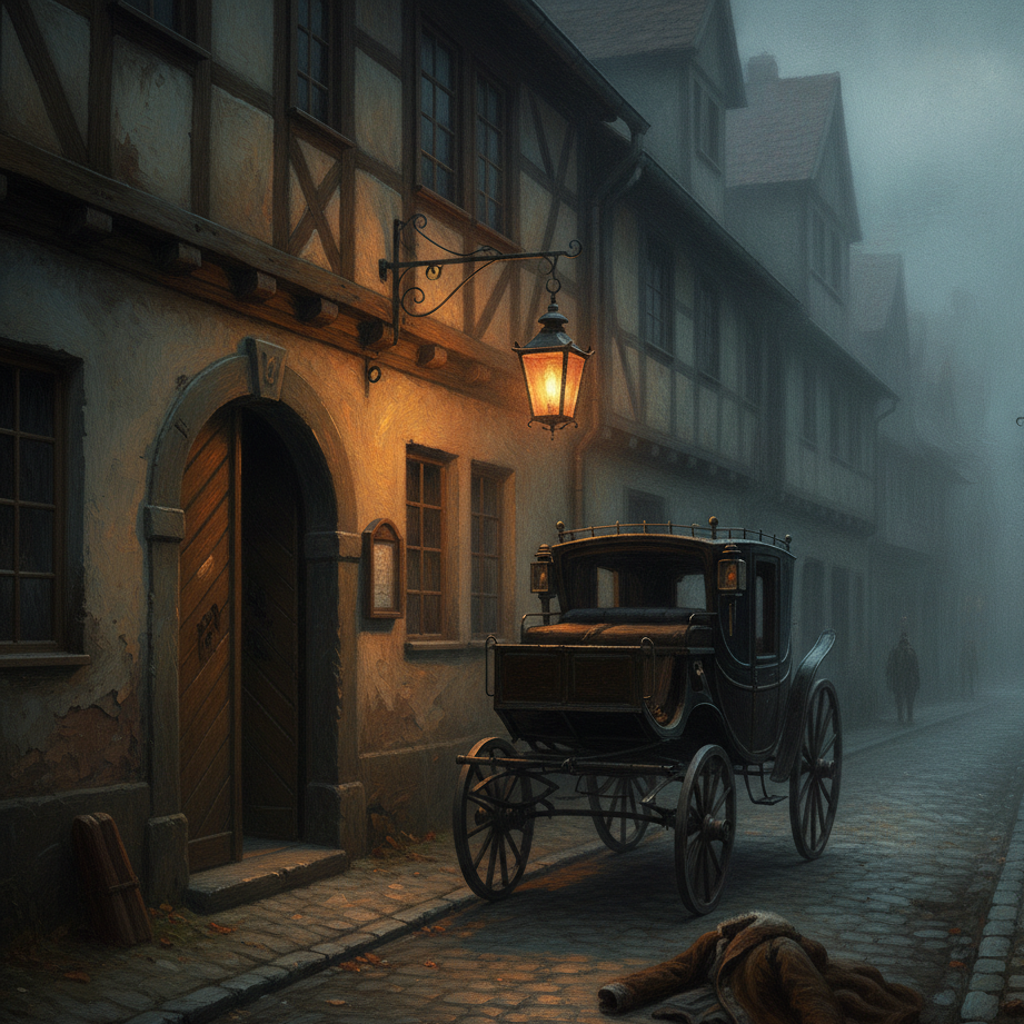
In the courtyard of an inn in a small town in northern Germany, a travel carriage stood ready. Fresh horses were harnessed. A servant was loading the luggage.
A man in a fur coat came out of the inn. He walked around to the other side of the carriage, towards the horses.
Nobody saw him again.
The man's name was Benjamin Bathurst. He was 25 years old, an English diplomat, travelling home in secret across a continent at war. The town was Perleberg, about 130 km northwest of Berlin, in what was then the Kingdom of Prussia.
Here is the whole mystery in one sentence: a well-dressed foreign envoy disappeared in a lit courtyard, a few steps from his own servants, and more than 200 years later nobody knows whether he was robbed and killed, kidnapped by the French, or something else.
A dangerous journey
To understand why he was so frightened, you need to know where he was coming from.
In 1809 Napoleon ruled most of Europe. Britain was his great enemy. That spring, the British government sent the young Bathurst to Vienna, the capital of Austria, with one task: to persuade Austria to go to war against France.
Austria did go to war. And Austria lost. In July 1809 its army was crushed. In October it signed a peace treaty with France.
Bathurst was now a British agent stuck in the middle of a continent controlled by his enemy. He had to get home. The safe sea route through the south was closed, so he chose to travel north, towards the German port of Hamburg, and from there to try to reach a British ship.
He travelled under a false name, posing as a merchant. His secretary travelled with him as his courier, also under a false name. According to a family account published decades later, Bathurst carried pistols and was convinced that Napoleon personally wanted him seized.
The afternoon in Perleberg
Bathurst's carriage reached Perleberg around midday on 25 November. He ordered fresh horses and went to eat at the inn, called the White Swan.
What happened next comes mainly from testimony gathered by the local authorities, later published by the family.
After his meal, Bathurst went to the local military commander, a cavalry captain who was at home in bed, ill. Bathurst told him that he believed his life was in danger, and asked for protection. A woman who was present later said that he was trembling so badly that he could not hold a cup of tea without spilling it.
The captain thought his fears were exaggerated. Still, he gave him 2 soldiers to guard the inn.
Bathurst then changed his plans. Instead of leaving in daylight, he decided to travel at night. He cancelled the horses and spent the afternoon in a room at the inn, writing letters and burning papers in the stove.
At 7 in the evening he sent the soldiers away. He ordered the horses for 9.
The moment he vanished
At about 9, the carriage was ready in the yard. The light was poor: an oil lamp, and a lantern held by a stable hand.
His secretary, a servant, the innkeeper, the stable hand and the coachman were all close by. Bathurst walked to the far side of the carriage, towards the horses' heads.
When the luggage was loaded, he was gone.
At first his people thought he had stepped away for a moment. Then they started looking. He was not in the inn. He was not in the street. No one had heard a shout or a struggle.
**From that moment, there is no certain trace of Benjamin Bathurst alive.**
The search
The next morning, the search began in earnest.
Soldiers and townspeople searched the inn, the stables, the houses nearby, the ditches, the woods and the marshes around the town. They dragged the river that runs through Perleberg. According to one detailed account, the searches went on until 6 December. They found nothing.
The investigation was badly run. The military, the town mayor and the police argued over who was in charge. According to the same account, time was wasted and some leads were never properly followed.
Then, 2 days after the disappearance, the first clue appeared. Bathurst's expensive fur coat was found hidden in the home of a family that worked at the inn. Accounts differ on the exact spot: one says it was in an outbuilding, another says it was behind firewood in the cellar.
The mother of the family said she had found the coat at the inn and given it to her son, who worked as a stable hand there. He had a bad reputation. He was questioned, but nothing linking him to the disappearance itself could be proved.
The trousers in the forest
On 16 December, 3 weeks after the disappearance, 2 women gathering firewood in a pine forest near a village about 5 km north of Perleberg found a pair of trousers lying on the ground, turned inside out.
They were Bathurst's.
From here the sources begin to disagree, and it matters.
According to an account published by an English writer in 1889, the trousers had 2 bullet holes, but no blood. In one pocket was an unfinished letter to his wife, written in pencil. In it, Bathurst said he feared he would never reach England, and named a French agent as the man who would ruin him. A London newspaper in January 1810 also reported a letter to his wife found in the trousers.
Other modern summaries mention the trousers but not the bullet holes or the letter. Whether the letter was real, and what exactly it said, cannot now be checked.
His wife takes up the search
In England, his family learned of the disappearance in December 1809. The British government offered a large reward. The family offered another. Accounts give different amounts.
The rewards brought a flood of tips. Most were useless, and some were invented by people hoping to collect the money.
His young wife did not wait. With a companion, she travelled across Europe to Perleberg and pursued every lead herself. She had the area searched again, at great cost, with trained dogs. Again nothing was found.
She then went to Paris and asked to see Napoleon. Through one of his senior ministers, the emperor assured her on his word of honour that he knew nothing about the case beyond what he had read in the newspapers. The official French newspaper went further, and claimed that Bathurst had lost his mind. Another Paris paper suggested he had taken his own life.
The family never believed it. To the end, they were convinced that the French had taken him.
The skeleton under the stable
The story was not quite over.
On 15 April 1852, 43 years after the disappearance, workers demolishing an old house in Perleberg found a human skeleton buried under the threshold of the stable. The house stood a few hundred metres from the inn.
The skull had been fractured at the back. One tooth in the lower jaw was missing in a way that suggested a dentist had removed it.
According to the 1889 account, the house had once belonged to a family whose son had worked as a servant at the inn on the night Bathurst vanished, and the family had later become surprisingly well off.
Bathurst's sister travelled to Perleberg to see the skull. She had not seen her brother for more than 40 years. She could not say whether it was him.
The skeleton was never identified. No test available in 1852 could settle it.
**That is where the documented trail ends. Everything beyond this point is interpretation.**
Conclusions and Open Questions
Four explanations have been offered. None is proven.
**He was robbed and murdered by local people.** The evidence: a valuable coat found with an inn worker's family, trousers dumped in a forest, and a skeleton with a broken skull found near the inn. The English writer of 1889 and a modern researcher who studied the records in 1990 both concluded that this is the most likely answer. The problem: the skeleton was never identified, and no one was ever convicted.
**He was kidnapped by the French.** The evidence: Bathurst himself believed it, his family believed it to the end, and a London newspaper reported it at the time. The problem: if the French wanted his papers, they could have arrested him openly. Napoleon denied it, and no French record of his capture has ever been found.
**He took his own life.** The evidence: his extreme fear that afternoon, reported by witnesses. The problem: this claim was spread by the French official press, which had every reason to deny involvement. And no body was found near where the trousers lay.
**He ran away on purpose to throw off pursuers.** The evidence: he was afraid, and he was already travelling under a false name. The problem: he never reappeared anywhere, never wrote to his wife, and never came home.
What remains unexplained is the very first moment. How did a man vanish without a sound, in a lit courtyard, a few metres from 5 people? And if he was killed for his money, why did his trousers end up in a forest 5 km away, with a letter still in the pocket?