The Black Dahlia: Elizabeth Short, a Vacant Lot in Los Angeles, and 79 Years Without a Name
On the morning of 9 January 1947, Elizabeth Short got out of a car in front of a large hotel in the centre of Los Angeles, in the United States.
She was 22. She had black hair, pale skin and blue-grey eyes. She carried a small suitcase and a handbag. Almost everything else she owned was in a few bags she had left with a bus company.
The man who drove her there was a 25-year-old travelling salesman. He was married. He had met her a few weeks earlier, and had driven her up from San Diego, about 190 km to the south, where she had been staying with a family she barely knew.
He later told the police that she said she was going to meet her sister. Her sister later said they had arranged nothing of the kind.
Some accounts say a hotel employee saw her using the telephones in the lobby that evening. Even that is disputed.
What is not disputed is this: after the evening of 9 January, nobody who has ever been found can say where Elizabeth Short was, or with whom.
6 days later she was dead.
A girl from near Boston
Elizabeth Short was born on 29 July 1924 in Boston, on the east coast of the United States. She was the third of 5 daughters.
When she was 5, her father's business failed in the great crash of 1929. In 1930 his car was found parked on a bridge. Everyone assumed he had jumped into the river. Years later the family learned that he was alive, and living in California, on the other side of the country.
As a teenager she had a lung operation. Doctors advised warm weather, so for 3 winters she was sent to the warm south of the country. She left high school without finishing.
In December 1942, at 18, she travelled across the country to live with her father. It lasted a month. They argued, and she left.
She found work at a shop on an army base on the California coast. In September 1943, at 19, she was arrested with friends for drinking under the legal age. The police took her fingerprints. That small file, in a drawer at the FBI, would matter 4 years later.
She was sent home to her mother, and went south again instead.
In 1945 she said she was engaged to an air force officer. He was killed in a plane crash in August 1945, days before the war ended.
In July 1946 she moved to Los Angeles. She worked as a waitress when she worked at all. She rented rooms and moved often, sometimes staying with friends, sometimes with near-strangers. The newspapers would later call her an aspiring actress. She never appeared in a single film.
She was, by every account, often short of money and often moving. That is why it was so hard, later, to say where she had been.
The morning of 15 January
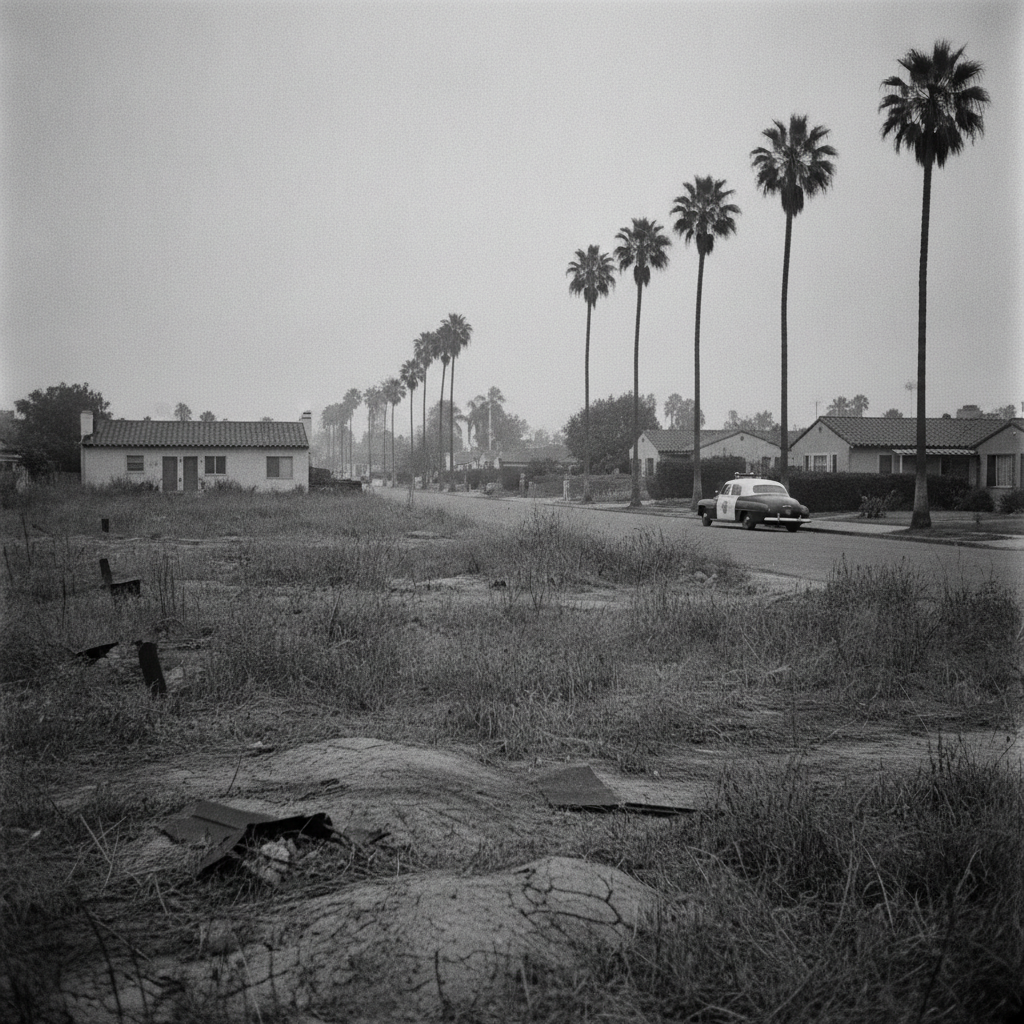
On Wednesday 15 January 1947, at about 10:00 in the morning, a young mother was walking with her small daughter along a street in a new neighbourhood in the south of Los Angeles, about 10 km from the city centre.
The street had houses on one side. On the other side there were empty lots, waiting to be built on, full of weeds.
In one of the lots, about 30 cm from the pavement, she saw something pale lying in the weeds. At first she thought it was a broken shop mannequin.
Then she saw that it was a woman.
She hurried her daughter away to a nearby house and telephoned the police. She did not give her name. She called back days later to identify herself.
The body was naked. It had been cut completely in two at the waist. The two halves lay about 30 cm apart, arranged on purpose. The face had been cut from the corners of the mouth towards the ears. There was almost no blood on the body or on the ground. The body had been washed.
It was clear from the first minute that she had not been killed there. The empty lot was only the place where someone had chosen to leave her.
The first mistake
The police were not the first to arrive in force. Reporters were.
Los Angeles had 4 daily newspapers in 1947, fighting each other for every story. Their crime reporters listened to police radio. Within minutes the lot was full of reporters, photographers and curious neighbours.
People walked all over the ground. A reporter from one evening paper was among the first at the body and took photographs.
When the two detectives assigned to the case arrived, much of what the ground could have told them had already been trampled.
Some things survived. Near the body there was a heel print among tyre tracks. There was an empty cement sack with traces of watery blood. That was all.
Doctors at the scene estimated that she had been dead about 10 hours. That put her death in the night between 14 and 15 January.
The autopsy
On 16 January the county coroner examined the body.
The woman was about 165 cm tall and weighed about 52 kg. Her teeth were in bad condition.
He found that she had died from bleeding from the cuts to her face and from shock caused by heavy blows to her head and face. The cutting of the body in two had been done after death. It had been done with some skill, along a line that a surgeon would recognise.
That detail would shape the whole investigation. If the killer knew how to cut a body, perhaps he had medical training.
The police decided to keep the real cause of death secret. Only the killer would know it. That way they could test every person who confessed.
Who was she?
The police had a body but no name. Her fingerprints matched nothing in Los Angeles.
The normal way was to send the prints to the FBI headquarters, on the other side of the country, by plane. But storms had grounded the planes.
One of the newspapers had a solution. It owned an early fax machine, used to send photographs over telephone lines. It offered to send the fingerprints that way. The prints reached the FBI, and the FBI found a match in 56 minutes.
It was the girl arrested for drinking in 1943. Her name was Elizabeth Short. A second set of her prints was also on file, from her job on the army base.
The phone call to her mother
What the newspaper did next is still remembered as one of the lowest moments in American journalism.
Reporters from that paper telephoned her mother in Boston. They told her that her daughter had won a beauty contest. They asked her many questions about her daughter's life. Only when they had what they wanted did they tell her the truth.
Then the paper offered to pay for the mother's trip to Los Angeles. People involved later said the real reason was to keep her away from the police and from the other newspapers.
The papers printed whatever sold. They wrote about torture, which was not in the autopsy report. The police let those stories run, because they helped hide the real cause of death.
At first one paper called it the Werewolf Murder. Within days another paper's name had won: the Black Dahlia.
Where that name came from is itself disputed. Some said that men at a drugstore in a nearby beach town had called her that in the summer of 1946, as a joke on a popular film of the time, The Blue Dahlia (1946), because she wore black. Others said reporters made it up. Investigators for the district attorney later concluded it was invented by the newspapers.
The two men who saw her last
The detectives started where they had to start: with the last people known to have been with her.
The first was the salesman who had driven her from San Diego. When the papers printed his name, he was found and held. He told his story many times. Parts of it were checked and confirmed. He took several lie detector tests and passed them. He was released and cleared.
The second was a nightclub owner in Los Angeles. She had stayed at his house twice. A friend of hers told the police that she had turned down his advances. He too was questioned, and he too was cleared. There was no evidence against him.
Both men are long dead. Neither was ever charged with anything.
The envelope
On 21 January, 6 days after the body was found, a man telephoned the editor of the same newspaper. He said he was the killer. He said he would send some souvenirs.
3 days later, on 24 January, an envelope arrived at the post office addressed to the newspaper. The address had been made of words cut out of printed pages and pasted on.
Inside were things that had belonged to Elizabeth Short. Her birth certificate. Business cards. Photographs. Slips of paper with names. And a small address book, with the nightclub owner's name pressed into its cover.
Everything inside had been cleaned with petrol, to remove fingerprints.
There may still have been partial prints on the envelope itself. They were damaged in transit before experts could use them. That was the second piece of evidence lost.
Some pages of the address book had been torn out. The police traced about 75 men whose names were in it. Most of them had met her once or twice. None led anywhere.
Around the same time, someone found a handbag and a black suede shoe on top of a rubbish bin in an alley, about 3 km from the lot. Sources disagree about who identified them as hers. Both had also been wiped with petrol.
The letters
On 26 January a handwritten letter arrived. It was signed with a name the newspapers had made famous. The writer promised to surrender to the police on 29 January.
On 29 January nobody came. Instead, another letter arrived. The writer said he had changed his mind.
The police could never establish whether these letters came from the killer or from someone enjoying the attention.
In March, men's clothing was found folded on a beach in the west of the city, with a note signed with a woman's first name. The note confessed to the murder. Nobody connected to it was ever found.
750 searchers, nothing found
In the first weeks the investigation was enormous. At least 750 people worked on it at its height. They included about 400 deputies from the county sheriff and about 250 officers of the state highway patrol.
They searched storm drains. They searched empty buildings. They walked the banks of the city's river. They were looking for the place where she had been killed and cut. It had to have running water and a lot of space. They never found it.
The detectives questioned more than 150 men as possible suspects. A city councillor offered a reward of 10,000 dollars.
Because of the skilled cutting, in February the police asked the medical school of a local university for a list of its students. Each was checked. Nothing came of it.
The confessions
From the first days, people walked into police stations and confessed. About 60 people confessed in the first period, most of them men.
The police had their test ready. They asked each one how she had died. Nobody gave the right answer.
Over the years, more than 500 people have claimed to have killed Elizabeth Short. Some were charged with wasting police time. Not one confession has ever been accepted.
A second body
On 10 February 1947, less than 4 weeks later, another woman was found beaten to death in Los Angeles. Words had been written on her body in lipstick. The newspapers called it the Red Lipstick Murder.
For a while the police and the papers wondered whether the same man had done both. No link was ever proven. That case was never solved either.
The case goes cold
By the summer of 1947 the leads had run out. One of the two lead detectives later blamed the newspapers. He said that leaks to the press had wrecked the investigation from the start.
The case did not disappear. It just stopped moving.
The psychiatrist and the letter writer
In 1949 the police department's own psychiatrist became convinced he had found the killer.
The man had once worked in a funeral home. He had written to him about the case. In his letters he said a friend of his might be the killer.
The psychiatrist decided that the friend did not exist. He believed the letter writer had a split personality, and that the friend was his other self. He arranged to bring the man to Los Angeles. Officers from a special police unit held him in a hotel and pressed him to confess.
The man managed to throw a note out of a window, asking for help. It reached a lawyer.
The friend turned out to be real. He was found, and he was innocent. A newspaper reported in 1949 that an investigation had shown the letter writer had been in another city, about 600 km to the north, when Elizabeth Short was killed.
The man sued the city. He was never charged.
The grand jury
The scandal grew. In September 1949 a grand jury in Los Angeles began to examine why the police had failed to solve the murders of a whole series of women and children in the county, including Elizabeth Short.
The grand jury heard many witnesses. It ended without charging anyone in her case.
The microphone in the wall
Then came the most famous episode in the whole file. It stayed secret for 53 years.
In 1949 a well-known Los Angeles physician named George Hodel was tried on charges brought after his teenage daughter accused him of abuse. In December 1949 a jury acquitted him.
Investigators for the district attorney were not satisfied, and he was on their list of suspects in the Elizabeth Short case.
From 15 February to 27 March 1950, a team of 18 detectives from the district attorney's office and the police secretly placed microphones in his house in the city. They listened and typed up what they heard.
On 18 February 1950, according to the transcript, he said: "Supposin' I did kill the Black Dahlia. They couldn't prove it now."
**Those words are real and they are on record. What they meant has never been established.**
Nobody knows if it was a confession, a joke, or the bitter remark of a man who knew he was being watched. The surveillance ended. He was never charged with the murder.
Later in 1950 he left the United States and lived for about 40 years in Asia. He died in 1999, aged 91.
The transcript, 146 typed pages, sat in the district attorney's archives. It was released to the public only in 2003. By then the original recordings themselves had disappeared.
Where it stands
Elizabeth Short was buried in a cemetery in northern California.
Her murder was never solved. Officially the case is still open with the Los Angeles police. It is one of the oldest unsolved murder cases in Los Angeles County. The FBI says it names no suspect, and that the case is likely to stay unsolved.
There are clear reasons why.
The lot was trampled before the detectives arrived. The place where she was actually killed was never found. Every object the killer sent was wiped with petrol. The prints on the envelope were ruined. The newspapers printed lies, and the police let them, so the public record was polluted from the first week. The best-known recordings in the file are gone. And everyone who could have been asked a question in 1947 is now dead.
**What is known: who she was, where she was left, how she died, and that her last 6 days are a blank. What is not known: where she was in those 6 days, where she was killed, and by whom.**
The theories
Many people have written books naming a killer. None of the people named was ever charged with this murder. Every one of them is dead, and each is entitled to the presumption of innocence. These are theories, not findings.
**The physician.** His son, a former Los Angeles police homicide detective, published a book in 2003 arguing that George Hodel was the killer. It is called Black Dahlia Avenger. The evidence: the 1950 transcript, his medical skill, and his son's comparison of handwriting and photographs. In 2006 a senior deputy district attorney said publicly he was impressed, and called the case solved. The problem: the police investigated him for a month in 1950 and cleared him. The detective then in charge of the file did not accept the theory. A later author found no convincing evidence that the physician had ever met Elizabeth Short.
**The letter writer.** A 2017 book argued that the man held in 1949 was the killer, and that police corruption protected him. The evidence: his letters showed unusual knowledge of the case, and he had worked preparing bodies in a funeral home. The problem: a 1949 investigation placed him about 600 km away, and other researchers reject the corruption link entirely.
**A link to another series.** Some writers have connected her death to the Cleveland Torso Murders of the 1930s, in Ohio, where bodies were also cut apart. The problem: no evidence links them, and the method in Cleveland was different.
**A father named by his daughter.** In the 1990s a woman claimed, from memories recovered in therapy, that her late father had done it. The problem: the police found nothing to support it, and members of her own family disputed it.
79 years later, the question is the same as it was on that January morning: where was Elizabeth Short for 6 days, and who was with her?