Dennis Nilsen: The Blocked Drain That Exposed a Serial Killer in London
London, the late 1970s.
In the pubs of the city centre, every night, there were young men with nowhere to sleep. Some had run away from home. Some had come from Scotland or Ireland to look for work.
Many of them moved from one room to another. Their families did not always know where they were. When one of them stopped appearing, often nobody asked why.
A quiet civil servant in his thirties understood this very well. His name was Dennis Nilsen.
Between December 1978 and January 1983, Nilsen killed at least 12 young men and boys in 2 flats in north London. He tried to kill at least 7 more. For more than 4 years, no police investigation was looking for him, because nobody knew that a killer existed.
**The case was not broken by a detective. It was broken by a blocked drain.**
This is the story of how it happened, and of how the police then had to rebuild, almost from nothing, a list of victims whose names the killer himself did not know.
Who he was
Dennis Nilsen was born on 23 November 1945 in a small fishing town on the north-east coast of Scotland.
At 15, in 1961, he joined the British Army. He served for 11 years as a cook. He was posted to West Germany, to Aden in the Middle East, to Cyprus and to Berlin. He left in October 1972 with the rank of corporal.
In December 1972 he joined the London police. He trained, and in April 1973 he was posted as a junior constable to a station in north-west London. He resigned after one year, in December 1973.
In May 1974 he became a civil servant. He worked in a Jobcentre, the government office where unemployed people come to look for work. He was good at the job. In 1979 he was made acting executive officer, and in 1982 he was formally promoted and moved to a Jobcentre in Kentish Town, in north London.
He lived alone, in a ground-floor flat with a garden, in Cricklewood, north-west London. For a while he had shared it with another man. In 1977 that man left.
From the outside, nothing about him looked unusual.
The first one: December 1978
On 30 December 1978, Nilsen met a boy in a pub in Cricklewood.
The boy was Stephen Holmes. He was 14 years old. He had been to a rock concert and was on his way home.
Nilsen invited him back to the flat. The boy fell asleep there. Nilsen strangled him.
He hid the body under the floorboards. It stayed there for about 8 months. In August 1979 he burned it on a bonfire in the back garden.
Nobody linked his disappearance to the man in the ground-floor flat. It would take 27 years before anyone put a name to Nilsen's first victim. We will come back to that.
The method
What happened to Stephen Holmes became a pattern.
Nilsen went to pubs in central London and in his own area. He looked for young men who were alone. Many were homeless, or between jobs, or new to the city.
He offered them a drink, a meal, a place to sleep for the night. In the flat they drank together. When the guest fell asleep, or was too drunk to resist, Nilsen strangled him. Sometimes he then drowned him in the bath or in a bucket.
He kept the bodies for weeks or months, under the floorboards. Then he cut them up and burned them on bonfires in the garden. He put an old car tyre on top of the fire, so the smell of burning rubber would hide the other smell.
The flat had a garden that nobody overlooked closely. The victims were men whom nobody was actively looking for. That combination kept him hidden.
The ones who got away
Not everyone died. And some of those who survived went to the police.
In October 1979, a student from Hong Kong went back to the flat with Nilsen. Nilsen tried to strangle him. The student fought him off, ran out, and reported the attack to the police.
The police questioned Nilsen. The student decided not to press charges. The matter was dropped.
In December 1979, Nilsen killed a 23-year-old tourist from Canada. In May 1980 he killed a 16-year-old catering student from the north of England. Later that year he killed a 26-year-old man from Scotland.
In November 1980, another young man woke up in the flat to find Nilsen trying to strangle him. He also escaped, and he also went to the police.
The police questioned Nilsen again. His account and the young man's account did not match. The officers decided it was a quarrel between two men who knew each other, and took no further action.
**So by the end of 1980, the London police had spoken to Dennis Nilsen twice about attempted strangling in his flat. Both times the file was closed.**
Nobody at the time connected these 2 complaints to any of the young men who had disappeared. There was no reason they would: the missing men had not been reported as murder victims, and many had not been reported at all.
The rest of the Cricklewood years
In 1981 the killings continued.
In January, Nilsen killed an 18-year-old Scot whom he had met in a pub in Soho, in central London. In February he killed a young man in his early twenties from Belfast. In the spring he killed a young Englishman. None of these 3 has ever been identified by name. Nilsen himself only knew them by their faces and a few details.
In September 1981 he killed a 23-year-old man who suffered from epilepsy. Nilsen strangled him with his hands while he slept.
That autumn, the landlord asked Nilsen to leave the flat. Before he moved, he burned the remains of the last 5 victims on one final bonfire in the garden.
Nilsen later said he had killed 12 or 13 people in that flat.
The attic flat
In October 1981 Nilsen moved into a small attic flat on the top floor of a house in Muswell Hill, north London, on the other side of north London.
The new flat had no garden. There were no floorboards to lift, and no place for a bonfire.
In November 1981 he tried to strangle a 19-year-old man, who survived. The young man did not go to the police. He later said he was afraid his sexuality would be exposed.
In March 1982 Nilsen killed a young man he had met near Leicester Square, in the centre of London.
In May 1982 he tried to drown a 21-year-old man in the bath. The man survived. This attack was later left out of the charges, because when the charges were drawn up nobody knew where the man was.
In September 1982 he killed a 27-year-old man he had met on a street in the West End.
In late January 1983 he killed a 20-year-old man. He was the last.
In the new flat, Nilsen had no garden to burn the remains in. So he cut the bodies up, boiled parts of them on the stove, and flushed what he could down the toilet.
The house had one shared drain for all the flats.
A blocked drain
At the beginning of February 1983, the tenants of the house in Muswell Hill complained that their toilets would not flush.
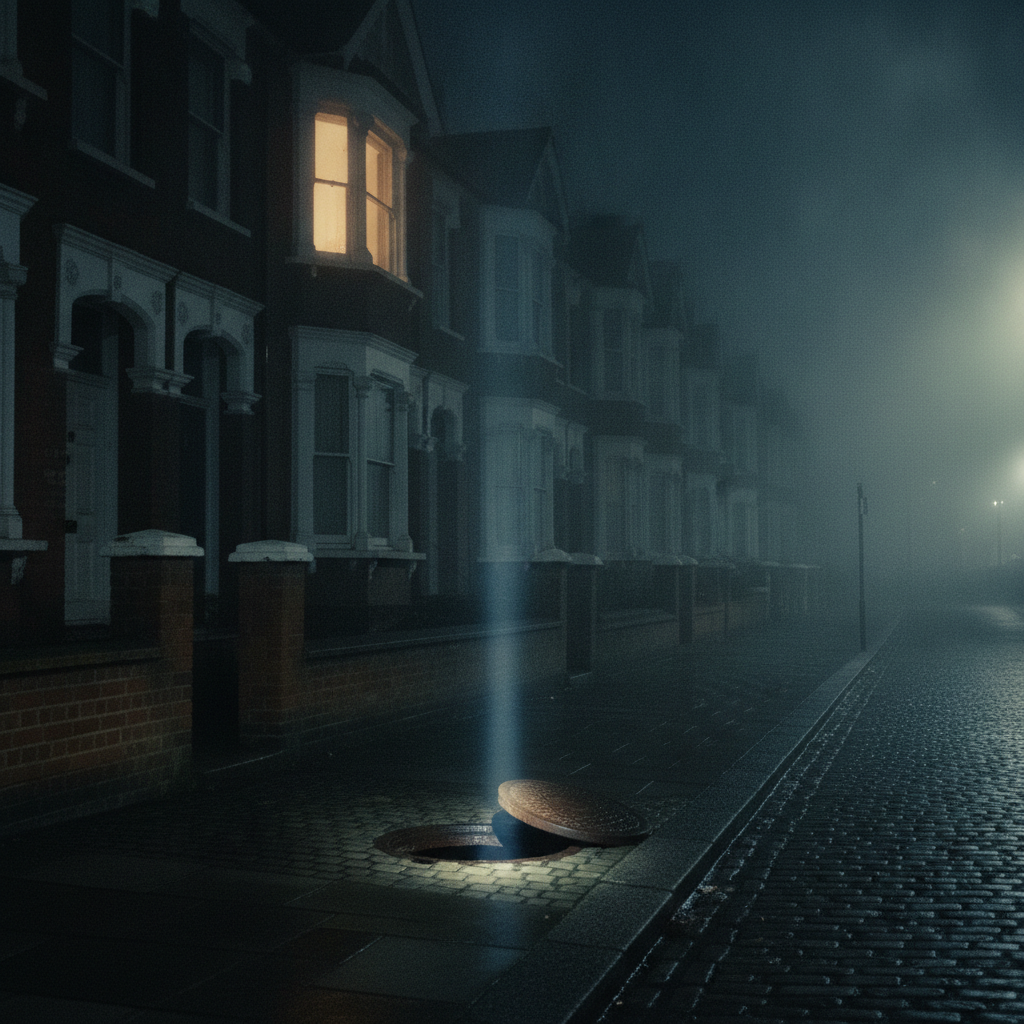
On the evening of 8 February 1983, at about 18:15, an engineer from a drain-clearing company came to the house. He opened the manhole outside and climbed down with a torch.
The drain was packed with a grey, flesh-like substance and small pieces of bone.
Nilsen was there. He came down from his flat and looked. He said that someone must have been flushing fried chicken down the toilet.
It was too late in the day to do the job. The engineer said he would return in the morning.
At 07:30 the next morning, 9 February, the engineer came back with his supervisor. They found more of the same material in the pipe that led from the house. This time they called the police.
The material was taken to a mortuary in north London. A pathologist examined it. He told the police that it was human. On one piece of a neck he found the mark of a ligature, a cord pulled tight.
The only drain that could have carried it came from the house. And the line led up to the attic.
"15 or 16, since 1978"
On the evening of 9 February 1983, a detective chief inspector and 2 colleagues waited outside the house in Muswell Hill.
Nilsen came home from work at the Jobcentre. He was 37 years old.
The detective introduced himself and told him what had been found in the drain. Nilsen acted shocked. They went up to the flat. Inside, the officers could smell rotting flesh.
The detective lost patience. "Don't mess me about," he said. "Where's the rest of the body?"
Nilsen dropped the act. He said the rest was in 2 plastic bags in the wardrobe.
He said it was a long story, that it went back a long time, and that he wanted to tell everything at the police station.
In the car, an officer asked whether they were dealing with one body or two.
Nilsen answered: "15 or 16, since 1978."
What the police found
That same evening the officers took the 2 bags out of the wardrobe. They contained the remains of more than one man.
On 10 February they searched the flat again. They found more remains in a bag in the bathroom and in a tea chest. Nilsen told them there were more remains in a drawer in the bathroom.
The same day, Nilsen took the police to the old flat in Cricklewood. He showed them 3 places in the garden where he had burned bodies.
The police searched that garden. Small fragments of human bone had survived the fires. The court would later hear that bones from at least 8 people were found at the old address.
The last victim, the 20-year-old killed in January 1983, was identified quickly. His fingerprints matched a record already held by the police. On 11 February 1983, Nilsen was charged with his murder.
Thirty hours of confession
Over the following days, the police interviewed Nilsen 16 times. In total, the interviews lasted more than 30 hours.
He spoke calmly and in detail. He described each killing he could remember. He described faces, clothes, accents and the pubs where he had met each man.
But he had a problem that was now the police's problem too: in most cases he had never known his victims' names. Or he had heard a first name once and forgotten it.
**A confession to murder is not enough to convict. The prosecution needs to prove that a specific, named person was killed.**
So the investigation turned into a search for names.
Detectives tried to match each of Nilsen's descriptions to a missing-person report. Where they found a possible match, they went to the family for a photograph. Some victims could be matched to a report. Others could not, because nobody had ever reported them missing.
In the end the prosecution could build firm cases for 6 murders and 2 attempted murders. Those were the charges.
Some of the survivors, who had never been believed or had never come forward, were now found and asked to testify. Several of the men who had escaped would give evidence in court.
The trial
The trial opened on 24 October 1983 at the Old Bailey, London's Central Criminal Court.
Nilsen did not deny that he had killed. The question for the jury was a different one: was he legally responsible?
His defence argued diminished responsibility. They said a mental disorder had substantially reduced his responsibility, so he should be convicted of manslaughter, not murder.
The prosecution argued that he was sane, that he had planned the killings, and that he knew exactly what he was doing. They pointed out how carefully he had hidden the bodies for years.
The survivors testified. They described waking up with Nilsen's hands, or a cord, around their necks.
On 3 November 1983 the jury retired to consider its verdict. They deliberated for more than 12 hours.
On 4 November 1983 they returned. Nilsen was found guilty of all 6 murders and both attempted murders. On most counts the verdict was by majority. On one of the attempted murders it was unanimous.
The judge sentenced him to life imprisonment, with a recommendation that he serve at least 25 years. In December 1994 that recommendation was changed to a whole-life tariff: he would never be released.
The name that took 27 years
After the trial, several of Nilsen's victims remained without names. Police went on trying.
The first victim, the boy he had met in the Cricklewood pub in December 1978, was one of them. Nilsen had described him as about 17. In 1990 police showed Nilsen a blurred photograph of a missing boy. He could not say whether it was him.
In January 2006, the boy's family gave the police a clearer photograph. Detectives took it to Nilsen in prison. This time he recognised him.
The boy was Stephen Holmes, 14 years old. His family had waited 27 years for an answer. His sister, who was living in Ireland, was told that her brother had been the first victim.
Nilsen was never charged with his murder. At the 1983 trial the boy had not yet been identified, and in 2006 the prosecution service decided that a new prosecution would not be in the public interest.
Afterward
Dennis Nilsen died on 12 May 2018, in a hospital in York, in the north of England. He was 72 years old. He had spent the last 35 years of his life in prison.
The case is closed. But it is not complete.
Nilsen said there were 15 or 16 victims. At least 12 are known. Several of them have never been named. Their families, if they are still alive, may never have learned what happened to them.
And one question has been asked ever since: whether Nilsen could have been stopped in 1979 or in 1980, when 2 young men walked into a police station and said that he had tried to strangle them.