The Green Bicycle and the Bullet in the Road
On Saturday 5 July 1919, at about half past 6 in the evening, Bella Wright got on her bicycle.
She was 21. She lived with her parents in a small village just east of Leicester, a city in the middle of England, about 160 km north of London.
She was the eldest of 7 children. She had left school at 12, worked as a servant in other people's houses, and then moved to a job in a rubber factory. She rode her bicycle to work and back every day.
She had a boyfriend who was away at sea with the navy. The war had ended 8 months earlier, and the country was full of young men coming home.
That evening she was going to visit her uncle. He lived in a village called Gaulby, about 7 km away along narrow country lanes.
Somewhere on the way, a man on a bicycle joined her.
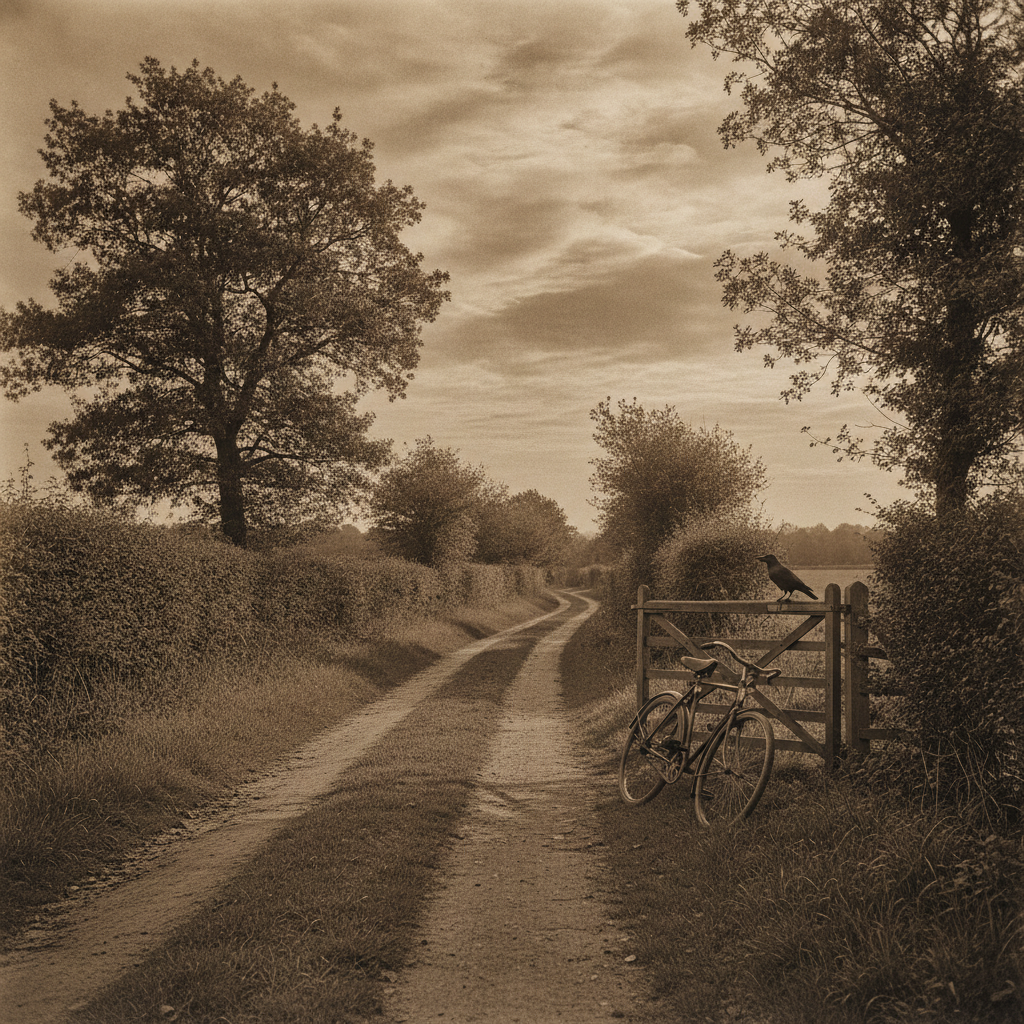
He was in his thirties, with greying hair. His bicycle was unusual. It was painted green, its handlebars turned upwards, and it had a brake that you worked by pedalling backwards.
Later he would say that they met by chance on the road, and that he stopped to help her with a wobbly front wheel.
At about a quarter to 8 she reached her uncle's cottage. The man did not go in. He waited outside.
Her uncle and a relative saw him there. The uncle did not like the look of him.
At about 9 o'clock she came out again. The sources give the time as 8:50 or 9:00.
The people at the cottage heard the man greet her. He said something like: "Bella, you have been a long time."
They rode off together.
At 9:20, a farmer on a lonely stretch of an old Roman road, about 3 km from the cottage, found her lying on the road next to her bicycle. Her face and head were covered in blood. She was dead.
Nobody, then or since, has been able to say exactly what happened in those 20 or 30 minutes.
In one sentence: a young woman rode away from her uncle's house with a stranger on a green bicycle, half an hour later she was dead on the road, and the police had to find out how she died and who was responsible.
The constable who went back
The farmer went for help. It came from a village constable, the only police officer in the area. The constable called a doctor.
By then it was getting dark. The doctor examined the body by candlelight.
He saw a great deal of blood on her face and head, and a bicycle lying on the road. He concluded that she had fallen off, hit her head, and bled to death.
It looked like an accident. The body was carried to an empty cottage nearby for the night.
Most cases would have ended there. A sad accident on a country road, a short report, a funeral.
The constable was not satisfied. At 6 o'clock the next morning he went back to the road alone and searched the ground.
About 5 metres from where the body had been lying, he found a bullet. It had been pressed into the mud by the hoof of a horse. It was a large bullet, of the kind fired by a heavy army revolver.
Then he went to the cottage and washed the dried blood off her face.
Under her left eye there was a small hole.
She had not fallen off her bicycle. She had been shot in the head.
The post-mortem examination later confirmed it. The bullet had entered below the left eye and come out through the back of the head. The doctors estimated that the gun had been fired from about 2 metres away.
The bird by the gate
Next to the place where she died there was a field gate.
On the gate, and on the ground between the gate and the body, there were marks of blood. According to later accounts, they were the tracks of a bird, going back and forth, a dozen times.
In the field behind the gate lay a dead crow.
The constable's explanation was simple. A bird had been drinking the blood, walking back and forth between the body and the gate. He said so in court.
At the inquest, the official hearing into the cause of death, a gun expert raised a different possibility. He thought the crow itself might have been shot.
If he was right, then someone had been shooting in those fields that evening. The bullet that killed her might have been fired by a person who never even saw her.
That question was never settled. The jury at the later trial never heard about it.
A man nobody could find
The police now had a murder. They had a bullet, but no gun. And they had a description: a man of about 35, riding a green bicycle.
The description went to the local and national newspapers. It described the bicycle in great detail: a man's model with 3 gears, a green frame, black mudguards, handlebars turned up, a brake worked by pedalling backwards, and a leather saddle of a well-known make.
It was not a common bicycle. Somebody, the police thought, would recognise it.
Nobody came forward.
The police did learn one important thing. That same evening, about 3 hours before the shooting, 2 girls aged 14 and 12 had been out cycling in the same area. They said a man on a green bicycle had followed them and pestered them.
A bicycle repairer in Leicester also remembered a green bicycle like that, and a customer who brought it in.
But none of this led to a name. The man on the green bicycle had simply vanished into the city.
The summer passed. Then the autumn. Then the winter.
**For 7 months, the investigation had a bullet, a description and 2 frightened girls, and no suspect at all.**
The rope on the canal
Here is where chance took over.
On 23 February 1920, a boatman was taking a barge loaded with coal along the canal that runs through Leicester. In those days a barge was pulled by a horse walking on the bank, attached by a long rope.
At one point the rope went slack and dipped into the water. When it rose again, something was caught in it.
It was the frame of a bicycle. It was green.
The police dragged the canal at that spot and pulled out more parts. The bicycle had been taken to pieces before it was thrown in.
Someone had also tried to erase its identity. The serial number, which every factory stamps on its bicycles, had been filed off the frame. The maker's name had been scraped off.
But whoever did it missed one place. A number could still be read on a hidden part of the bicycle. The sources disagree about exactly where. Most say it was on the inside of the front fork. One says it was on the stem of the handlebars.
That one number was enough.
The detectives took it to the maker's records. The records led them to a bicycle shop in another city, about 40 km away. And the shop's own books showed that the bicycle had been sold in May 1910, 9 years before the murder, to a man named Ronald Light.
On 19 March, the canal gave up more. From the same water the police recovered an army revolver holster. With it were 12 live bullets, of the same large type as the bullet found in the road.
The holster was identified as one that had been issued to Ronald Light in the army.
The revolver itself was never found.
The man with the green bicycle
Ronald Light was 34. He had served in the army during the war and had been discharged in 1919. According to several accounts, he came home suffering from shell shock and partly deaf.
He lived in Leicester with his widowed mother.
At the start of 1920 he had left the city to teach mathematics at a boarding school in another part of England, about 120 km away. He had been there for 2 months.
On 4 March 1920, the police came to the school and arrested him.
When he was questioned, he denied everything. He said he had never owned a green bicycle. He said he had never met the girl.
Both statements were soon shown to be false.
Bella's uncle and his relative picked him out. So did the 2 girls who said they had been followed. So did the bicycle repairer.
His mother's maid made a statement too. She said that on the night of 5 July he had come home at about 10 o'clock, much later than expected, and said that his bicycle had broken down.
It also emerged that the bicycle had stayed at home for months after the killing. In the autumn of 1919 he had filed off its numbers, taken it to a bridge over the canal, and thrown it into the water piece by piece. A labourer standing nearby saw him do it, and later told the police.
He was charged with murder.
It must be said clearly: the accused was entitled to be presumed innocent, and the jury would later find him not guilty.
The trial in the castle
The trial opened on 8 June 1920 in the old courtroom of the castle in Leicester. It lasted 5 days.
The prosecution was led by the most senior government lawyer in the country. The defence was led by the most famous defence barrister in England at the time, a man known for winning cases that looked lost.
The prosecution's case was simple.
The accused was the last person seen with her. He had owned a heavy army revolver, and ammunition of the same type as the fatal bullet. He had lied to the police about everything. He had taken his bicycle apart, filed off its numbers, and thrown it and his holster into the canal. Innocent men, the prosecution argued, do not behave like this.
The defence then did something that was still unusual at that time. It put the accused into the witness box and let him tell his own story.
He admitted almost everything.
Yes, he had met her on the road. Yes, he had ridden with her to her uncle's house and waited outside. Yes, they had ridden away together.
But, he said, a short distance later they had parted at a road junction. She went her way, and he went back toward Leicester. He said he got home late because his bicycle gave him trouble on the way.
He said he had never called her "Bella." He said he did not even know her name.
Why had he lied? When he read about her death in the newspaper, he said, he panicked. His mother was elderly and unwell, and he was afraid of what a scandal would do to her. So he said nothing. And once he had said nothing, it seemed too late to speak, so he got rid of the bicycle.
He was cross-examined for 5 hours. According to the reports of the trial, he did not contradict himself once.
Then the defence barrister turned to the bullet.
He reminded the jury that the bullet had been found in the road, not in her body. Nobody could prove which gun had fired it. It might have come from far away, he suggested. A stray shot, perhaps a ricochet, perhaps someone shooting at birds. Such a shot would be a tragic accident, not a murder.
And he asked the question that the prosecution could not answer: why?
The 2 of them had never met before that evening. She was not robbed. She was not assaulted. Nobody could show any reason at all for him to kill her.
On 12 June 1920, the jury went out to consider its verdict. They were gone for about 3 hours.
The verdict was not guilty.
People in the courtroom cheered.
Under English law at that time, he could never be tried for her death again.
What the investigation got right, and what it got wrong
Looking back, the investigation had a strange shape.
It began with a mistake. A doctor, working by candlelight, called it an accident. If the village constable had not gone back at 6 in the morning, the bullet would have stayed in the mud. Bella Wright would have gone into the records as a young woman who fell off her bicycle.
Then it stalled completely. For 7 months, a detailed public description of an unusual bicycle produced nothing, even though its owner was living in the same city the whole time.
Then it was rescued by a horse, a rope, and a coal barge.
And in the end, all the physical evidence was circumstantial. There was no gun. Nobody saw the shot. In 1920 there was no way to link a bullet to a particular weapon without the weapon itself.
What the police did prove, beyond any doubt, was that he had lied, and that he had destroyed evidence.
The jury decided that lying was not the same as killing.
After the verdict
He left Leicester. For a while he lived under a different name. In December 1920 he was fined for signing into a hotel under a false name.
By the late 1920s he was living by the sea in Kent, in the south-east of England. In 1934 he married a widow. He died in 1975, at the age of 89.
His stepdaughter said later that she had known nothing about the trial until after his death.
Bella Wright was buried in the churchyard of her home village.
Decades later, researchers going through old records reported finding other documents about his past. They described trouble in his youth, including an accusation of improper behaviour toward a girl, and a job he had lost before the war. None of this was known to the jury. None of it was ever tested in court, and he was never convicted of anything connected to it.
The researchers also found a note, said to have been written by a senior police officer 3 days after the verdict. According to the note, while he was waiting for his trial the accused had admitted to him that the gun went off by accident while he was showing it to her.
Whether the note is genuine, and whether that conversation ever took place, has never been proven.
**This is where the documented record ends: a young woman was shot on a country road, the man who rode away with her lied and destroyed his bicycle, a jury found him not guilty, and nobody else was ever charged.**
Conclusions and Open Questions
More than 100 years later, there are 4 main explanations. None of them fits everything.
**He shot her on purpose.** The evidence: he was the last person seen with her. He owned the right kind of gun and ammunition. The 2 girls said he had pestered them earlier that evening. And his behaviour afterwards was that of a man hiding something. A writer who studied the case in 1993 concluded that he was guilty, and that the jury was swayed by his education and his social class. The problem: nobody could show a motive, and nobody saw the shot. A jury heard all the evidence and acquitted him, and in law he is innocent.
**The gun went off by accident.** The evidence: the police note describes exactly this. He was showing her the revolver, and it fired. That would explain a shot from 2 metres, and the panic, the lies and the destroyed bicycle that followed. The problem: the authenticity of the note has been questioned. He never said this in public, and he always denied killing her.
**A stray shot from far away.** The evidence: this was the defence's argument, and it had some support. There was the dead crow, and a gun expert who thought it might have been shot. That would mean someone was firing in those fields that evening. The problem: a random shot from a long way off, hitting a cyclist in the head in the half hour after she left her uncle's house, would be an extraordinary coincidence. And nobody ever came forward to say they had been shooting there that night.
**Someone else entirely.** The evidence: he said they parted at a junction, and nobody has ever proved otherwise. A book published in 1930 argued that he was innocent. The problem: no other suspect was ever found. No other man was seen with her, and nobody else on those roads that night has ever been identified.
What remains open is the one question that the missing revolver and the unexamined crow could have answered: was the shot fired from 2 metres away, or from far across the fields?
The road is still there. The only man who could have answered that question died in 1975, and never did.