Landru, the Bluebeard of Gambais: 11 Victims, a Black Notebook and a Kitchen Stove
In the spring of 1915, France had been at war for 8 months. Millions of men were at the front. In Paris, the newspapers printed long lists of the dead.
In the same newspapers, another kind of column grew longer every week: the marriage advertisements.
Widows read them. So did women whose fiances had been killed, and women the war had simply left alone. One of the advertisements that appeared again and again ran, in the version quoted in later accounts: a serious gentleman seeks a widow aged 35 to 45, or a woman unlucky in love.
The man who placed it was not a widower. He was married, a father of grown sons, and a convicted swindler on the run from the police. His name was Henri Désiré Landru.
Between January 1915 and January 1919, 10 women who answered him disappeared. So did the teenage son of one of them. Not one body was ever found.
This is the case of Landru, the man the French press called "the Bluebeard of Gambais". It is the story of how 2 sisters of 2 missing women, a village mayor and a Paris police inspector found him, and how a French court sent him to the guillotine for 11 murders without a single corpse.
A swindler long before the war
Landru was born in Paris on 12 April 1869. He did his military service from 1889. In 1893 he married his cousin.
He worked at many small jobs and never stayed long in any of them. What he did steadily was fraud.
His first known conviction came in July 1904: 2 years in prison for fraud. In 1909 he was jailed for 3 years after swindling a widow in the city of Lille, in the north of France. Between 1902 and 1914 he went in and out of prison for small frauds again and again.
In July 1914 a court tried him in his absence and convicted him for the 6th time. The sentence was severe: 4 years of hard labour, followed by deportation for life to New Caledonia, a French colony in the Pacific Ocean.
He never served it. He moved often and used false names.
A month later, in August 1914, the First World War began. In the chaos of the war, with men leaving for the front and families scattered, a man with a false name was very hard to find.
The first villa
In December 1914 Landru rented a house called the Villa Ermitage in Vernouillet, a small town about 35 km northwest of Paris.
The first woman he took there was Jeanne-Marie Cuchet, a widow of 39. With her came her son, André. Sources give his age as 16 or 17. With them, Landru called himself Raymond Diard.
Mother and son were last seen around 26 January 1915. Her family later came to believe she had handed him 5,000 francs.
That summer came Thérèse Laborde-Line, aged 46. She was last seen after 26 June 1915.
A few weeks later came Marie-Angélique Guillin, aged 51. She disappeared around 3 August 1915. After that, 12,000 francs left her bank account.
In Vernouillet, the neighbours began to notice things. Landru did not wait to find out what they would do. He moved on.
The house in Gambais
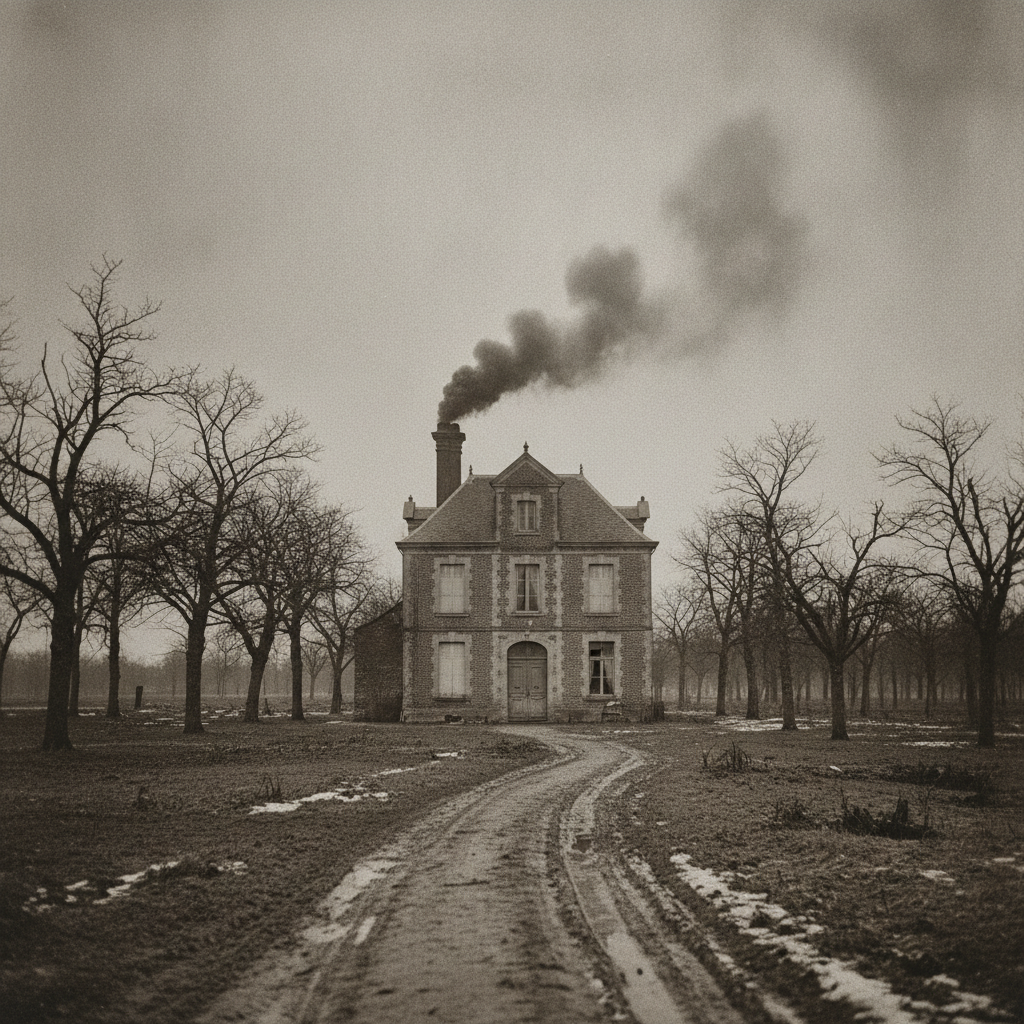
In December 1915 Landru rented a second house: the Villa Tric, in Gambais, a village in the countryside west of Paris. The nearest neighbour lived about 300 m away.
Soon after he moved in, he bought a large kitchen oven and a large quantity of coal.
From then on, the women went to Gambais. The pattern was always the same, and Landru himself wrote it down. At the station he bought 2 tickets: a return ticket for himself, and a single ticket for the woman.
Here are the women, in the order the investigators later reconstructed:
Berthe-Anna Héon, aged 55, a war widow. The tickets are dated 8 December 1915.
Anna Collomb, aged 44. Last seen after 27 December 1916.
Andrée-Anna Babelay, aged 19, the youngest. Last seen after 12 April 1917.
Célestine Buisson, aged 47. The tickets are dated 19 August 1917. Last seen after 1 September 1917. With her, Landru was "Georges Frémyet".
Louise-Joséphine Jaume, aged 38. Last seen around 24 to 26 November 1917. With her, he was "Lucien Guillet".
Anne-Marie Pascal, aged 36. Taken to Gambais on 5 April 1918.
Marie-Thérèse Marchadier, aged 37. Taken to Gambais on 13 January 1919. She brought her dogs.
Ages differ slightly between sources. What does not differ is the ending: none of them came back.
What the village saw
The people of Gambais later told the investigators what they had seen.
The man from the Villa Tric arrived with a different woman each time. He left alone.
Sometimes thick black smoke came out of the chimney, with a foul smell. Neighbours remembered smoke like that in January 1919, the month Marie-Thérèse Marchadier came.
Nobody went to the police. It was wartime, and a man burning rubbish in a stove was not a crime.
Where the money went
Landru did not kill for passion. Everything in the record points to money.
He sold the women's furniture and their securities. He withdrew money from their bank accounts, sometimes by posing as a relative. His wife later admitted that she had forged signatures to give him access to the bank accounts of 2 of the victims.
He was careful and he was cheap. In his notebooks he sorted the women who answered his advertisements by how much property they seemed to have. A woman marked as having nothing was dropped.
Two sisters start asking
For 4 years, nobody connected the disappearances. The women were widows, many lived alone, and their relatives assumed they had remarried and moved away.
The case began with a sister.
Marie Lacoste was the sister of Célestine Buisson. She kept writing to her at the house in Gambais. No answer ever came.
In January 1919 she wrote to the mayor of Gambais.
The mayor had already received a similar letter. It came from Victorine Pellat, the sister of Anna Collomb, who was also asking about a woman who had gone to Gambais and gone silent.
The mayor put the 2 women in touch.
They compared what they knew. Each sister described the man her sister had planned to marry. Collomb had known him as "Dupont". Buisson had known him as "Frémyet". The 2 descriptions were of the same man.
The sisters filed missing-person complaints with the prosecutor of Seine-et-Oise, the department around Paris that included Gambais.
The complaints reached Jules Belin, an inspector of the Paris mobile brigade, the police unit that handled serious crime.
A man who did not exist
Belin had 2 names, a house in a village and the descriptions of 2 sisters. That was not much.
"Dupont" and "Frémyet" led nowhere. The man who had rented the Villa Tric had given false details. He did not live in Gambais. He came and went.
The investigation was stuck. Then chance changed it.
On 11 April 1919, a friend of Marie Lacoste named Laure Bonhoure was walking in central Paris, near the Rue de Rivoli. She saw a man she recognised as her friend's sister's suitor. He was with a young woman, and they went into a shop.
She told Marie Lacoste. Marie Lacoste telephoned Belin.
At the shop, the police found that the man had left a business card. It carried the name "Lucien Guillet" and an address: 76 Rue de Rochechouart, near the Gare du Nord railway station in Paris.
The arrest
On 12 April 1919, around midday, the police knocked on the door of the apartment on the Rue de Rochechouart.
Inside was a bearded man of about 50 and a young woman, Fernande Segret, aged 24. She was his mistress. She did not know who he really was.
Accounts differ on who led the arrest. One official account says it was carried out under the authority of a police commissioner. Another names Belin and a second inspector. All agree on the charge on that first day: fraud. The police did not yet have a single body.
At first the man refused to confirm who he was. Then he admitted it: he was Henri Désiré Landru, he had been living under false names as a fugitive, and he was a swindler.
A murderer, he said, he was not.
According to the official account of the case, on the day of his arrest he tried to get rid of a small black notebook. The police kept it.
The black notebook
The notebook became the centre of the case.
Landru had written down everything. Meetings. Trips. Expenses, down to the smallest train fare. The return ticket for himself and the single ticket for the woman, again and again.
He had also written down names. The investigators counted 283 women with whom he had corresponded or had some kind of contact.
And there was a separate list of 11 names. They matched the missing: the 10 women and André Cuchet.
The police set out to find every one of the 283 women. Most of them were found alive. They had answered an advertisement, met a polite gentleman, and been dropped, usually because they had no money.
72 of the women were never traced. That does not mean they were victims. In a country at war, many people simply could not be found. But it was never explained either.
When the investigators asked Landru about the women on his list, he refused to answer. "That's my secret," he said. And: "Just because I am Landru doesn't prove I am a murderer."
The search at Gambais
On 29 April 1919 the police searched the Villa Tric.
The accounts of the search do not fully agree. One account says the inspector came expecting to find 11 bodies and at first found only the remains of dogs. The detailed record of the case describes what was found in the ashes.
Under a shed and inside the kitchen oven, the searchers collected 4.176 kg of burned debris. In it were 295 fragments of human bone and 47 small teeth or pieces of teeth. There were also scraps of cloth, buttons, pieces of corsets and shoes.
In the garden, they dug. They found only 2 dog skeletons. Landru said the dogs had belonged to Marie-Thérèse Marchadier and that he had buried them at her request.
The bone fragments went to a forensic doctor, Charles Paul. His conclusion was careful. The fragments came from at least 3 human skeletons. He could not say whether they were men or women, because no pelvic bones were found. He could not link them to any particular missing woman.
That was the hole in the case, and it never closed. There were bones, but no body. There were 11 missing people, but no proof of how any of them died.
Everything else the police found
What the police did find was the women's belongings.
In garages that Landru used, they found furniture and clothing belonging to the missing women. They found identity papers and bank documents.
Each object had to be traced back to its owner. A dress, a wardrobe, a set of papers. Piece by piece, the investigators connected the property of each of the 11 to the man who said he did not know what had become of them.
In December 1919 the police also arrested Landru's wife, then 51, and his eldest son, then 25. Both were released in July 1920 without charge. His youngest son had helped move the victims' furniture. He was never arrested.
Meanwhile, the case had become a national obsession. In the November 1919 elections, about 4,000 voters wrote Landru's name on their ballots.
The investigation took 2 and a half years. Only then did the case go to trial.
The trial at Versailles
The trial opened on 7 November 1921 at the Assize Court of Seine-et-Oise, in Versailles, the royal city just outside Paris. It lasted more than 3 weeks.
The courtroom was packed. Famous singers and writers of the day came to see the "villainous bearded man", as one account calls him.
Landru was defended by Vincent de Moro-Giafferi, one of the most famous lawyers in France.
The witnesses came one after another. The sister of Jeanne-Marie Cuchet. The neighbours from Gambais. People who had seen him at the station. Fernande Segret also testified.
Landru's position never changed. He admitted he was a swindler. He denied he was a murderer or a madman.
When the presiding judge asked him about the women, he answered that his private life concerned no one but himself.
When he was asked about his sons, who had helped him move furniture, he said they obeyed him without asking why. Then he asked the judge how he raised his own children.
His lawyer built the defence on one point: there was no body. How, he asked the jury, can a man be convicted of killing 10 women when not one of them has been found?
At one moment, according to the official account, the lawyer told the court that one of the supposedly dead women had been found and was about to come in. Everyone in the courtroom, jurors included, turned to look at the door.
The prosecutor answered that only one person had not turned around: Landru himself.
The verdict
On 30 November 1921, after about 3 hours of deliberation, the jury found Landru guilty of 11 murders. The decision was by a majority of 9 to 3.
The sentence was death.
He asked the President of France for clemency. The request was refused.
On 25 February 1922, at 6:05 in the morning, Henri Désiré Landru was guillotined outside the Saint-Pierre prison in Versailles.
According to the official account, his lawyer asked him at the foot of the scaffold whether he would finally confess. Landru answered, in French: "Cela, maître, c'est mon petit bagage" - "That, sir, is my little bit of luggage."
He took the answer with him.
What remains open
Landru never confessed. No complete body of any of his 11 victims was ever found, and exactly how he disposed of them was never proven in court. The conviction rested on the notebook, the tickets, the property and the burned fragments, and the jury did not reach it unanimously.
The 72 women from his notebook who were never traced remain an open question. Nobody has shown that any of them was a victim.
After the trial, the kitchen oven from the Villa Tric was sold at auction in 1923. For a short time, the house in Gambais became a restaurant with a morbid theme. Fernande Segret, the young woman found with him on the day of his arrest, later sued the makers of the 1963 French film "Landru" for the way it portrayed her, and won damages.