The Board From the Attic - 30 Months to Catch the Man Who Took the Baby
Charles Augustus Lindbergh Jr. was 20 months old and had a cold.
That cold is the reason he was in the house at all. The family normally spent the middle of the week elsewhere and came to the new country house in New Jersey, in the United States, only at weekends. The child was unwell, so they stayed on.
On the evening of 1 March 1932 the nurse gave him a bath, rubbed his chest, and put him into a flannel shirt she had cut and sewn herself that afternoon because the one he had was too thin. She fastened him to the mattress with two large safety pins so he could not kick the covers off.
She closed the shutters. One of the shutters on the south east window was warped and would not close properly. It had been like that for a while.
She put the light out at 20:00 and went downstairs.
At about 21:00 the father was sitting in the library, which is directly below the nursery. He heard a noise. He described it later as the sound of a wooden crate falling off a chair in the kitchen. He thought nothing of it.
At 22:00 the nurse went back up to check on the child.
The crib was empty. The covers were still pinned in place at the top, and the mattress was cold.
What the first men through the door found
The father came up with a rifle and found an envelope on the windowsill, which he did not open.
Outside, in the mud under that window, were two round impressions about 75 centimetres apart, and a carpenter's chisel lying on the ground.
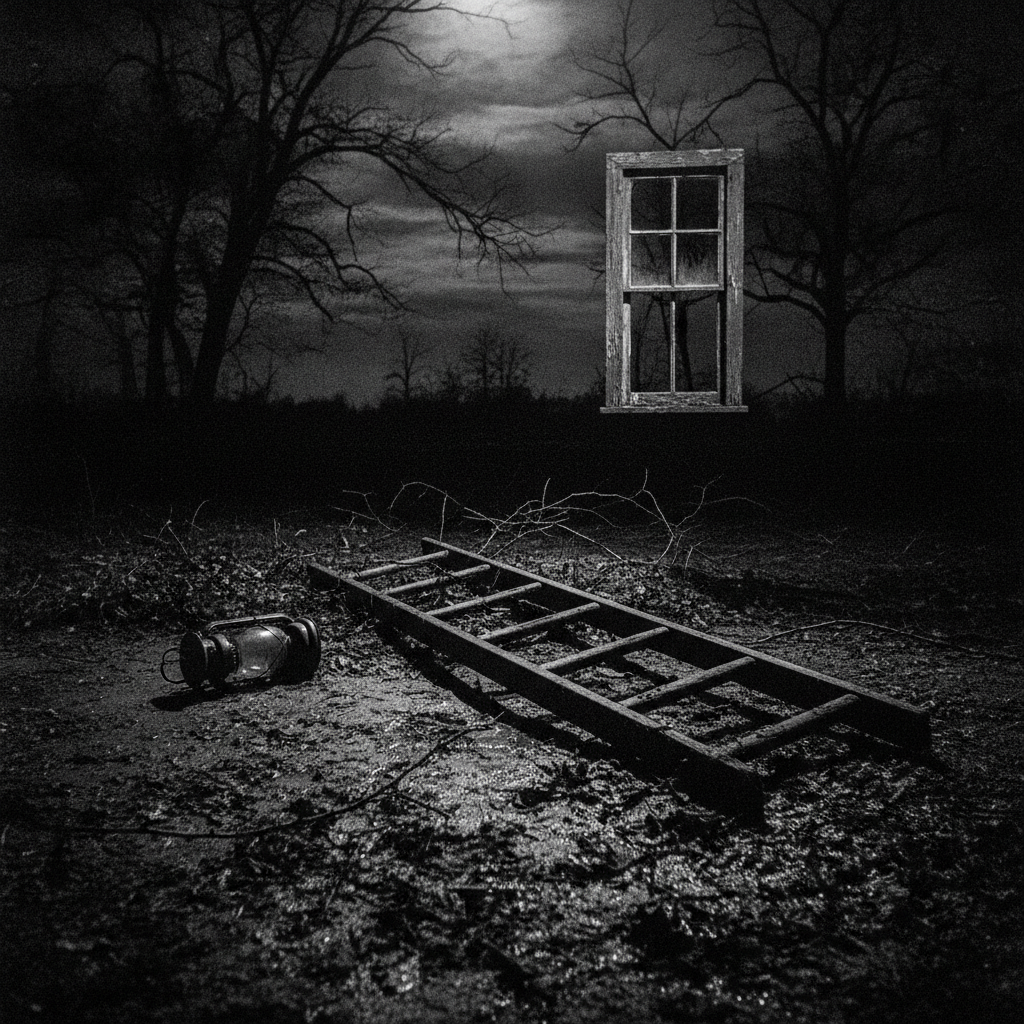
About 20 metres away, in the direction of the road, the searchers found a ladder. It was homemade, in three sections that fitted inside each other, so it could be carried in a car. The side rails of one section were split near the top, as if something had given way under a weight.
The local police arrived, and then the state police, and behind them came the rest of the country. This was the child of the most famous man alive, a pilot who five years earlier had flown alone across the Atlantic and had been met by crowds of a hundred thousand people. Within a day reporters, photographers and sightseers were walking over the grounds.
Footprints under the window were never measured. Nobody made a cast. By the time the scene mattered, the scene had been walked on for 24 hours by people who had no business being there.
The envelope contained a note. The spelling and grammar were those of someone who had learned English as a second language. It asked for 50,000 dollars in specified denominations, warned against going to the police, and carried a signature at the bottom that no forger would think of: two interlocking blue circles around a red centre, with three small holes punched through.
That symbol appears on every genuine note that followed. It is the reason the investigators could tell real communications from the flood of fakes.
No usable fingerprints were found on the note, on the windowsill, on the chisel or on the ladder. Whoever it was had worn gloves and had covered his shoes.
The wrong tree, and what it cost
The first theory was the obvious one, and it lasted for months: it was somebody who knew the house.
The family had only just started living there. A stranger would have needed to know which window was the nursery, and would have needed to know that the family, who should have left on Monday, was still there on Tuesday.
So the investigators took the household apart. Servants were interviewed again and again.
One of them, a young British maid, gave a muddled account of where she had been that evening and changed details between interviews. She was questioned three times and was to be questioned a fourth. The day before it, on 10 June 1932, she swallowed a silver polish containing cyanide and died.
Her alibi was confirmed afterwards. She had been at a cinema with people who remembered her. She had lied about small private matters and had panicked.
That is the first thing that went wrong in this investigation, and it cost a life.
The father takes over
The second thing that went wrong was that the family, not the police, ran the negotiation.
The father did not want an arrest. He wanted his son back, and he believed the way to get him back was to pay quietly and keep the state police at a distance. The head of the state police accepted this. So the investigation spent March 1932 watching from a room while other people handled the only line of contact it had.
The go between was not chosen. He volunteered.
A retired teacher in the Bronx, in New York, published an open letter in a local paper offering his own money for the child's safe return. Out of everyone in America who did something like that, he was the one the kidnapper answered.
Over the following weeks he met a man twice, at night, in two cemeteries in the Bronx. The man spoke with a German accent and called himself John. He said he was one of a gang of five, three men and two women. He said the child was on a boat and was well.
To prove he had the child he posted the baby's sleeping suit. The father identified it.
On the night of 2 April 1932 the go between handed over 50,000 dollars at a cemetery gate, in a wooden box made specially for the purpose, and took a note in return. The note said the child was on a boat near an island off the coast of Massachusetts, about 400 km to the north east.
For several days the father flew search patterns over that stretch of water, looking for a boat that was not there.
There was one decision from those weeks that turned out to matter more than everything else combined. Treasury officials had insisted that most of the ransom be paid in gold certificates, a kind of banknote that was about to be withdrawn from circulation, and that every serial number be recorded. The bills themselves were not marked. Nobody handling them would notice anything.
That decision was made in March 1932. It paid off two and a half years later.
12 May 1932
A truck driver pulled off a road about 7 kilometres south of the house and walked a short way into the trees.
He found the body of a child in a shallow scrape in the ground, partly covered by leaves, badly decomposed and damaged by animals. The skull was fractured.
The nurse identified him by a shirt she had made and by the overlapping toes on his right foot.
The medical conclusion was that he had died of a blow to the head, and that he had probably been dead since the night he was taken. The body was found about half a kilometre off the road that leads away from the house.
So the ransom had been paid for a child who was already dead, and the man at the cemetery gate had known it.
This changed the case from a kidnapping into a murder, and it changed the mood of the investigation. The negotiation was over. There was nothing left to protect.
Two slow lines of work
What follows is the part that almost never gets told, because it is not dramatic. For two and a half years, two people did dull work that nobody expected to produce anything.
The first line was the money.
The recorded serial numbers were printed in a booklet, and 250,000 copies were handed out to banks, shops, petrol stations and cinemas, mostly in New York. Tellers were asked to check gold certificates against it.
Bills began to appear, one here, one there, most of them in two neighbourhoods in the north of New York City. Nobody could ever say who had passed them.
Then the economy did the investigators a favour. In 1933 the United States came off the gold standard, and all gold certificates had to be exchanged for ordinary money by 1 May of that year. Anyone still holding them had to walk into a bank.
A few days before the deadline, a man exchanged 2,980 dollars of gold certificates at a bank in Manhattan. He filled in a name and an address on the exchange slip. Both were false. The bills were identified as ransom money only after he had gone.
The second line was the wood.
In February 1933 the ladder was sent to a government forest products laboratory in Wisconsin, about 1,300 km away, and handed to the chief wood technologist there. He took it apart.
It was made of four kinds of wood, some of it new and some of it old. One rail, the one numbered 16 in the investigation, was different from the rest: it was old, it had four odd square nail holes in it that served no purpose in a ladder, and it had been cut down from something else.
He looked at the planed surfaces under a microscope and found the marks left by the cutting machine that had smoothed the boards. From the spacing of the marks he calculated the machine that made them: how many knives were in the cutter head, that it turned at 3,300 revolutions per minute, and that the wood had been fed through it at 79 metres per minute.
That is a fingerprint of a particular mill on a particular day.
He wrote to 1,598 mills that handled that kind of pine. He asked each of them for a sample of planed board. He narrowed 1,598 down to 25, then to one: a mill in South Carolina. From the mill's shipping records he followed the consignment north, to a lumber yard in the Bronx.
The work took him from February to November 1933. Ten months.
And here is the thing that should have made somebody sit up, and did not, because the two lines of work were being done by different people in different states. The ransom bills were surfacing in the Bronx. The wood in the ladder had been sold in the Bronx.
18 September 1934
A bank teller in Manhattan noticed a gold certificate in a deposit and checked it against the booklet. It was ransom money.
On the margin of the note, in pencil, was a car registration number.
A petrol station attendant had written it there. A customer had paid for five gallons with a gold certificate, which was unusual by then, and had said he had more of them at home. The attendant thought the man might be passing counterfeit notes, so he noted the plate.
The registration led to a carpenter, a German immigrant with a criminal record in his own country, living in the north of the Bronx.
He was arrested carrying one 20 dollar gold certificate from the ransom in his wallet.
In his garage, wrapped and hidden in the structure, police found more than 14,000 dollars of it.
Inside the house, on the trim of a closet, were the go between's telephone number and address, written in pencil on the wood. In a notebook there was a drawing of a ladder with sections that fitted into each other.
Investigators also went through his finances. He had stopped working as a carpenter within days of the night the ransom was paid, and had spent the following two years trading stocks with money he could not account for.
His explanation was this. A friend and former business partner, a fur dealer, had left a shoebox with him before sailing for Germany, where he died of tuberculosis in March 1934. He said he had only opened it much later, found money inside, and kept part of it because the man had owed him money.
The fur dealer had been so poor in his last months that his landlady testified he could barely pay his weekly rent of 3.50 dollars, and that he had no money for treatment.
The attic
The most damaging piece of evidence was found above his head.
In the attic of the rented house, a section of one floorboard had been sawn out. The rest of the board was still nailed down.
The wood technologist was brought to the house. He matched rail 16 of the ladder to the gap in that floor: the species, the growth rings and their curvature, the width of each ring, the planer marks on the underside, and finally the four square nail holes, which lined up exactly with nails in the joists below, at the same spacing, the same angle and the same depth.
He told the court that a tree never lies, and that you cannot fake or make a tree.
The trial, and the doubts that never went away
The trial opened on 2 January 1935 and ended on 13 February 1935. Eight handwriting experts testified that the ransom notes matched his writing. The defence called one to argue otherwise; two others refused to testify unless they were paid in advance.
He was convicted of murder and sentenced to death. He was executed on 3 April 1936. He refused a large newspaper payment for a confession, and he refused an offer to have his sentence reduced to life imprisonment in exchange for one. He said he was innocent until the end.
His widow spent the next 58 years trying to clear his name. She sued the state twice in the 1980s. Both suits were dismissed on procedural grounds, not on the facts, and she died in 1994 at the age of 95.
The objections raised then and since are real ones, and an honest file has to carry them.
There were no fingerprints of his on the ladder, on the notes, or in the nursery. A fingerprint specialist who used a silver nitrate method on the ladder later said he found none of the accused's prints even in the places the builder of the ladder must have gripped, that his findings were set aside, and that the ladder was afterwards washed.
The identification witnesses were weak. One was an elderly man who said he had seen the accused near the house. Another placed him in a cinema. None of it was strong on its own.
His lawyer was paid by a newspaper in exchange for the rights to his story, which is not an arrangement that serves a defendant.
And the governor of the state was uneasy enough to visit him in his cell in secret and push for further investigation, saying the crime did not look like the work of one man.
**Here is where the file stops being certain. The wood shows that a rail of that ladder came out of that attic. The money shows that most of the ransom was in that garage. Neither of those things shows what happened inside the nursery, or who was standing in the room.**
Conclusions and Open Questions
The case is legally closed. A man was tried, convicted and executed, and no court has ever set that verdict aside. What is still argued about is how much of the crime that verdict actually explains.
**He did it alone.** The physical evidence is on one man: his attic, his garage, his tools, his handwriting, his sudden wealth. The man at the cemetery collected the money personally. The problem: the ladder broke, and a 70 kilogram man carrying a child down a broken ladder in the dark is a difficult picture. The governor of the state, who read the file closely, did not believe one person had done it.
**He was part of a group.** The man at the cemetery said he was one of five. Somebody had to know that the family was still at the country house that Tuesday. Later books have argued for one or two accomplices who were never charged. The problem: in 94 years nobody has produced a second name that stands up. No accomplice was ever identified, and none of the other ransom money was ever traced to another person.
**He handled the money but did not take the child.** This is the version his widow argued for the rest of her life. In it, the fur dealer who died in Germany was involved, and the shoebox story is true. The problem: the attic board. A man can be given money he did not earn. He cannot be given a floorboard out of his own attic that ends up in a ladder used at the scene, and his explanation never addressed it.
**The child died in the fall.** The ladder rail split. The impressions under the window are consistent with it. The injury was to the head. The problem: this is an inference about a fracture in a body that had been outdoors for 10 weeks, and the medical evidence could not distinguish between a fall and a blow.
Three questions remain open.
How did anyone know the family was still at that house on a Tuesday night, when their habit was to be somewhere else?
Why did a man who had over 14,000 dollars of traceable ransom money in his garage keep it for 30 months instead of burning it, and then spend it a note at a time in his own neighbourhood?
And why, offered his life in exchange for a confession, did he refuse?
The investigation itself has one clean legacy. A country that had no federal kidnapping law in March 1932 had one by May 1932, because of this case. And a wood scientist in Wisconsin who spent 10 months writing letters to sawmills showed a court, for the first time, that a plank could be followed backwards through a country until it stopped at a name.