Peter Manuel: the Lanarkshire killer, the husband jailed in his place, and the banknotes that ended it
Lanarkshire, Scotland, the winter of 1956.
This is the industrial country just east and south of Glasgow. Coal pits, steelworks, rows of miners' cottages, and between them a scatter of new suburbs with detached houses and gardens. Families who had done well after the war moved there for the quiet.
Over the next 2 years, that quiet broke. A teenage girl was beaten to death on a golf course. A mother, her daughter and her sister were shot in their beds. Another teenage girl vanished on her way to a dance. A father, a mother and their young son were shot in their home on New Year's morning.
For most of that time, the police did not know that one man was behind it. Worse: for more than 2 months, they held the wrong man in prison, a grieving husband whose family had just been murdered.
The killer was Peter Manuel, a 29-year-old burglar who lived with his parents in the village of Birkenshaw, about 12 km south-east of Glasgow. He was caught in January 1958, convicted of 7 murders in May, and hanged in July. He was the man who taunted the police, offered them help, lied to them, and finally led them to a grave in a field.
This is the story of those crimes, of an investigation that kept looking in the wrong places, and of the bundle of new banknotes that ended it.
The man in the background
Peter Manuel was born in New York on 15 March 1927, to Scottish parents. The family moved back to Scotland when he was a small child, then to Coventry in England, and back again to Lanarkshire during the war.
His criminal record began early. He was first arrested at about 9, for breaking into a school. Through his teens he went in and out of approved schools, borstals and prisons for burglary and theft. At 15 he attacked a woman in her home.
In 1946, aged 18, he was arrested for a series of break-ins around Glasgow. While on bail he attacked 3 women in a few days, raping one of them. He was sentenced to 8 years, served most of it in Peterhead prison in the north of Scotland, and came out in 1952.
He had one habit the police noted. He liked to defend himself in court. He saw himself as cleverer than the lawyers.
In 1955 he did it again. He was charged with attacking a woman at knifepoint in a field near his parents' home. He conducted his own defence, and the jury returned a verdict of "not proven", a third verdict that exists only in Scottish law. He walked free.
To his neighbours he was a polite young man who lived with his mother and father. To the detectives of Lanarkshire he was a known housebreaker. Nobody yet saw him as a killer.
The first victim: the girl on the golf course
On the evening of 2 January 1956, a 17-year-old machinist named Anne Kneilands left her home in East Kilbride, a new town about 13 km south of Glasgow. She was going to meet a young man for a date. He did not turn up. She was last seen alive at about 6:40 that evening.
Two days later, on 4 January, a workman found her body in a small wood on a golf course at the edge of the town. She had been struck on the head many times with a heavy object. The marks on the ground showed she had been chased for several hundred metres before she was caught.
The detectives questioned many men in the area. One of them was Peter Manuel, who was working nearby for the gas board. He had fresh scratches on his face. He said they came from a fight.
His father told the police that Peter had been at home that night. There was no physical evidence against him. The police let it go, and the murder of Anne Kneilands stayed unsolved for 2 years.
The house in Burnside
On the night of 16 to 17 September 1956, someone broke into a house at 5 Fennsbank Avenue in Burnside, a comfortable suburb on the south-east edge of Glasgow.
Inside were 3 women. Marion Watt was 45. Her daughter Vivienne was 16. Marion's sister, Margaret Brown, 42, had come to stay. The man of the house, William Watt, was away on a fishing holiday in the west Highlands, about 150 km away by road.
Early in the morning of 17 September, the daily cleaner arrived and found the house strangely silent. A pane of glass in the back door had been broken.
Marion Watt and Margaret Brown were dead in the main bedroom. Both had been shot in the head at close range. In the second bedroom, Vivienne had been beaten and shot. When the cleaner found her she was still breathing. She died within moments.
Nothing of value had been taken. The house had been searched, drawers opened, but no money or jewellery was missing.
Why the police turned to the husband
The detectives faced a crime that made no obvious sense. A burglar who kills 3 people and takes nothing. Three women shot with a revolver, in a quiet suburb, on the one night the husband was away.
They started with the husband.
William Watt had an alibi. He had been staying at a hotel in Lochgilphead, on the west coast. The owner of the hotel said he had been there at about midnight, and had breakfast there the next morning.
But the police calculated that a fast car, on empty roads, could make the return journey to Burnside and back in the hours between.
Then 2 witnesses came forward. A senior crewman on the Renfrew Ferry, a small car ferry across the river Clyde, said that in the early hours of 17 September he had carried a man and his car across the river, and that the man was William Watt. A motorist said he had seen a man who looked like Watt on the road near Loch Lomond, on the route between the hotel and Glasgow. Both men later picked Watt out of an identity parade.
For the investigators, that was enough. On 27 September 1956, 10 days after the killings, William Watt was arrested and charged with murdering his own wife, daughter and sister-in-law. He was taken to Barlinnie, Glasgow's main prison.
He told them again and again that he had been asleep in his hotel bed that night. Nobody listened.
The letter from a prisoner
Here the case took a strange turn.
By the autumn of 1956, Peter Manuel was himself in Barlinnie. He had robbed the canteen of a colliery office in Blantyre, a few kilometres away, and on 2 October 1956 he was sentenced to 18 months. So the man who had killed the Watt family was sitting in the same prison as the husband accused of the crime.
In early October 1956, William Watt's solicitor received a letter. It was from Manuel. He wrote that he had information that could help clear Watt.
The solicitor went to see him in the prison. Manuel told him a story that was full of details. He described the inside of the Watt house. He described the furniture, the layout of the rooms, things that had not appeared in any newspaper. He said another man had done the killing, and that he, Manuel, had only helped get rid of the gun afterwards.
The solicitor was shaken. He went to the police with what he had heard.
The police asked Manuel to repeat it to them. Manuel refused. He would talk to the solicitor, he said, but not to detectives.
The investigators decided he was a known liar trying to make trouble, or trying to make himself important. They did not follow it further.
From what is known today, this was the moment the case could have broken. A man who knew things only the killer could know was telling a lawyer about them, from inside a prison. And nothing was done.
Watt goes free, and the trail goes cold
The case against William Watt did not hold. The hotel staff were sure about him. The timing of the night drive was very tight. There was no gun, no blood on his clothes, no motive anyone could prove.
In early December 1956, after 67 days in Barlinnie, he was released. The charges were not pursued. He was never tried.
But he was not cleared either. In the eyes of many people around Glasgow, he remained the man who had probably got away with killing his family. He spent the next year trying to prove his own innocence.
Manuel came out of prison on 30 November 1957.
From that point, the killings came fast.
December 1957: a taxi driver in England
On 8 December 1957, a taxi driver named Sydney Dunn picked up a fare at Newcastle railway station in north-east England, across the border from Scotland. His body was found later that day on an empty moorland road in County Durham. He had been shot in the head and his throat had been cut.
Manuel was in Newcastle that weekend, looking for work. Witnesses later identified him as the passenger.
Because this crime happened in England, it was never part of the Scottish trial. Its place in the story is described at the end.
28 December 1957: Isabelle Cooke
On the evening of 28 December 1957, Isabelle Cooke, 17, left her home in Mount Vernon, on the east side of Glasgow, to meet her boyfriend at a bus stop. They were going to a dance in the nearby town of Uddingston.
She never reached the bus stop. Her boyfriend waited, and then went home thinking she had changed her mind.
The next day her family reported her missing. Police officers and volunteers searched the fields, woods and riverbanks around Mount Vernon. Some of her belongings, a shoe and her handbag, were later found in a river. Her body was not found.
For the next 2 weeks, her parents did not know whether she was alive or dead.
1 January 1958: the house on Sheepburn Road
Four days later, on the first morning of 1958, a family was asleep in their bungalow at 38 Sheepburn Road, Uddingston, a short distance from Manuel's parents' home.
Peter Smart lived there with his wife Doris and their son Michael, who was 11 (some accounts say 12). The next day they were due to go away on holiday. On 31 December, Peter Smart had gone to his bank and taken out £35 in new £5 notes for the trip.
Someone broke into the house in the early hours. Peter and Doris Smart were shot in the head in their bed. Michael was shot in the head in his own room.
Then the killer stayed. Over the next days, according to his own later account, he ate food in the kitchen and moved around the house. He took the money from Peter Smart's wallet and the family car, a small Austin, and later left the car on a street in the Gorbals, an inner district of Glasgow. On 2 January, driving that car, he even gave a lift to a young police officer who was working on the search for Isabelle Cooke.
Nobody missed the Smart family at first. Everyone assumed they had gone on holiday as planned.
On 6 January, Peter Smart did not come back to work. His colleagues grew worried. The police went to the house and found all 3 dead.
The investigation turns
Now the detectives of Lanarkshire were facing 6 killings by gun in 2 houses a few kilometres apart, plus a missing girl, all within a few weeks.
Several things pointed in one direction.
First, the method. Both the Watt house and the Smart house had been broken into at night by someone who did not seem to care about stealing. Both families had been shot in their beds.
Second, a detail from the past. A senior detective remembered that when Peter Manuel was arrested in 1946, he had been found hiding in a loft in a house he had broken into. He was a burglar who stayed inside houses. That fitted the Smart house, where the killer had stayed for days.
Third, the neighbourhood. Manuel lived a short walk from Sheepburn Road, and close to Mount Vernon.
Fourth, the money. In the days after New Year, Manuel, who had been short of cash on 31 December, was suddenly spending freely in local pubs. He paid with new £5 notes.
This was the detail that broke the case.
The banknotes
In 1958, a £5 note was a large sum, more than a week's wages for many workers. Banks in Scotland kept a record of the serial numbers of new notes when they paid them out.
The detectives went to Peter Smart's bank. The bank had the serial numbers of the notes he had withdrawn on 31 December.
Then they collected the £5 notes that Manuel had spent in the pubs. Several of them carried serial numbers from the same series.
This was not a description from a nervous witness, or a guess about driving times. It was a paper trail from the dead man's bank to the suspect's hand.
The arrest
At 6:45 in the morning on 14 January 1958, police officers arrived at the Manuel family home in Birkenshaw with a search warrant. They arrested Peter Manuel.
In the house they also found items stolen in another break-in. His father, Samuel Manuel, was arrested too, for receiving stolen goods.
That evening Peter Manuel was charged with the murders of the Smart family.
For a full day he said nothing useful. Then he made an offer.
The confession
On 15 January 1958, Manuel asked to see the detectives. He said he would tell them everything if they released his father and did not charge his family.
Then he talked. Over that night he described 8 killings in Lanarkshire: Anne Kneilands on the golf course, the 3 women in the Watt house, Isabelle Cooke, and the 3 members of the Smart family.
He gave details that only the killer could know.
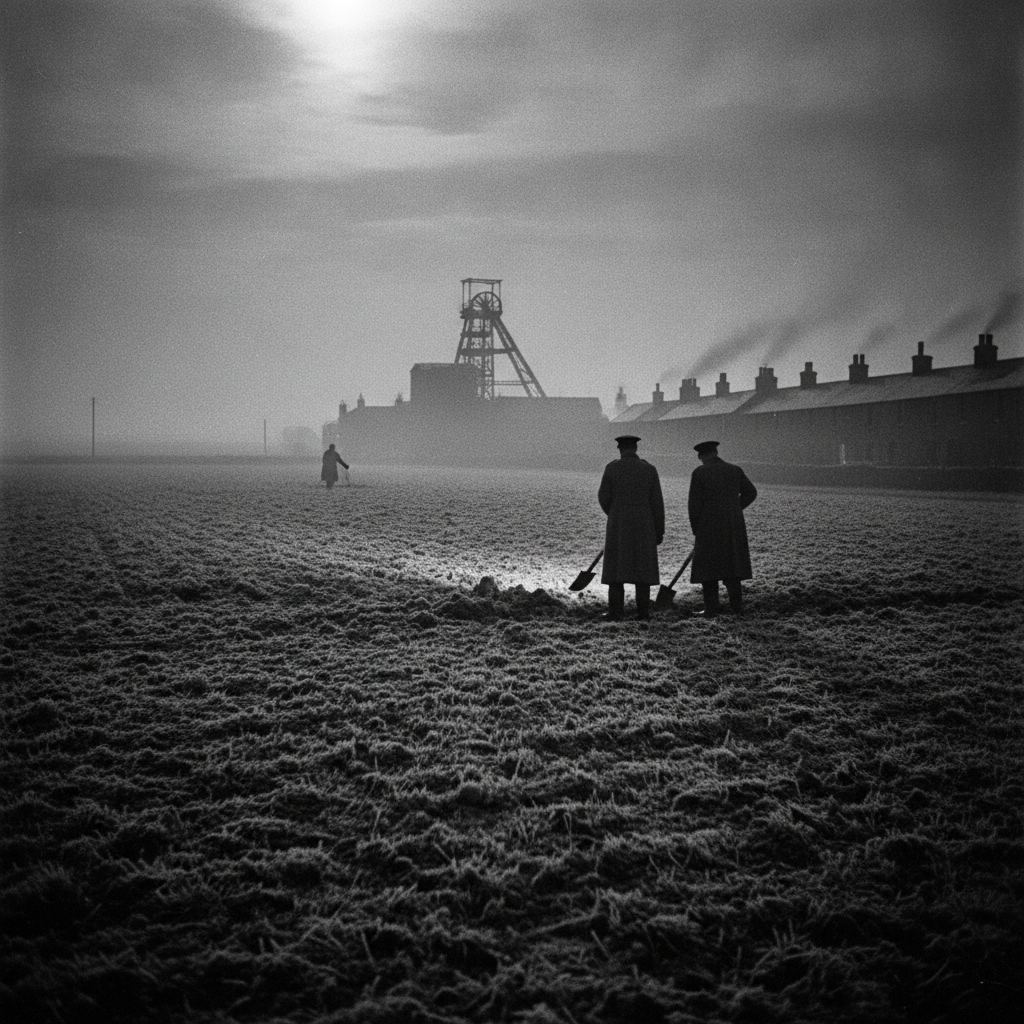
In the early hours of 16 January, he took the detectives out to a ploughed field at Burntbroom Farm, near Mount Vernon. In the dark he paced across the field, stopped, and said that he thought he was standing on her.
The officers dug. They found the body of Isabelle Cooke in a shallow grave. She had been strangled.
After 19 days, her parents finally knew.
Back at the police station, Manuel wrote out a confession of several pages. In the days that followed he led police divers to places on the river Clyde where he had thrown 2 guns. The divers recovered them: a Webley revolver and a Beretta pistol. Ballistics tests showed that the Webley had killed the Watt family and the Beretta had killed the Smarts.
He also showed the police the place where he had thrown away the piece of iron he had used to kill Anne Kneilands.
The trial
The trial opened at the High Court in Glasgow on 12 May 1958. It was one of the biggest trials Scotland had seen. It ran for about 2 weeks.
Manuel pleaded not guilty to everything. His lawyers argued that his confessions had been forced out of him, through threats against his family. The judge heard that argument and rejected it. He ruled that the confessions could be put to the jury.
On 15 May, William Watt stepped into the witness box. He was called by the prosecution. For the first time, he stood in a court in front of the man who had killed his family, and told the jury he had nothing to do with it.
On 22 May, Manuel did what he had done before. He dismissed his lawyers and took over his own defence.
His story now was that the police had made everything up. He said the detectives had driven him to the field and shown him where to stand. He said that William Watt had killed his own family, and that Peter Smart had killed his own wife and son and then himself. He cross-examined William Watt in person.
The detectives denied all of it. The physical evidence did not fit his version. The banknotes, the guns from the river, the grave in the field, were not things the police could have invented.
On 26 May, Manuel made his closing speech to the jury. It lasted about 2 and a half hours.
The verdict
There was one problem the prosecution could not solve. In Scottish law, a confession alone is not enough to convict. There must be at least one other piece of evidence that supports it. For the murder of Anne Kneilands, the confession was the only thing the police had. The judge told the jury to acquit Manuel on that charge.
On all the others, the jury took less than 2 and a half hours.
Peter Manuel was found guilty of the murders of Marion Watt, Vivienne Watt and Margaret Brown; of Peter, Doris and Michael Smart; and of Isabelle Cooke. 7 murders.
The judge sentenced him to death.
Manuel appealed, again claiming that his confessions had been forced. On 24 June 1958, 3 senior judges rejected the appeal.
At 8 in the morning on 11 July 1958, Peter Manuel was hanged in Barlinnie prison, the same prison where William Watt had been held for 67 days. He was 31 years old. He was buried in an unmarked grave inside the prison walls.
Afterward
A few things remain open, and they are short.
On the taxi driver Sydney Dunn: Manuel was never tried for his death, because it happened in England. After the execution, a coroner's jury in Newcastle found that Manuel had killed him. Some writers on the case still question this, pointing to witness accounts that do not fully match.
In the weeks before his death, Manuel also confessed to 3 other killings, 2 in Glasgow and 1 in London. Investigators at the time doubted all 3. In the London case, the police believed another man had done it. These confessions are not accepted as fact.
And William Watt. He was never convicted of anything, and the man who killed his family was convicted and hanged. But the 67 days in prison, and the year of suspicion, stayed with him. For many people in Scotland, the Watt case became the lasting lesson of this story: how close an investigation came to destroying an innocent man, while the real killer sat in the same prison, writing letters about the crime.