Seventy Pieces in a Scottish Ravine: The Case That Made Forensic Science Believable
On Saturday 14 September 1935 Isabella Ruxton drove to Blackpool to look at the illuminations. She was thirty four years old, a tall, striking woman from Falkirk who had managed a cafe in Edinburgh before she met the doctor she would live with for the rest of her short life. She went with two of her sisters, they had tea, they walked the front, and at about half past eleven at night she got into her car for the twenty five mile drive home to Lancaster. Her sisters watched her go. Nobody outside the house on Dalton Square ever saw her alive again.
Waiting at the house was Mary Jane Rogerson, twenty years old, the nursemaid. She came from Morecambe, from a family of modest means, and she had been with the household for about three years. The three Ruxton children were small and she was, by every account given afterwards, devoted to them. She had a regular day off and a stepmother who expected her home on it. That was the arrangement that would eventually make people ask questions.
The house was 2 Dalton Square, a tall terrace facing the town hall in the middle of Lancaster, with the surgery on the ground floor and the family above it. The doctor was Buck Ruxton, born Bukhtyar Rustomji Ratanji Hakim in Bombay, holder of medical degrees taken in India and France, a former officer of the Indian Medical Service who had changed his name by deed poll and settled in Lancaster at the start of the decade. He was a popular general practitioner. He treated poor patients for whatever they could pay, and after his arrest thousands of his neighbours signed a petition on his behalf.
At home the picture was different, and it was on the record before anyone died. Isabella and Ruxton were not married, although they lived as husband and wife and both used the name. He was consumed by the conviction that she was unfaithful to him. There had been scenes, and there had been police at the door. Isabella had gone to the authorities herself more than once, and the substance of her complaints was that she was afraid of what he might do to her. Nothing came of any of it. On the Saturday night in question a young woman and a man who was jealous of her were alone in a house with three sleeping children.
The week that followed
On the Sunday morning the charwoman, Mrs Agnes Oxley, came as usual to Dalton Square and found the doctor at the door telling her that she was not needed, that Mrs Ruxton had gone away to Edinburgh and taken Mary with her, and that he would fetch her himself when she was wanted. The children went to stay with friends. Over the following days the household ran on a strange rhythm. Carpets were rolled up and given away. The stair carpet disappeared. Suits went out to be cleaned with stains on them. A quantity of material was burned in the back yard, and neighbours later spoke of the smell. Ruxton told a series of people, with variations, that Isabella had gone off with another man and that Mary had gone with her because she was pregnant and in trouble. He engaged decorators. He was, in the words of more than one witness, everywhere at once.
Mary Rogerson did not come home on her day off. Her family began to ask, then to press. Isabella's sisters in Edinburgh, who had said goodbye to her on the Blackpool promenade, heard nothing from her at all, which was not how she behaved. Both sets of questions were still circling in Lancaster when, ninety miles to the north, a woman on a country road looked over a parapet.
Gardenholme Linn
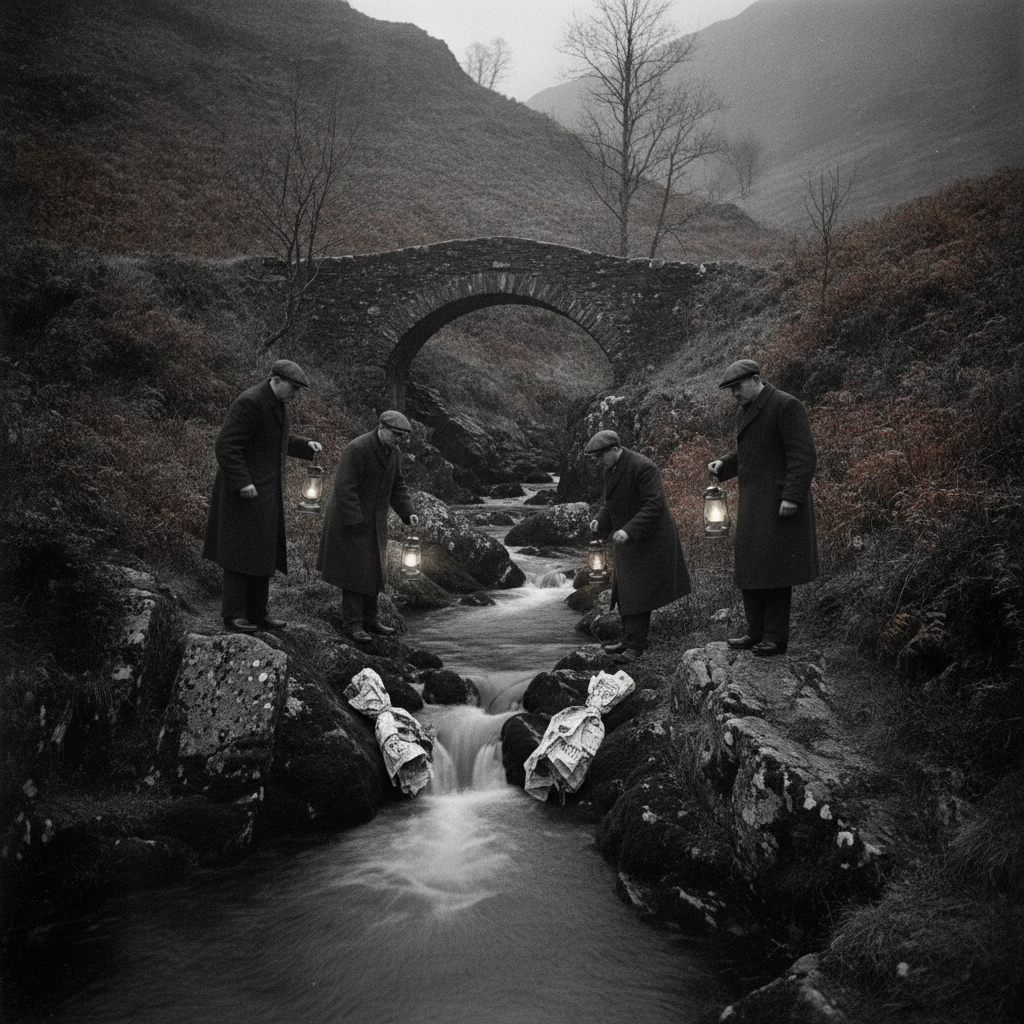
On Sunday 29 September 1935 Susan Haines Johnson, visiting Moffat in Dumfriesshire from Edinburgh, was walking the road that climbs towards the Devil's Beef Tub. She stopped on the bridge over a burn called the Gardenholme Linn, looked down into the ravine, and saw what she took to be a human arm. Her brother went down the bank to look. Within hours the local police, and then detectives sent from Glasgow, were working their way along the gully with the water running over their boots.
What they took out of that ravine over the following days, and later from other spots along the roadside where more had been thrown, amounted to roughly seventy separate pieces of two human bodies. They had been made into parcels. Some were wrapped in newspaper, some in a pillowcase, some in cotton wool, some in clothing, including a blouse with a distinctive patch under one arm and a child's romper suit. Heavy rain had raised the burn after the parcels were left, and the water had scattered them down the ravine, which is the only reason they were visible from the bridge at all.
The first thing the investigators noticed was not what was there. It was what was gone. The fingertips had been cut away. Teeth had been drawn. The eyes had been removed, and the ears, the nose and the lips. Skin had been stripped from areas of the legs. From one body a large section of tissue had been taken out of the thigh. From the other, internal organs including the uterus had been removed. Whoever had done this understood exactly which features of a human body allow a name to be attached to it, and had gone after every one of them in turn. And the dismemberment itself was not butchery. The bodies had been taken apart at the joints, with skill. That single observation narrowed the field of possible killers from the whole population of Britain to a small number of people with anatomical training.
Then the investigation went wrong. The early examination of the remains concluded that one of the two bodies was male. The reasoning was not stupid. So much identifying tissue had been removed, including the organs that would have settled the question, that the pathologists were reading a body with the answers cut out of it. For a period the police in Dumfriesshire were looking for a missing man and a missing woman, and the Lancaster inquiry about two missing women had no obvious reason to connect itself to a Scottish ravine.
Two tables in Edinburgh
The remains were taken to the department of forensic medicine at the University of Edinburgh, and what happened there is the reason the case is still taught. Professor John Glaister of Glasgow, Professor James Couper Brash, the Edinburgh anatomist, and Sir Sydney Smith set up two tables and began, piece by piece, to build two people out of a heap of parts.
It was done by matching tissue at the cut surfaces, by fitting joint to joint, by blood grouping, and by the slow anatomical logic of what belongs with what. Body One resolved into a young woman of about twenty. Body Two resolved into a woman in her thirties. The age estimate for the younger came in part from the state of the growing ends of her bones, which fuse on a known schedule. The male body did not exist. It had never existed. The correction was as important as anything that followed, because it turned a Scottish mystery into a Lancashire missing persons case.
Four separate threads then closed at once.
The first was printed on the wrappings. Among the newspaper used to parcel the remains were pages of the Sunday Graphic of 15 September 1935. It was not the national edition. It was a slip edition, a run of a few thousand copies carrying local content, distributed only in Morecambe and Lancaster. That piece of paper put the parcels within a few miles of one particular town on one particular day.
The second was the clothing. Mary Rogerson's stepmother was shown the blouse with the patch under the arm and identified it. She had put the patch there herself. The child's romper suit was traced to the Ruxton household as well. Cloth from the ravine had come out of a specific house.
The third was insects. Alexander Mearns, an entomologist at Glasgow, took the maggots from the remains, reared them through their stages, and worked backwards to the point at which the flies had laid on the tissue. His answer was in the region of twelve to fourteen days before the discovery, which put the deposit in the ravine in the middle of September. It matched the date on the newspaper and it matched the night Isabella Ruxton drove home from Blackpool.
The fourth was the one the judge would later call the most damning of all. Detective Lieutenant Bertie Hammond of the Glasgow force found that on one hand of the younger body, the killer had missed. Enough ridge detail survived on the left hand for prints to be taken. Ruxton had been meticulous with the bodies. He had not thought about the house. Hammond and his colleagues went through 2 Dalton Square and lifted hundreds of prints from jars, bottles, cups, plates and dishes, the ordinary traffic of a nursemaid's working day. The prints from the ravine matched prints from the house. A body in a Scottish stream had been physically placed inside a Lancaster home.
The photograph and the skull
That left the older woman. Her hands were beyond use, and here Glaister and Brash did the thing the case is famous for. They took a studio portrait of Isabella Ruxton, a formal photograph in evening dress, and they photographed the skull recovered from the ravine at exactly the scale and angle at which the living head had been sitting when the portrait was made. Brash rigged the camera to reproduce the geometry. The two images were then printed as transparencies and laid over one another.
The skull fitted the face. The line of the jaw, the height of the orbits, the width across the cheekbones, all of it sat where the photograph said it should. The scientists also ran the test the other way, laying Mary Rogerson's photograph over the same skull, and it did not fit at all. That negative result mattered as much as the positive one, and the experts were careful in court about what the technique could and could not do. It was strongest as a way of excluding a person, and it did not stand alone. It sat on top of fingerprints, dental work, clothing, insects and a local newspaper.
Meanwhile the Lancaster end of the case had filled in. The bath and the stairs had been scrubbed but the traces were there. Blood had soaked into the wood and the plaster where scrubbing could not reach. There was the burnt heap in the yard, the carpets given away, the stained suit, the decorators brought in at speed, and a household of witnesses who each held one piece of the week. And there was the car. Ruxton had made journeys north in the days after the fourteenth, and his account of them did not survive contact with the record, because on 17 September he was involved in a collision with a cyclist on the road near Kendal and a constable took his particulars. He had put himself, in a police notebook, on the road towards Scotland.
Manchester, March 1936
Ruxton was arrested on 13 October 1935 and charged first with the murder of Mary Rogerson, and afterwards with the murder of Isabella. He was tried at Manchester before Mr Justice Singleton, from 2 to 13 March 1936, for Isabella's murder alone. The prosecution was led by J C Jackson KC, with David Maxwell Fyfe and Hartley Shawcross, two juniors who would later prosecute at Nuremberg. The defence was in the hands of Norman Birkett KC, the outstanding defender of his generation.
Birkett understood exactly where the case had to be fought. He barely contested the domestic evidence, which was hopeless. He attacked identification. If the two reconstructed bodies could not be proved to be Isabella Ruxton and Mary Rogerson, there was no murder to answer for. So for eleven days a criminal trial turned into an examination of anatomy, entomology, fingerprint ridges and photographic overlay, argued in front of twelve ordinary citizens who had never heard of any of it. Ruxton gave evidence himself, at length and emotionally, and it did not help him.
The jury was out for about an hour. Singleton, passing sentence, told him he had been convicted on evidence that could leave no doubt in anyone's mind, and afterwards excused the jurors from jury service for the rest of their lives because of what they had been made to look at. The appeal was dismissed. A petition signed by thousands of people in Lancaster, who knew him as the doctor who did not chase them for money, made no difference. He was hanged at Strangeways prison in Manchester on 12 May 1936.
The following Sunday the News of the World published a confession. Ruxton had written it two days after his arrest, in October, sealed it, and handed it to one of the paper's reporters on the condition that it stay shut until he was dead. In it he said that he had killed Isabella in a rage, believing she had been unfaithful, and that he had killed Mary Rogerson because she had seen him do it.
Glaister and Brash published their reconstruction the following year as a technical monograph. It became the model for how scattered and mutilated remains are handled, and the phrase that stuck to the case in the newspapers, the jigsaw murders, was for once close to what had actually been done.
Conclusions and Open Questions
The verdict has never been seriously challenged, and the confession removed most of the room for argument. What the case leaves open is narrower, and more interesting.
The first question is the confession itself. It describes a strangling in a moment of jealous fury and a second killing forced by a witness, and it is the version almost every account repeats. The medical evidence was thinner than that. The pathologists were working with bodies from which the relevant tissue had been deliberately cut away, and the injuries they could describe were, in places, hard to reconcile with a single brief loss of control. Some later writers have argued that the removal of the uterus from one body and the extent of the mutilation point to something more deliberate than a sudden rage. Others reply, with force, that a doctor destroying evidence would remove exactly those parts whatever the motive had been, and that reading intention into a mutilation is guesswork. Neither side can settle it, because the evidence that would settle it was destroyed on purpose.
The second is whether he acted alone. The arithmetic is tight. Two bodies had to be dismembered, drained, mutilated with care, wrapped into dozens of parcels, and driven roughly a hundred miles north and a hundred miles back, while a full surgery, three children and a household of visitors carried on around him, and while he was seen in Lancaster repeatedly during the same days. One theory holds that the timetable is simply impossible for one man and that someone else must have driven or carried. The counter argument is that Ruxton was working at frantic speed, that the trips north are partly accounted for, and that no second person was ever identified in an investigation that turned the household inside out. No accomplice was ever charged, and no name has ever been credibly proposed.
The third question is why Mary Rogerson died, and it is the one that still troubles people. The confession says she walked in. But Ruxton had also told several people, before anyone knew she was dead, that she was pregnant and had gone away to deal with it. That story was a lie in the sense that she had not gone away. Some writers have suggested it was a lie built on a fragment of truth, and have connected it to the removal of the younger woman's tissue. The pathologists at the time did not support a pregnancy, and there is no documentary basis for the theory beyond Ruxton's own convenient story. It is fair to say only this: the man who invented the explanation for her absence was the man who killed her.
The fourth is a methodological question that has grown larger with time rather than smaller. Craniofacial superimposition, the technique that made the case a legend, is now regarded by forensic anthropologists as a tool with real limits. It is good at exclusion and much weaker at positive identification, because more than one skull can be made to fit a photograph if the angle and scale are chosen for it. In 1936 it was presented to a jury as something close to proof. In the Ruxton case that did no harm, because fingerprints, dentition, clothing, the local newspaper edition and the insect evidence all pointed the same way. The uncomfortable question is what happened in the cases that followed, in which the same technique was borrowed with less around it.
And there is a last thing, which is not a scientific question at all. Isabella Ruxton had been to the police before that Saturday, and had told them she was afraid. Her fear was recorded and nothing followed from it. In 1935 there was no mechanism that would have acted on what she said. Every one of the reconstructions performed in Edinburgh, brilliant as they were, was work that began after the only intervention that could have mattered had already failed.