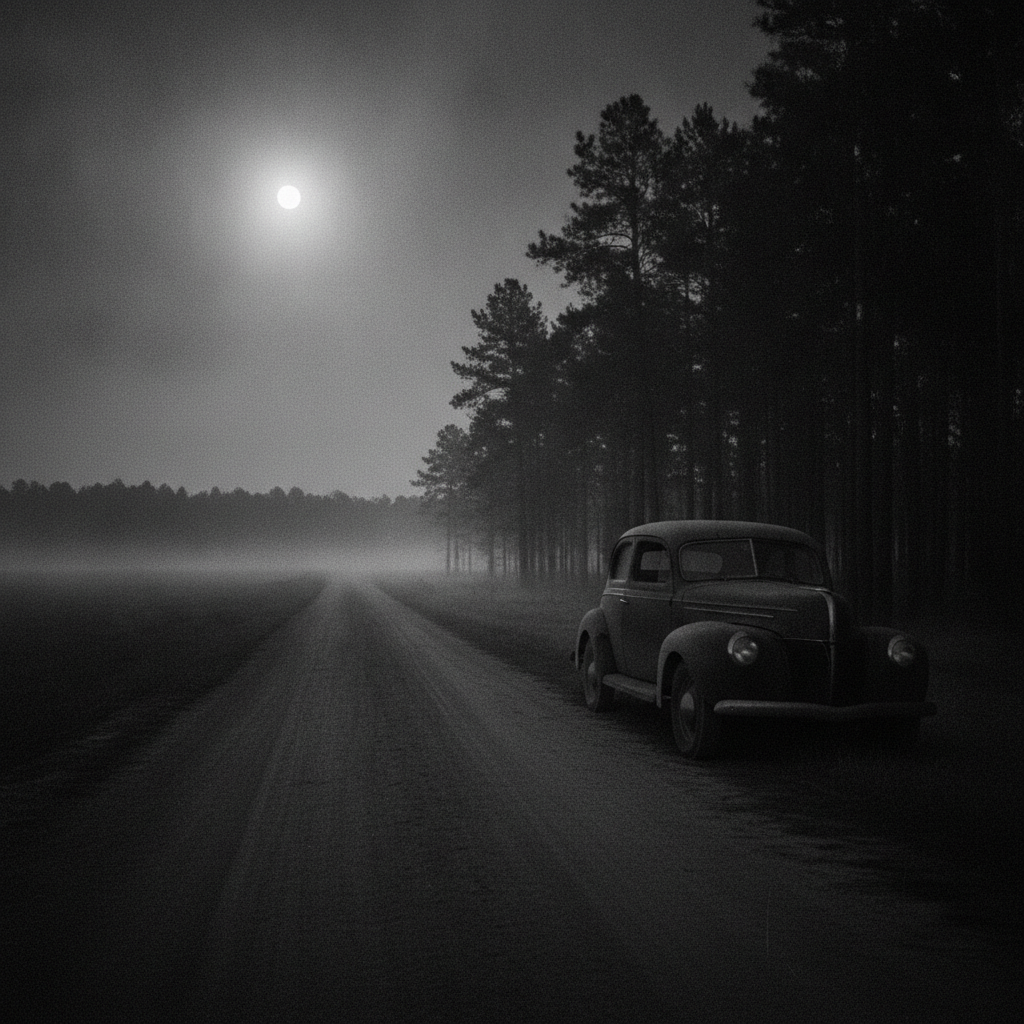
The Texarkana Moonlight Murders: 10 Weeks, 5 Dead, and a Phantom Never Charged
In the spring of 1946, a whole town stopped going out after dark.
The town is called Texarkana. It sits in the south of the United States, exactly on the border between 2 states, Texas and Arkansas. The state line runs down the middle of the main street. One half of the town is in Texas. The other half is in Arkansas. Each half had its own police force.
The war had ended a few months earlier. Young men were home again. On weekend nights, couples drove out of town in their cars and parked on quiet dirt roads at the edge of the fields. Everyone knew these places. They were called lovers' lanes.
Between February and May of 1946, someone came out of the dark on those roads.
In 10 weeks there were 4 attacks. 8 people were hurt. 5 of them died. All the attacks came on weekend nights, 3 to 4 weeks apart. Then they stopped, as suddenly as they had begun.
The newspapers called them the Texarkana Moonlight Murders. The local paper gave the killer another name: the Phantom. That is what people in the town still call him.
The police checked almost 400 suspects. One of them was held for many years, but for a different crime. Nobody was ever charged with the murders. This is the story of those 10 weeks, and of the investigation that followed.
The first night: a man in a mask
On Friday night, 22 February 1946, a young couple parked on a dark road just outside the Texas side of town.
He was Jimmy Hollis, 25. She was Mary Jeanne Larey, 19. The spot was only about 90 m from the last row of houses in the town.
They parked at about 11:45 at night. About 10 minutes later, a man walked up to the car. He held a gun. His face was covered by a white cloth mask with holes cut for the eyes.
He ordered them out of the car. He struck Jimmy Hollis twice on the head with the gun. The skull broke. Then he struck Mary Jeanne Larey and sexually assaulted her.
She got away. She ran about 800 m in the dark until she reached a house, and the people there called for help.
Both of them survived. He spent several days in hospital with a fractured skull. She was kept overnight with a head wound.
What they told the police did not match. Both said the man was about 1.80 m tall. She said he was a light-skinned black man. He said he was a white man of about 30 with a deep tan.
The police did not believe them. Some officers thought the couple knew the attacker and were protecting him. Nobody linked this night to anything else. At this point there was nothing else to link it to.
The second night: a car on a lovers' lane
A month later, on the morning of Sunday, 24 March 1946, a driver passing along a back road in the same county saw a parked car. Two people were inside, and they were not moving.
The road was a known lovers' lane, about 90 m south of the main highway that runs west out of Texarkana.
In the car were Richard Griffin, 29, and Polly Ann Moore, 17. They had been going out together for 6 weeks.
Both had been shot once in the back of the head. The gun was a .32 calibre pistol.
There was blood on the ground beside the car. The investigators read the scene this way: the couple had been killed outside the car, and then the killer put them back inside it. One account says she was killed on a blanket on the ground and then placed on the back seat.
No record shows that a pathologist examined either of them. Rumours went around the town that she had been sexually assaulted. Sources from the time and from later disagree about this, and modern accounts of the case say the rumour is not supported.
The police questioned more than 200 people in the first weeks. They followed about the same number of false leads. On 30 March a reward of 500 dollars was offered. It brought in more than 100 tips. None of them led anywhere.
Nobody yet connected this killing to the masked man of February.
The third night: the girl with the saxophone
3 weeks later, on the night of Saturday, 13 April 1946, a dance band played at the veterans' club in Texarkana.
One of the musicians was Betty Jo Booker, 15. She was in her third year of high school, played the saxophone, and was an officer of the school band.
At about 1:30 in the morning, after the show, a friend came to pick her up. He was Paul Martin, 16. They drove off in his car.
At about 6:30 that morning, Paul Martin's body was found lying beside a road at the north end of town. He had been shot 4 times: through the face, through the ribs from behind, through the right hand, and through the back of the neck.
Betty Jo Booker was missing.
Volunteers and police searched the woods. At about 11:30 in the morning a search party found her, behind a tree, almost 3 km from where Paul Martin lay. She had been shot twice, once in the chest and once in the face.
The car was found near a park on the edge of town, with the keys still in the ignition. It was about 2.5 km from his body and about 5 km from hers.
Her saxophone was gone.
The bullets came from a .32 calibre automatic pistol. The investigators believed it was the same gun that killed Richard Griffin and Polly Ann Moore 3 weeks earlier.
Now there was no more doubt. The same person was killing couples in parked cars. The local newspaper started calling him the Phantom.
The town that locked its doors
After the third night, Texarkana changed.
People bought guns and stayed at home after dark. A curfew was set for businesses, so that people would be off the streets at night. The police patrolled the quiet roads and the lovers' lanes.
Couples stopped driving out of town. Lovers' lanes stood empty.
Reporters came from across the United States. The reward grew within days to more than 1,700 dollars.
The case was now handled by many forces at once: the police of the Texas half of the town, the police of the Arkansas half, the sheriffs of the surrounding counties, the Texas Rangers, and the FBI.
The best-known face of the investigation was a captain of the Texas Rangers, nicknamed "Lone Wolf". He was a famous lawman, always in front of the cameras. His critics later called him a showman.
The officers worked shifts of 24 hours. They tried a trick: they put young officers, or volunteers, or even shop dummies, in cars parked on the lovers' lanes, and waited in the dark for the Phantom to come.
He did not come.
On 27 April, in a port city in the far south of Texas, police arrested a man who was trying to sell a saxophone. In his hotel room they found bloody clothes. For a few days the town believed the Phantom was caught. Then the man was cleared. It was not her saxophone.
The fourth night: a farmhouse
On Friday night, 3 May 1946, the Phantom did something new. He did not go to a lovers' lane. He went to a house.
Virgil Starks, 37, owned a farm of about 200 hectares, about 16 km northeast of Texarkana, on the Arkansas side of the state line. He also had a welding workshop.
Some time before 9 that evening he was sitting in his armchair reading. His wife, Katie Starks, 36, was in another room.
Two shots came through the closed window behind him. Both hit him in the back of the head. He died in his chair.
Katie Starks heard the glass and ran to the telephone. It was an old crank telephone, and she began to call the operator. Two more shots came through the same window. Both hit her in the face.
She did not fall. Bleeding, barefoot, she ran out of the house in the dark to a neighbour's farm. The neighbour fired a rifle into the air to bring help, and she collapsed. She was taken to hospital in Texarkana, and she survived.
Nothing was taken from the house. Money was left. Her purse was left. Most of the officers concluded that the motive was not robbery.
This time the weapon was a .22, not a .32. The sources do not agree whether it was a pistol or a rifle. Because of the different gun, some investigators were never sure that this attack was by the same man. Others pointed to the tyre tracks found near the farm, which looked like tracks found at earlier scenes.
That same night the reward jumped to 7,025 dollars. Within 10 days it was more than 10,000 dollars.
The investigation grows
By 5 May, 47 officers were working on the case.
On 9 May a mobile radio station arrived in Texarkana, with 20 Arkansas state police officers and 10 patrol cars. On 11 May a teletype machine was installed, so that the town could send and receive police messages at once from across the country.
The tips poured in. Every one had to be checked.
On 7 May, an armed hitchhiker took a driver's car and boasted that he had killed 5 people in Texarkana. The Ranger captain did not believe him. The Phantom, he said, had always worked hard to hide who he was. A man like that does not boast to strangers.
On 8 May the police announced a new suspect: a German prisoner of war who had escaped from a camp, stolen a car in Arkansas, and tried to buy bullets in Oklahoma. He was described in detail. He was never found.
On 10 May, in a small town in Oklahoma, a man attacked a woman and boasted that he had killed 3 or 4 people. 20 officers and 160 local people searched for him. He was arrested 2 days later. The police did not believe he was the Phantom.
9 people walked into police stations and confessed. All 9 were ruled out.
Three men were held because they had blood on their clothes. All three were released.
One local man was questioned because his tyre tracks were found near Paul Martin's body. He failed a lie detector test. Under hypnosis he explained what he had really been doing that night, and he was cleared.
A death on the railway line
On the morning of 7 May, a man was found on the railway tracks about 26 km north of Texarkana. A freight train had passed over him about half an hour earlier.
He was Earl McSpadden. The coroner's jury found that he had died "at the hands of persons unknown", and that he was already dead before he was placed on the tracks.
Nobody was ever charged with his death either. Rumours in the town made him a sixth victim of the Phantom. Other rumours made him the Phantom himself. The police never officially connected his death to the other attacks, and he is not counted among the victims.
The first night is finally connected
All this time, the attack on Jimmy Hollis and Mary Jeanne Larey in February had not been officially linked to the murders.
On 10 May the local newspaper interviewed Mary Jeanne Larey. The next day, 11 May, the officers said publicly for the first time that the masked man of February was probably the same man.
From then on the official count was 4 attacks, 8 victims, and 5 dead.
The officers also noticed something else. The first 2 attacks came about a week after a full moon. That is where the name "Moonlight Murders" came from. But the last attack, at the farmhouse, came close to a new moon, when the nights were darkest. The moon explained nothing.
The detective who watched the stolen cars
Then, in the summer, came the closest the case ever came to an answer.
A detective of the Arkansas state police had noticed a pattern that nobody else had looked at. Before each of the attacks, a car had been reported stolen in the area. After each attack, a stolen car was found abandoned.
He started watching stolen cars.
In July 1946, a stakeout around one of these cars led the police to a young woman. Through her, they reached the man she was with: Youell Swinney, 29, a career criminal. He had a record for car theft, counterfeiting money, burglary and assault.
The woman began to talk. She said he was the Phantom. She said she had been with him the night Paul Martin and Betty Jo Booker were killed. She described things that the police had never made public.
The police said they were able to check some of what she told them. For example, she knew where certain belongings of one of the victims had been thrown away.
Then she changed her story.
She took back what she had said. Soon after, she married him. Under the law, a wife could not be forced to testify against her husband.
The prosecutors looked at what they had. Her story could not be used in court, and she had already told it 2 different ways. Without her, everything else was circumstantial. They decided not to charge him with murder.
Instead, in 1947, he was tried for car theft. Because of his long record, he was sentenced to life in prison as a habitual offender.
Here is where the documented trail ends. Nobody was ever put on trial for the Phantom killings.
Where the case stands
The killings stopped after May 1946. Whoever the Phantom was, he never struck again in Texarkana.
Youell Swinney stayed in prison for many years. In 1973, a court ruled that one of his old convictions, used to give him the life sentence, was invalid, and he was released. The sources disagree about his end. Some say he died in prison. Most accounts say he died on 15 September 1994, in a nursing home in Dallas, Texas. One account says the case was officially closed after his death. He was never charged with any of the murders, and in law he remained innocent of them.
Today, almost nothing of the physical evidence survives. In 1946 there was no DNA testing, and accounts of the case say that today the physical evidence is virtually gone.
Betty Jo Booker's saxophone was found on 24 October 1946, more than 6 months after she was killed, near the place where her body had been found.
The last surviving member of the investigation, a deputy sheriff from the Arkansas side, died in 2008.
The suspects and the theories
These are the explanations that are on the record. None of them was ever proved in court.
The car thief. A book published in 2014 by a writer from Texarkana, after years of research, concludes that Youell Swinney was the Phantom. It points to his girlfriend's first account, to the details she knew, and to the stolen cars. The problem: she took her story back. There was no physical evidence. He was never charged, and he must be treated as innocent of the murders.
The student who left a confession. On 4 November 1948, a university student from a well-known Texarkana family killed himself. He left a note confessing to the murders of Paul Martin, Betty Jo Booker and Virgil Starks. The problem: the investigators found nothing else to support it, and a friend gave him an alibi for the night of the farmhouse attack. They treated the note as a false lead.
The man on the railway tracks. A local rumour says that Earl McSpadden was the Phantom and killed himself. The problem: the coroner's jury found that he was dead before he was put on the tracks, killed by persons unknown. That is not a suicide.
More than one attacker. Some officers never accepted that the farmhouse shooting, with a different gun, was the work of the same man. The problem: the tyre tracks and the timing fit the pattern, and after that night all the attacks stopped together.
The film
In 1976 a director who grew up in Texarkana made a film based on the case, "The Town That Dreaded Sundown". The sources differ on whether it came out in 1976 or 1977. A new film with the same name followed in 2014. The town has screened the original film every year since 2003.
Much of what people today believe about the Phantom comes from that film, and not from the records. The records tell a quieter and sadder story: 5 people who drove out on a weekend night, a town that locked its doors, and a case that was never closed in court.