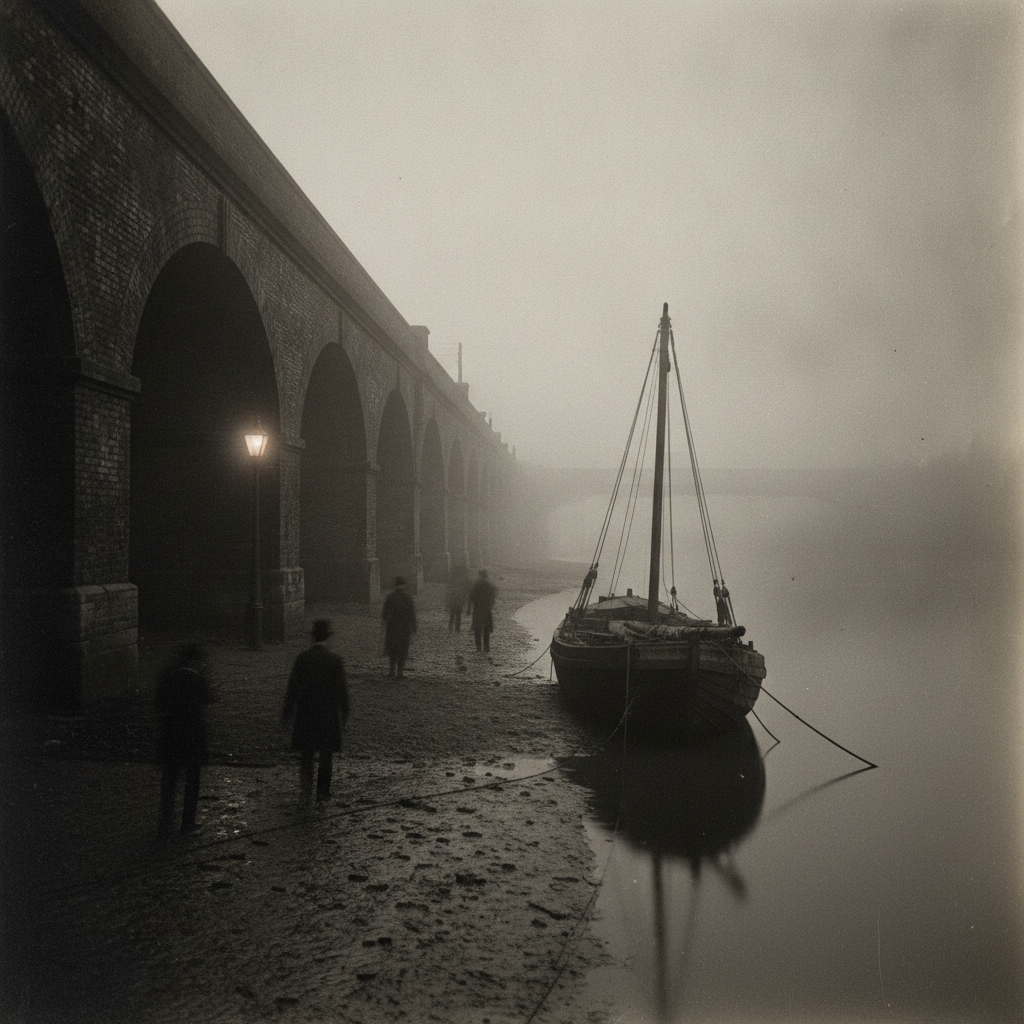
The Thames Torso Murders: 4 women cut apart, a river that carried them, and a killer London never found
In the late 1880s, London was afraid of one man.
The newspapers called him Jack the Ripper. In the autumn of 1888 he killed 5 women in the poor streets of Whitechapel, in the east of the city. Every policeman in London was looking for him.
But in the same years, along the same river, something else was happening. And it got far less attention.
Between May 1887 and September 1889, the bodies of 4 women were found in pieces. A torso in a sack in the water. An arm on the mud. A leg buried at a building site. Parcels of flesh tied with string, floating past the bridges of central London.
None of the 4 were found whole. In 3 of the 4 cases, the head was never found at all. Without a head, there was no face to show to the public. 3 of the women were never identified.
Only one of them got her name back: Elizabeth Jackson, a young homeless woman from Chelsea, who was 7 to 8 months pregnant when she died.
The press called them the Thames Torso Murders. The police filed them as one series. Nobody was ever charged.
This is the story of the 4 cases, of the investigation that followed each one, and of why it never led anywhere.
The river
To understand the case, you first need to understand the river.
The Thames runs through the middle of London, from west to east, and on to the sea. In the 1880s it was the busiest working river in the world. Thousands of barges, small boats and steamers moved on it every day. Men worked on it for a living: lightermen who moved goods from ships to the shore, watermen who rowed passengers across, labourers on the wharves.
The tide rises and falls twice a day. Something thrown into the water at one bridge can turn up days later many kilometres away, upriver or downriver, depending on the tide.
For a killer who wanted to get rid of a body, this was the perfect tool. For the police, it was a nightmare. The place where a body part was found told them almost nothing about where the murder had happened.
The first case: a sack at Rainham, May 1887
On 11 May 1887, at about 11:30 in the morning, a lighterman was working on the river at Rainham. Rainham is a village on the Thames, about 23 km east of the centre of London, on the way to the sea.
He saw a sack floating in the water and pulled it out. Inside it was the torso of a woman. No head, no arms, no legs.
The torso was taken to the local mortuary. The surgeon who examined it found that the woman had been between 27 and 29 years old, and in a "very well nourished condition". She had not been starving. She was not living on the street.
He also noticed something that would come back in every case after this one. The body had not been hacked apart. It had been cut carefully, at the joints, by someone who knew where to put the knife. The surgeon said the person had some knowledge of anatomy, and had done it soon after death.
What he could not find was a cause of death. There was no wound on the torso that could have killed her. Whatever killed her had been done to a part of the body that was missing.
A month later, the river began to return the rest.
On 5 June 1887, a pier worker found a right thigh floating near Temple Pier, in the centre of London. On the same day, the lower part of a chest and an upper belly, in one piece, were found on the south bank near Battersea. The surgeon examined them and said they fitted the torso from Rainham.
Over the next 3 weeks, more parts were found further inland, in the Regent's Canal, a man-made waterway in the north of the city: 2 arms, and 2 lower legs with their feet.
The head was never found. Neither was the upper part of the chest.
The surgeon estimated that the woman had died at the end of April or the start of May 1887.
At the inquest, the jury could not say she had been murdered, because nobody could say how she had died. The verdict was "Found Dead". The woman was never identified.
**At this point, in 1887, nobody yet called it a series. It was one unknown woman, in pieces, in the river.**
The second case: the building site at Whitehall, autumn 1888
The next case began 16 months later, in the worst possible week.
On 11 September 1888, a right arm and shoulder were found on the mud of the Thames at Pimlico, in west London. This was 3 days after the second Ripper murder in Whitechapel. London was in a panic.
At first, The Times newspaper suggested it was a prank by medical students, who had access to bodies for dissection. That explanation did not last long.
On 2 October 1888, workmen were building a new headquarters for the Metropolitan Police on the Victoria Embankment, near Whitehall. Whitehall is the street of the British government, in the very centre of London. The new building would later become famous as New Scotland Yard.
In the foundations there was a vault, a dark underground space that had been built about 3 months earlier. A workman had last gone into it on 29 September, and had seen nothing.
Now, in a corner of the vault, a worker found a parcel. It was wrapped in cloth, possibly an old black petticoat, and tied with string. Inside was the torso of a woman.
So the body had been brought into the most closely watched building site in London, the future home of the police, at some point in the 3 days before it was found. How, and by whom, nobody ever found out.
The torso was examined by a police surgeon. He matched it to the arm found at Pimlico 3 weeks earlier. The arm had been removed after death, by someone with knowledge of anatomy.
The doctors described the woman as tall and well fed: about 24 years old, about 173 cm tall, with fair skin and dark hair. Her hands did not look like the hands of a woman who did manual labour. The uterus had been removed. She had a serious disease in one lung. Nothing suggested she had ever had children.
They estimated that she had been dead for some weeks. They could rule out drowning and suffocation. They could not rule out loss of blood. The cause of death was never established.
There were small clues. The woman's dress was made of satin with a woven pattern. It was traced to a manufacturer in Bradford, in the north of England, and the pattern was estimated to be about 3 years old. With the remains were pieces of newspaper, one of them from the Echo of 24 August 1888.
None of it led to a name.
On 17 October 1888, a newspaper reporter got permission from the police to search the site with a trained dog. With a labourer's help, the dog found a left leg, cut off above the knee, buried near the building.
The head was never found. Neither was the rest of the body. The woman was never identified.
The newspapers immediately linked the Whitehall case to Jack the Ripper. The police said there was no connection. The Ripper killed in the street and left his victims where they fell. This killer cut his victims into pieces, carried them away, and hid them.
**The Whitehall woman was the second unknown victim. Like the first, her death has no cause, no scene and no name.**
The third case: the woman who got her name back, June 1889
On 4 June 1889, 3 boys went swimming in the Thames near Albert Bridge, in Chelsea, west London. They found a left thigh wrapped in women's underclothing.
On the same day, much further east, below London Bridge, a labourer found another parcel at the water's edge. It held parts of a woman's belly, together with a uterus, cord and placenta. It was wrapped in the same kind of underclothing and pieces of the same tweed coat, and tied with bootlaces.
The doctors said she had been dead about 48 hours.
Over the next 6 days, the river gave up the rest of her, piece by piece, in more than 10 places:
- 6 June: part of the upper body, found by a gardener in the bushes of Battersea Park, about 180 m from the river. - 6 June: more of the upper body, pulled from the water at a wharf in Battersea by a barge worker, using a broom. It was wrapped in a dark skirt. The hair still on it was red. - 7 June: a lower right leg and foot, near Wandsworth Bridge, wrapped in a piece of the same coat. - 7 June: a left leg and foot, far downriver near Limehouse, wrapped in a sleeve of the coat. - 8 June: a left arm and hand, off Bankside. - 8 June: the pelvis, near the Battersea steamboat pier. - 8 June: a right thigh, thrown into the garden of a house on the Chelsea Embankment. - 10 June: a right arm and hand, near Blackfriars Bridge.
The head, the heart, the lungs and the neck were never found.
The pieces were laid together at the mortuary. A senior police surgeon examined them. He said they all came from one woman. She was under 25, about 165 cm tall, with bright sandy-red hair. She had been 7 to 8 months pregnant. The baby had been removed after her death.
He said the cutting had been done with skill, but the skill of a butcher, not of a surgeon. He could not find the cause of death. The stomach was missing, so poison could not be ruled out either.
At first, many newspapers decided this was a failed illegal abortion that had gone wrong, and that someone had cut up the body to hide it. At the inquest, the surgeon said there was no evidence of that.
There were 2 clues that could give her a name.
The first was the clothing. One piece of underwear was marked with a name: L.E. Fisher. The police traced a woman of that name who had gone missing. She was found alive and well. The name led nowhere.
The second was a scar. A woman came forward and said her sister had been missing since the end of May, had been pregnant, and had a peculiar scar on one wrist from childhood. The doctors went back to the mortuary. They lifted a small piece of skin on the arm and found the scar underneath.
On 25 June 1889, the woman was identified as Elizabeth Jackson.
She had grown up in Chelsea. In the last months of her life she had no home. She slept in cheap lodging houses when she had money, and when she did not, she slept outside: on the Chelsea Embankment, or in Battersea Park after the gates were locked. She told a friend she did that. Women who knew her later recognised the tweed coat and the skirt as hers.
Her mother and her sisters came to the inquest and identified her. One brother had doubts. He said the hands were too delicate to be his sister's. The doctors had noted the same thing: the hands looked like the hands of a woman of a better class than her clothes. They also found a mark on one finger where a ring had been removed. Elizabeth had worn a cheap brass ring, to pass as a married woman.
For a few months before her death, she had lived and travelled with a man. He was the father of her child. Witnesses said he had treated her badly. He had left her at the end of April.
The police found him in a village in Devon, in the south-west of England, on 8 July 1889. He came back to London of his own will. He was arrested on suspicion of the murder.
Then the police checked his story. He had left London 10 days before the first remains were found. People had seen Elizabeth alive in London after he left. He had witnesses for where he had been. He was released and never charged. Under the law he was, and remains, an innocent man.
Witnesses said Elizabeth was last seen alive with a man about 3 June. Who that man was, nobody ever found out.
On 25 July 1889, the jury returned its verdict: wilful murder, by some person or persons unknown.
**Of the 4 women, only Elizabeth Jackson has a name. Even in her case, nobody knows where she was killed, how, or by whom.**
The fourth case: the railway arch in Pinchin Street, September 1889
3 months later, the killer, or someone like him, came to Whitechapel itself.
Pinchin Street was a dark little street in Whitechapel, in the east of London, the same district where the Ripper had killed a year earlier. Along one side ran railway arches: brick tunnels under the tracks, open to the street, where homeless men sometimes slept.
On Tuesday 10 September 1889, a police constable was walking his beat. He passed through Pinchin Street about every half an hour. At his last pass before 5 in the morning, as the day was breaking, he looked into the arches. There was nothing there.
At about 5:25, he passed again. (Some reports give 5:15.) This time he saw a bundle about 4 m inside one arch.
It was the torso of a woman, with no head and no legs. It was partly covered by an old, torn chemise, a woman's undershirt. It had been cut open down the front.
The constable searched the other arches. In one he found 2 sailors asleep. In another, a shoeblack. All 3 had gone in during the night, drunk, and had seen nothing. They were questioned, and the police were satisfied they had nothing to do with it.
No other policeman on duty had seen anyone carrying a bundle. There was a street lamp about 3 m from the arch. So the torso had been brought there and put down in the half hour before it was found, in a street with a police constable walking through it, and nobody saw anything.
The doctors examined it that day. They said the woman had been between 30 and 40, of stout build, with a dark complexion, about 160 cm tall. She had been dead at least 24 hours.
Before she died, she had been badly beaten. There were 4 bruises on her back, 8 on her right arm and 7 on her left, the kind of marks left by hands that grip hard. Across the belly was a long cut, about 38 cm.
The senior police surgeon of the district said the head and legs had been removed after death, by someone who was "accustomed to cut up animals or to see them cut up", with a knife at least 20 cm long. He thought she had died from loss of blood. In her stomach were fresh plums. There was no poison.
The coroner was asked to compare the case to the Ripper murders. The surgeon said he saw no real similarity. At the end, the coroner said the case did not appear connected to the earlier murders in the district, and that the body might have been brought from the West End, the richer part of London.
The newspapers tried to give her a name. One missing woman was suggested. She was found alive, in hospital, recovering from what was described as "a bit of a spree". A missing girl was suggested. The torso was of an older and taller woman.
On 24 September 1889, the jury returned its verdict: wilful murder, by some person or persons unknown.
No other part of the body was ever found. The woman was never identified.
What the police thought
After Pinchin Street, the 2 most senior men on the case wrote down what they believed.
The chief inspector in charge of the Whitechapel investigation, and the Commissioner of the Metropolitan Police, the head of all London's police, both reported that Pinchin Street was not a Ripper murder. They noted that blood remained in the torso, and took that to mean she had not died from a cut throat, which was the Ripper's method.
Instead, they linked it to the other torso cases: Rainham, Chelsea and Whitehall. In their view, one person, or one group, had been killing women, cutting them up, and getting rid of them in the river and around London for more than 2 years.
That was where the official investigation stopped.
Why it was never solved
The killer had found the weak point of Victorian police work, and used it every time.
**There was no crime scene.** Each woman was killed somewhere private, a room or a building, and cut up there. Only the pieces came out into the open. The police never found a room, a floor, a table or a knife.
**There was no face.** In 3 of the 4 cases the head was never found. In 1887, the only way to identify an unknown body was to show it, or describe its face, to people who might know her. Without a face, a woman who had no family looking for her simply disappeared.
**There was no cause of death.** Because the parts that showed how she died were missing, the doctors could not say how any of the 4 women had been killed. In the first case, the jury could not even say it was murder.
**The river destroyed the trail.** The tide moved the parts many kilometres. The water washed away blood, fibres and smells. Several parts were found only after they had decomposed.
**The science did not exist yet.** There were no fingerprint records in London police work until 1901. There was no way to test blood to tell whose it was, and no way to match a piece of flesh to a missing person except by scars, clothes and a family's memory.
Every lead the police did have, they followed. The name on the underwear: a living woman. The Bradford dress: a common pattern. The newspaper pieces: sold in thousands. The men in the arches: drunk and asleep. The father of the child: an alibi. Each one ended the same way.
**This is where the documented trail ends. The killer of the 4 women was never identified, and nothing that was found then has been able to identify him since.**
The other bodies
Over the years, writers have suggested the series was longer than 4.
In September 1873, a woman's body was found in pieces in the Thames near Battersea. A police surgeon put it back together almost completely, except for the head, which was never found. A medical journal said the body had been "dexterously cut up". A reward of 200 pounds brought no answer. In June 1874, another headless female body was found in the river at Putney, in west London.
In October 1884, parts of a woman were found in parcels near Tottenham Court Road, in central London. In June 1902, a torso was found in an alley in Lambeth, on the south bank.
All of these remain unsolved. Whether any of them were the work of the same hand cannot be proved either way.
The suspects and the theories
No person was ever charged in any of the 4 cases. Everything below is a theory.
**One theory: it was Jack the Ripper.** The cases were in the same city, at the same time, and one of them in the same district. Both killers cut women's bodies after death. The problem: the police at the time rejected it, and so do most modern researchers who have studied both. The Ripper killed in the street and left the body where it fell. This killer worked indoors, removed the head, and carried the pieces away. The methods are different.
**One theory: a man who worked on the river, or in a butcher's trade.** The cutting showed the skill of someone used to cutting animals, as 2 different surgeons said. The parts were spread along the river in ways that suggest someone who knew the tides, and perhaps had a boat. In a 2024 book, a researcher proposed a Thames waterman of that period as the killer, and a 2026 BBC documentary series examined the idea. The problem: it rests on the profile and on old records, not on any piece of evidence that ties a person to a body. The man named lived and worked in the 1880s, and was never charged with any of these crimes.
**One theory: not one killer, but several.** Victorian London had other dismemberment cases, and a few were solved. Cutting up a body is a common way for a killer to get rid of it. The problem: the police chiefs who saw all the files believed these 4 belonged together. The skill of the cutting, the use of the river, and the missing heads are the same in every case.
What all 3 theories share is the same gap. Nobody knows where the 4 women died, how they died, or, in 3 cases, who they were.