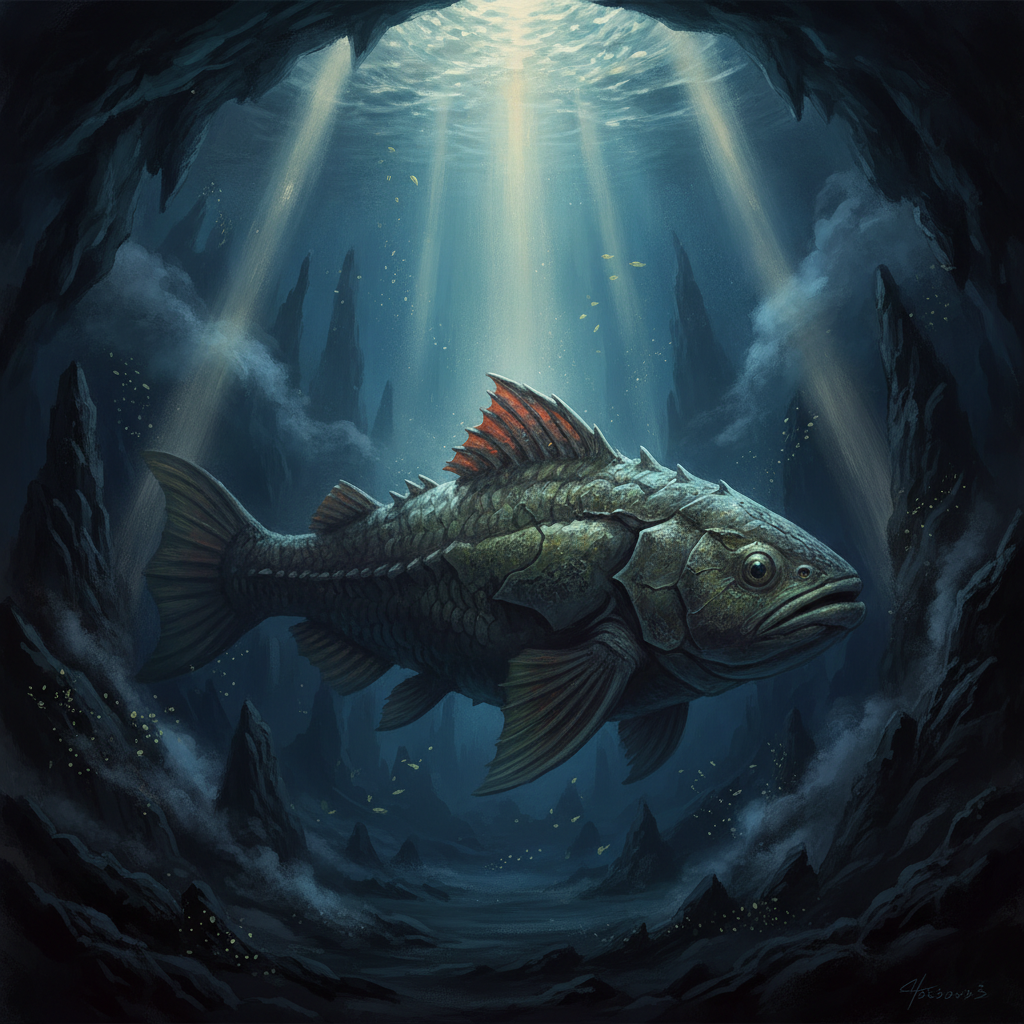
The Coelacanth: The Fish That Rose From 66 Million Years of Extinction
On the morning of December 22, 1938, the trawler Nerine came into the harbour at East London, on South Africa's southeast coast, after dragging its nets near the mouth of the Chalumna River. Its captain, Hendrik Goosen, telephoned a friend to ask whether she wanted to pick through the catch, as he sometimes did. Marjorie Courtenay-Latimer, the thirty-year-old curator of the town's small museum, almost did not go; it was three days before Christmas and she had a display to finish. She went anyway. Beneath a heap of sharks and rays, a flash of blue caught her eye - the most beautiful fish, she would later say, that she had ever seen.
What she worked free was a heavy, steel-blue fish about a metre and a half long and some fifty-odd kilograms, sheathed in hard armoured scales and balanced on thick, fleshy fins that moved more like limbs than anything she associated with a fish. She had never seen its like, yet it struck her as somehow ancient, as if it had swum out of deep time. She wanted it for the museum, and the struggle to get it there has become part of the legend: a reluctant taxi driver, unwilling to let a large and increasingly pungent fish into his cab, was talked into carrying it in the boot, wrapped in a sack.
Unable to name it, and with no naturalist in town, Courtenay-Latimer sketched it and mailed the drawing to J.L.B. Smith, a chemistry lecturer and largely self-taught fish expert at Rhodes University. Days passed with no reply while the specimen began to rot in the summer heat; a taxidermist mounted the skin, but the internal organs were thrown out. Then Smith's telegram arrived, and it was electric: MOST IMPORTANT PRESERVE SKELETON AND GILLS. He had recognised the unmistakable outline of a coelacanth, a lineage known only from fossils and believed to have died out around 66 million years ago, at the close of the age of dinosaurs. Reaching East London in February 1939, Smith confirmed the find and named the animal Latimeria chalumnae - the genus for its discoverer, the species for the nearby river.
To grasp why Smith wept, and why the world's newspapers lost their heads, you have to know what a coelacanth is. It is not just any old fish. It belongs to the lobe-finned fishes, the sarcopterygians, whose thick, muscular, limb-like fins set them apart from every ordinary fish and mark them as close kin to the creatures that first hauled themselves out of the water and became amphibians, reptiles, birds and mammals - which is to say, our own deep ancestors. The Swiss naturalist Louis Agassiz had named the coelacanths back in the 1830s purely from fossils, stony impressions pressed into ancient rock, and every last scrap of them in the record stopped dead at the close of the Cretaceous, alongside the dinosaurs. So to lift a living, dripping one from the deck of a South African trawler in 1938 was, in the phrase everyone reached for, like meeting a dinosaur ambling down a country road: a whole branch of the family tree that science had confidently sawn off, found still green and breathing. Smith would give the rest of his life to the fish and wrote a celebrated account of the whole affair, "Old Fourlegs," the nickname that caught at once the animal's strange, striding fins and its impossible antiquity.
One specimen was not enough, and Smith spent fourteen years obsessed with finding a second, whole, with its organs intact. He printed reward leaflets in English, French and Portuguese and scattered them along the East African coast, offering a hundred pounds - a fortune to a local fisherman. In December 1952 word came from the Comoro Islands, thousands of kilometres to the north: a fisherman named Ahmed Hussein had landed one off Anjouan. Smith, frantic that the specimen would spoil, persuaded the South African prime minister to lend a military aircraft, flew to collect it, and by his own account wept over the fish. The Comoros, it turned out, were the animal's true home - and the islanders had known it all along. Local fishermen called it gombessa, hauled the oily, inedible fish up from time to time, and had no idea that science thought it long dead.
And for decades, extraordinarily, no scientist had ever seen a coelacanth alive in its own world. Every specimen was a corpse, hauled up dying from the depths, its body wrecked by the change in pressure. That changed only in 1987, when the German zoologist Hans Fricke rode a tiny research submersible down the steep volcanic flanks of Grande Comore and, at long last, filmed the fish where it actually lives - between roughly one hundred and two hundred metres down, drifting in the black mouths of lava caves. What he saw was stranger than anyone had guessed. The coelacanth hardly swims at all; it hangs almost motionless in the current and sculls with those lobed fins in a slow, deliberate, cross-limbed motion, for all the world like a four-legged animal walking underwater, and now and then it tips forward and stands on its head for minutes on end, apparently reading its surroundings through an electric sense in its snout.
Then the story reopened entirely. In September 1997 a marine biologist named Mark Erdmann and his wife Arnaz Mehta spotted a coelacanth on a cart in a market in Manado, on the Indonesian island of Sulawesi - thousands of kilometres from any known population, in another ocean. A second Indonesian specimen was secured in 1998, and in 1999 the fish was named a separate species, Latimeria menadoensis, genetically distinct from its African cousin. Then, in October 2000, mixed-gas scuba divers came upon coelacanths of their own at Sodwana Bay in South Africa, more than a hundred metres down a submarine canyon - proof that the fish was never confined to one lonely island group, but scattered thinly and secretly along the deep African coast.
The living animal only deepened that strangeness. A 2021 study led by Kelig Mahe of the French marine institute IFREMER, published in Current Biology, re-read the growth rings on coelacanth scales under polarised light and overturned everything. Earlier work had guessed the fish lived about twenty years; the new count, validated against faint annual rings the old methods had missed, put the maximum near one hundred years. The same study concluded the females do not reach sexual maturity until somewhere between forty and sixty-nine, and carry their young for roughly five years - the longest gestation known in any animal. This is a fish living at the slowest tempo biology allows, which makes it exquisitely fragile: a species that breeds so late and so slowly can be fished to nothing before anyone notices it declining. Fricke's long surveys, though, hinted that the whole Comoros population might number only a few hundred animals, and the species is today listed as critically endangered - a darker turn to the fairy tale, for a fish rediscovered in triumph could still, this time, be lost in earnest.
Conclusions and Open Questions
The press, meanwhile, crowned the animal a "living fossil," and the label stuck for good. Modern biologists push back hard against it, and the argument is worth weighing. A 2013 study of the coelacanth genome, published in Nature, did find some genes evolving unusually slowly - but slowly is not the same as not at all. The living fish is not identical to its prehistoric relatives; it is a different genus from the fossils, its genes carry the ordinary drift of any lineage, and calling it "unchanged" flatters a resemblance that is really one of body plan, not identity. What survived is a very old design, not a frozen animal. And yet the phrase endures, because the truth it distorts is genuinely strange: here is a creature built on a template tens of millions of years old, still swimming.
If a two-metre fish could persist, unnoticed by science, off inhabited coasts, what did its 66-million-year silence in the fossil record really mean? Did coelacanths genuinely vanish from the world at the end of the Cretaceous and cling on in a single overlooked pocket? Or did they simply retreat into deep, rocky, volcanic habitats where bodies almost never fossilise - so that the "extinction" was never an extinction at all, only a long gap in the evidence? The record cannot yet say, and careful scientists read the silence both ways. One has to wonder how many other "extinct" creatures are not gone but merely unlooked-for, in some deep place we have never troubled to search.
How a lineage this rare and this sedentary came to be split across two oceans, with nothing charted in the vast water between, no one has fully explained. Did a single ancient population fragment and drift apart, or are there uncharted coelacanth colonies still hidden along the seamounts in between, waiting to be stumbled upon in some future fish market?
Even now, the most basic facts of its life stay hidden. Coelacanths do not lay eggs but bear live young, and yet no one has ever found where those young are born. Pregnant females are vanishingly rare in the catch, a newborn has almost never been seen in the open sea, and the nurseries of the species - wherever the pups drift and grow through their first years - have never been located at all. We have now sequenced the animal's entire genome and counted the faint rings in its scales, and still we cannot say where a baby coelacanth comes from, or where it hides until it is grown.
That an animal presumed dead for tens of millions of years could be breathing quietly off populated shores is less a story about one fish than a measure of our own ignorance - of how little of the deep ocean we have truly looked at, and how much may still be down there in the dark, waiting to rise up and embarrass the textbooks all over again.