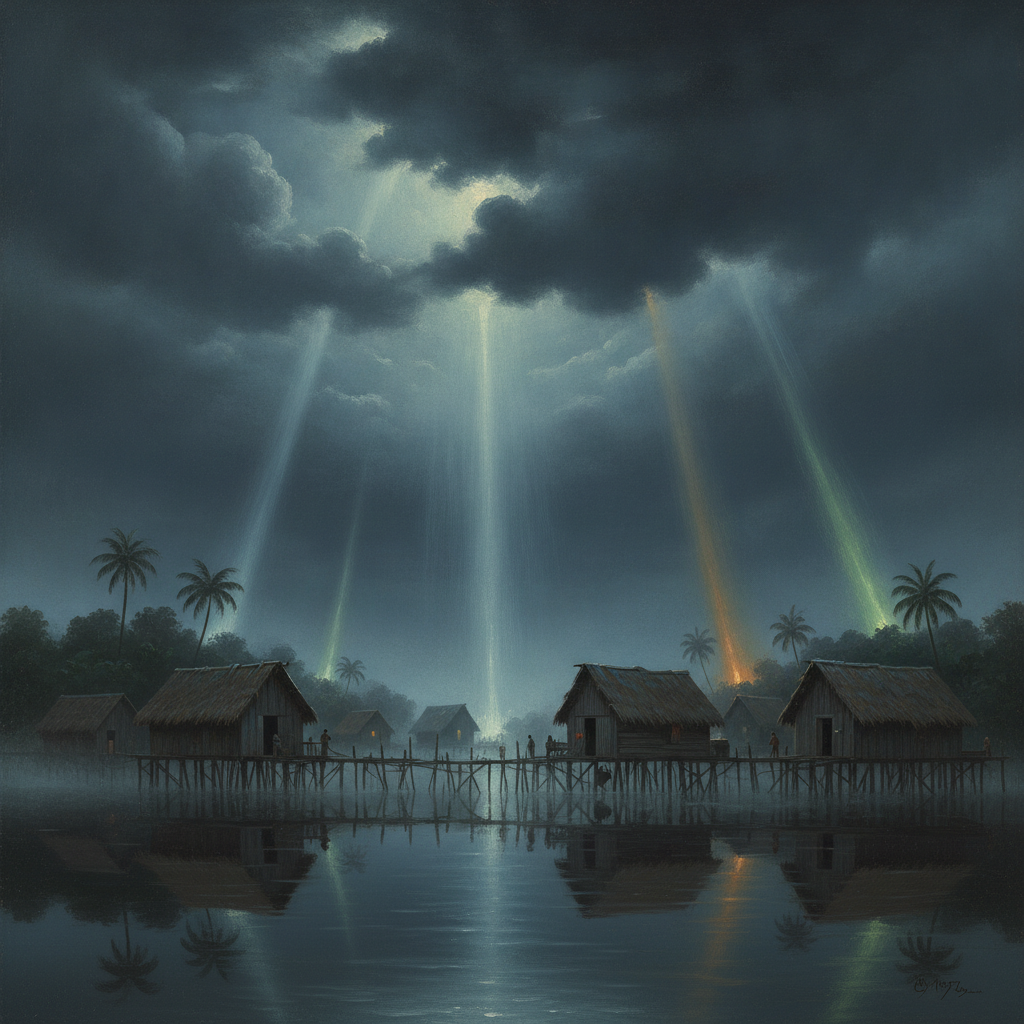
The Lights Over Colares: Brazil's Air Force and the Chupa-Chupa
Colares is a small island municipality in the state of Para, in the north of Brazil, sitting in the wide brackish water where the Amazon meets the Atlantic. In 1977 it was a fishing community of a few thousand people. Many houses were built of timber with roofs of tile or palm thatch, mains electricity was limited, and the nights were very dark.
In the second half of that year, residents began reporting strange lights over the water and over the town. At first the accounts were of the ordinary kind: glows moving low across the river, objects that stopped and changed direction, lights that appeared over the mangroves. Then the reports changed character.
People said that at night a beam of light entered their homes, through the roof or through a window, and settled on a person. The descriptions were consistent enough to become a template. The beam was narrow and intensely bright. It usually struck the chest, sometimes the face. The person could not move while it was on them. There was a sensation of heat rather than sharp pain, sometimes a sound like a swarm of insects or a low hum from outside. Afterwards, the victim felt drained, dizzy and weak, sometimes for days.
Because the beams appeared to draw something out of people, the phenomenon acquired the local name chupa-chupa, from the Portuguese verb chupar, to suck.
The reports were not confined to Colares. Similar accounts came from Vigia on the mainland, from the island of Mosqueiro, from Baia do Sol and from villages along the Para river. Over several months hundreds of people said they had seen the lights, and dozens said they had been struck by them.
The town's response was collective and desperate. Families stopped sleeping alone. People lit bonfires on the beaches and along the shoreline, banged drums and pots, and set off fireworks in the belief that noise and light would keep the objects away. Church bells were rung. Night vigils became routine. A number of families left the island altogether, and the mayor of Colares appealed to the state authorities for help.
At the centre of the medical side of the story is Dr Wellaide Cecim Carvalho de Oliveira, the physician then in charge of the health unit on the island. She examined and treated a group of patients, generally given as about thirty five, who said they had been hit by the light. Her description of what she saw has been repeated in interviews for decades and is the most concrete part of the whole affair.
The injuries, she said, were on the face or on the upper chest. They began as an intense reddening of the skin over the affected area. The hair over the lesion fell out, and the skin later darkened. There was little or no pain, only a sensation of warmth. In the middle of the affected area she found very small puncture marks in the skin, usually two, close together. Her patients presented with headaches, dizziness, trembling, low blood pressure, weakness and, in her account, a picture resembling anaemia. She said the lesions reminded her of radiation injuries rather than ordinary burns. She reported that she had no explanation for what had caused them.
By this point the affair had reached the Brazilian Air Force. In the autumn of 1977 the First Regional Air Command, based in Belem, opened an investigation under the codename Operacao Prato, Operation Saucer or Operation Plate. Brazil was then under military government, and the operation was classified from the outset.
It was placed under Captain Uyrange Bolivar Soares Nogueira de Hollanda Lima. Hollanda took a small team, generally described as five or six sergeants, to Colares. They rented a house in the town, recruited local informants, and worked mainly at night. Their equipment was modest: cameras with telephoto lenses, binoculars, notebooks and standardised questionnaires. Hollanda later said that, contrary to popular accounts, the team had no radar. The men interviewed witnesses, filled in forms, photographed lights over the water and kept nightly observation logs.
The operation ran in phases across the last months of 1977, with the documented core period between late October and early December, and wound down at the start of 1978. Its file was sent up the chain of command and closed. The official position afterwards was that nothing anomalous had been established. The material was archived as secret, and the officers involved were expected not to discuss it.
For twenty years Hollanda did not. Then, in 1997, he agreed to speak to Ademar Jose Gevaerd and Marco Antonio Petit, the editors of the Brazilian magazine Revista UFO. In a long recorded interview he gave his own account of Operacao Prato. He said his team had observed objects at close range on multiple occasions, that some had come very near the ground and near the men, that several of his sergeants had been badly frightened, and that he had come to believe the objects were structured craft under intelligent control and not of human origin. He said the operation had produced more than two thousand pages of documentation, more than five hundred photographs and roughly sixteen hours of film. He also said he had been instructed to keep quiet about it.
Not long after the interview, Hollanda was found dead at his home. He had been hanged with the belt of his bathrobe, and the death was officially recorded as suicide by asphyxiation. He had spoken in the interview about the psychological weight of the assignment.
The paper trail slowly came into the open. From 2004, Brazilian researchers pressed for the release of military UFO files whose classification periods had expired. The Ministry of Defence acted on the requests, and in 2009 the Air Force transferred a body of Operacao Prato material to the National Archives in Rio de Janeiro. The holdings include mission reports, correspondence, witness questionnaires, hand-drawn sketches of the objects and a selection of photographs. They can be consulted by the public. The sixteen hours of film that Hollanda described have never been released.
Conclusions and Open Questions
Colares remains genuinely unresolved, and several explanations compete, each with a weak point that its supporters have not closed.
The official conclusion of the Air Force was that no unusual phenomenon had been established. Its weakness is internal: the service devoted an officer, a team and months of nights to the problem, classified the result, and its own commanding officer publicly contradicted the finding two decades later. A negative conclusion that requires secrecy invites questions.
The strongest conventional theory is mass psychogenic illness. On this reading, an isolated community under stress, primed by rumour and by nights of genuine unexplained lights, produced a self-reinforcing wave of symptoms, with anxiety, insomnia and hyperventilation accounting for the dizziness and weakness. The weakness of this theory is dermatological. It does not comfortably explain reddening followed by hair loss and skin darkening, or paired puncture marks, in dozens of patients examined by a working physician who had no stake in an exotic answer.
A related line holds that the lights themselves were ordinary: the lamps of fishing boats, aircraft on the Belem approach, Venus low over the water, or electrical phenomena of the kind the Amazon basin produces in abundance. That may well account for a large share of the sightings. It does not address the indoor beams or the injuries.
Jacques Vallee, who investigated the case and wrote about it in his 1990 book Confrontations, argued that the injuries were consistent with the effects of directed radiation in the microwave range, and treated Colares as evidence of an unknown energy source rather than of any particular origin. The weakness is evidential access: Vallee worked largely from secondhand testimony and copies, without laboratory samples, biopsies or original clinical files.
Some argue that the source was terrestrial and human. On this open theory, the beams came from clandestine activity during the dictatorship, whether aerial survey work, experimental aircraft or some radiation-emitting equipment, and the Air Force investigation and subsequent secrecy were an attempt to contain the damage. Its weakness is that nothing in the released archive supports it, and that the file reads throughout like an organisation trying to identify something rather than conceal its own operation.
Others point out that the Amazon has long-standing traditions of night-flying entities that take something from sleeping people, and that chupa-chupa may be an old story wearing a modern costume. Even so, folklore does not usually leave marks that a doctor writes down.
What remains unexplained is concrete rather than theoretical. There is no accepted physical cause for the lesions Dr Carvalho documented. No independent laboratory analysis of tissue from the period has ever been published. The film footage that the operation's own commander said existed has not been produced. And the two accounts of what Operacao Prato found, the official one and Hollanda's, cannot both be right.
The open questions follow from that. Where is the film, and does it still exist? Were biopsies ever taken, and if so by whom? What became of the health of the people who were treated in 1977? How much of Hollanda's 1997 testimony, given from memory after twenty years, can be matched line by line against the documents now in the National Archives? And is there any part of the file that was never sent to Rio at all?
Hollanda's death was recorded as suicide, and no evidence of anything else has ever been produced. Some researchers regard the timing as suspicious. That is a theory, not a finding, and it should be treated as such, out of respect for a man who spent his last recorded hours trying to explain what he believed he had seen.