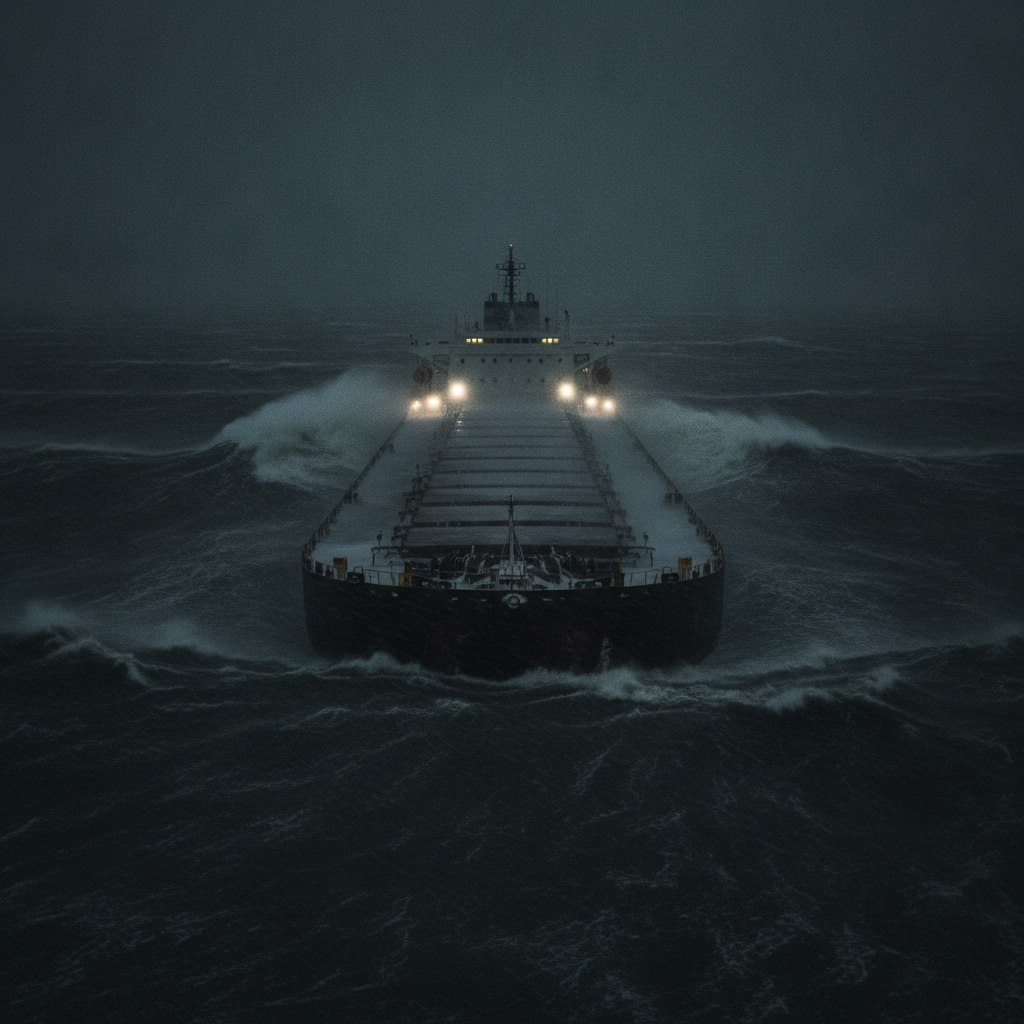
We Are Holding Our Own: The Last 10 Minutes of the Edmund Fitzgerald
On the afternoon of 9 November 1975, a cargo ship left a loading dock at the western end of Lake Superior, the largest of the freshwater lakes that sit on the border between the United States and Canada.
She was called the Edmund Fitzgerald. She was 222 metres long and 23 metres wide, and when she was launched in 1958 she was the biggest ship on those lakes. Crews called her the Big Fitz.
In her holds were about 26,500 tonnes of iron ore pellets, bound for a steel mill at the other end of the waterway. There were 29 men aboard.
A weather warning was already out. That is normal for November on these lakes, and both the Fitzgerald and a second freighter that left around the same time chose to take a northern course, close to the Canadian shore, where the land would break the wind.
The two ships stayed in radio contact through the night and into the next day. The storm grew instead of passing.
By the afternoon of 10 November the wind was gusting to around 139 kilometres per hour and the waves were running between 7 and 11 metres.
At about half past three that afternoon, the captain of the Fitzgerald called the other ship. He said he had lost two vent covers and a section of fence rail, and that the ship had developed a list. He said he was slowing down so the other freighter could close the distance behind him.
He also said something that stayed with everyone who heard it. He had pumps running.
Here is the mystery in one sentence, before the rest of the story. A 222 metre ship carrying 29 men sank in under ten minutes in one of the most heavily monitored bodies of water in the world, with another ship watching her on radar, and nobody sent a distress call or launched a lifeboat.
Two blind ships in a storm
Within an hour the situation got worse in a way that is easy to overlook.
Both of the Fitzgerald's radar sets failed.
That left the ship running through a storm at night with no way of seeing where she was. The captain asked the other freighter to track him and tell him where he was going. For the rest of the evening, the ship behind him was his eyes.
The Fitzgerald was heading for Whitefish Bay, a sheltered corner at the eastern end of the lake. There was a radio beacon and a light there that ships use to find the entrance. Both were out of service that night because of the storm.
So the largest ship on the lake was running for shelter she could not see, guided by a voice on the radio.
Around seven in the evening the snow closed in and the other freighter lost sight of her lights.
At about ten past seven the two ships spoke for the last time. The other captain asked how the Fitzgerald was doing.
The answer was: we are holding our own.
**That is the last thing anybody heard from the Edmund Fitzgerald. Everything after this point is reconstruction.**
Minutes later the Fitzgerald was no longer on the other ship's radar. There was no mayday. No flare. No emergency radio beacon. Nothing on the surface.
The search
The other freighter turned around and went back into the storm to look, which took real courage, because the same waves were still running.
Aircraft and other vessels joined through the night and the following days. What they found was debris: broken lifeboats, life rings, an inflatable raft, propane tanks. Both lifeboats were recovered, badly damaged and empty.
Nobody was found. Not one of the 29 men was ever recovered.
That last fact has a cold physical explanation. The water in that lake stays close to freezing below the surface. Bodies that go down there do not usually come back up.
On 14 November, four days after the sinking, an aircraft carrying equipment that detects large masses of metal picked up a strong signal about 27 kilometres from the mouth of Whitefish Bay.
The Fitzgerald was lying in 160 metres of water. She was in two pieces. The bow section was sitting upright on the bottom. The stern section was lying upside down, about 50 metres away, turned at an angle. Between them was a field of spilled iron ore and wreckage.
What the wreck showed, and what it did not
An unmanned submersible surveyed the wreck in 1976. Later expeditions filmed it again in the 1980s and 1990s.
The pictures showed that several of the hatch covers over the cargo holds were missing or bent inward. Some of the steel frames around the hatch openings were fractured.
That sounds conclusive. It is not, and this is the heart of the argument that has gone on for 50 years.
A ship that hits the bottom at 160 metres, breaks in half, and dumps 26,500 tonnes of ore does enormous damage to herself in the process. A bent hatch cover on the lake floor may be the reason she sank, or it may be the result of her sinking. The images cannot separate the two.
Divers in 1994 recorded more than 40 hours of video. One of them saw a crew member on the lake bed near the bow, in coveralls and a life jacket, which tells us at least one man knew the ship was in trouble and had time to put it on.
In July 1995, a diving team recovered the ship's bell and brought it up. A replica was left on the wreck in its place, engraved with the names of the 29 men. The families asked that the site then be left alone, and it is now protected.
Conclusions and Open Questions
Two official investigations reached two different answers, which is unusual.
**The hatch covers leaked, and the ship filled slowly.** This was the conclusion of the Coast Guard board in 1977. The clamps that hold the covers down were worn and not all fastened, so water washing over the deck could work its way in, hold by hold, until the ship no longer had the buoyancy to lift over a wave. The problem: the shipping companies rejected it angrily, because it puts the blame on the crew for not fastening clamps. It also sits badly with the fact that the captain reported his pumps were coping.
**The hatch covers collapsed suddenly under the weight of water on deck.** This was the conclusion of the national safety board in 1978, which formally disagreed with the Coast Guard. In this version the ship did not fill gradually. A wall of water landed on the deck, one or more covers gave way, and the hold flooded in seconds. The problem: it explains the silence, because there would have been no time to call. It does not explain why the ship was already listing hours earlier.
**She scraped an uncharted shoal earlier in the day.** The shipping association argued that the damage reported in the afternoon, the list and the lost vents, came from the ship touching bottom near a shallow patch on her northern route, and that she had been quietly taking water ever since. The problem: nobody has found the corresponding damage. The underside of the bow is buried in mud, so the one place that would settle the question cannot be examined.
**Two enormous waves hit her at the end.** The captain of the other freighter reported that around the critical time two waves large enough to bury his own deck passed his ship and travelled on in the direction of the Fitzgerald. The problem: it is one man's account of water in the dark, and it does not rule out any of the other explanations. It only supplies the final push.
**She broke in half on the surface.** Some of the 1994 divers concluded the hull failed while she was still afloat, from stress cracks and flexing that had been a known issue on that class of ship. The problem: the freighter behind her was watching her on radar and saw one target vanish, not two.
What everyone agrees on is small: she was damaged, she was listing, she was blind, and then she was gone in less time than it takes to send a radio message.
What nobody can say is which of those things killed her.
Fifty years on, the Edmund Fitzgerald is the best documented shipwreck on the Great Lakes and still the least explained. The lake gave up the ship's position in four days, its photographs in one year, and its bell in twenty. It has never given up the reason.