The Physicist Who Bought a Ticket and Never Arrived: The Vanishing of Ettore Majorana
Ettore Majorana was born in Catania, Sicily, on 5 August 1906, into a prominent and highly educated family. His uncle Quirino Majorana was himself a physicist of standing. As a child Ettore was known for prodigious mental arithmetic, and in 1923 he enrolled in engineering at the university in Rome. In 1928, persuaded by his fellow student Emilio Segre, he transferred to physics.
He joined the group that Enrico Fermi had gathered at the Institute of Physics in Via Panisperna, the young researchers remembered ever since as the Via Panisperna boys. Majorana took his degree in 1929 with a thesis on the quantum theory of radioactive nuclei. Colleagues described a man who did his hardest work in his head, scribbled the result on the back of a cigarette packet, and threw the packet away once the answer satisfied him. Fermi, who was not given to flattery, is reported to have said that scientists fall into several categories, and that beyond the very good ones there are the geniuses, like Galileo and Newton, and that Majorana was one of these.
In 1932 the physicists Irene and Frederic Joliot-Curie published results from bombarding beryllium with alpha particles. Majorana read them and concluded that the radiation they had produced was not a form of gamma ray at all but a previously unknown neutral particle of roughly the mass of the proton. Fermi urged him to publish. He refused, saying the work was not worth printing. Later the same year James Chadwick in Cambridge announced the discovery of the neutron, and in 1935 he received the Nobel Prize for it.
Early in 1933 Majorana travelled to Leipzig on a research grant and worked with Werner Heisenberg on nuclear forces. The two became friends and his contribution to the theory of exchange forces still carries his name. He went on to Copenhagen and to Niels Bohr.
After returning to Rome he withdrew. For roughly four years, from 1934, he rarely appeared at the institute, worked at home, saw few people and published almost nothing. He suffered from gastritis, ate very little, and those close to him described a man who had turned inward. The notebooks recovered after his disappearance show that he had never stopped working; he simply stopped showing anyone the results.
In 1937 he published his last paper, a symmetrical theory of the electron and the positron. It contained an idea that has outlived everything else he wrote: that an electrically neutral particle could be identical to its own antiparticle. Such particles are called Majorana fermions, and physicists are still looking for them, in neutrino experiments and in the behaviour of certain solid-state systems. In November 1937 he was appointed full professor of theoretical physics at the University of Naples without sitting a competition, on the grounds of high renown of singular expertise. He began lecturing in January 1938 to a very small class.
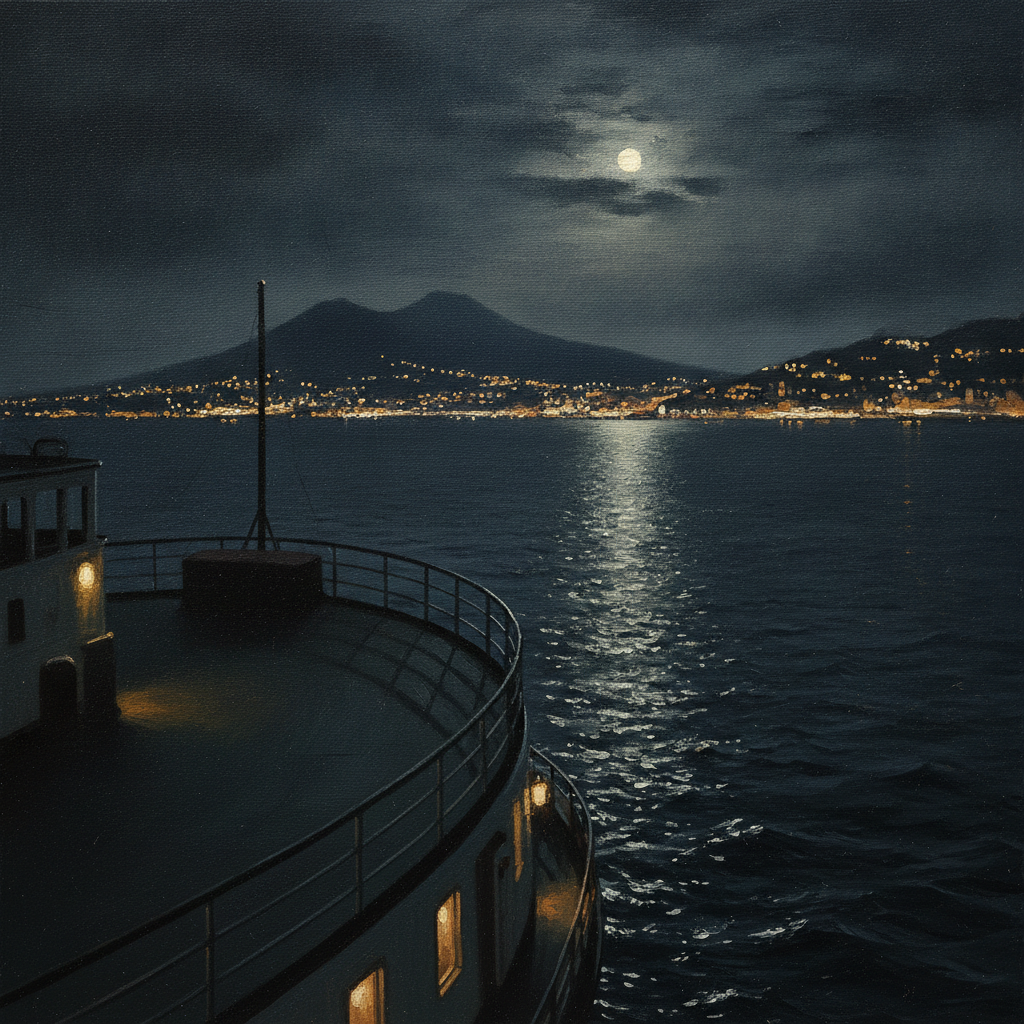
In the third week of March 1938 he settled his affairs. He collected the money that the institute was holding for him, several months of accumulated salary, and he took his passport. On the evening of Friday 25 March he left two letters. One was addressed to Antonio Carrelli, director of the Naples physics institute. The other was for his family. He then boarded the ten thirty steamer of the Tirrenia line from Naples to Palermo.
The letter to Carrelli reads in part: "I made a decision that has become unavoidable. There isn't a bit of selfishness in it, but I realize what trouble my sudden disappearance will cause you and the students." He asked to be remembered to his colleagues, adding that he would keep a fond memory of them all at least until eleven that night, possibly later too. The letter to his family asked them not to go into mourning for more than three days.
On Saturday 26 March a telegram from Palermo reached Carrelli, telling him not to be alarmed and that a letter would follow. The letter came the next day, written on the headed paper of the Grand Hotel Sole in Palermo. In it Majorana said that the sea had refused him, that he would be back in Naples the following day at the Hotel Bologna, and that he no longer stood behind what he had written the day before. He added that he intended to give up teaching.
That same day he bought a ticket for the return crossing and boarded the ferry from Palermo to Naples on the night of 26 March. The ship docked in Naples on the morning of Sunday 27 March. Ettore Majorana did not appear at the Hotel Bologna. He did not return to the institute. He was thirty-one years old, and from that morning there is no confirmed sighting of him anywhere.
The alarm was raised within days. Carrelli contacted the family, his brother Salvatore travelled to Naples and Palermo, and the Majorana family placed a reward of thirty thousand lire for information. Fermi wrote to Benito Mussolini asking that the search be pressed, and the police did search: hotels, hospitals, ports, and monasteries, including Carthusian houses in Calabria and Sicily. Nothing was found. No body was recovered from the sea, and no unidentified body brought ashore in that period was ever matched to him.
The investigation of 1938 produced no answer, and the file went quiet for decades.
In 1975 the Sicilian writer Leonardo Sciascia published a short book, The Disappearance of Majorana, which returned the case to the public. Sciascia rejected suicide and argued that Majorana had chosen to vanish, retreating into a religious house, and suggested that he had foreseen where nuclear physics was heading and wanted no part in it. His former colleagues Edoardo Amaldi and Emilio Segre publicly disputed the reconstruction.
The case was reopened in a formal sense in March 2011, after a witness who appeared on the Italian television programme Chi l'ha visto? said he had known Majorana in South America after the war. The Rome prosecutors examined the account. In June 2011 the forensic unit of the Carabinieri compared a photograph taken in 1955 in Venezuela with images of Majorana and reported ten points of similarity between the two faces. On 4 February 2015 the Rome prosecutor's office closed the case with a formal statement: Majorana had been alive between 1955 and 1959 in the city of Valencia, Venezuela, where he used the name Bini; his disappearance had been a personal choice; no crime had been committed. In January 2025 a Rome civil court issued a decree of presumed death, fixing the official date at 25 March 1938.
Conclusions and Open Questions
Eighty-eight years after the ferry docked, there is no body, no confession, no document written by Majorana after March 1938 and no agreement about what happened. The competing readings are worth setting out with the objection each of them carries.
Suicide is the oldest reading and was held by colleagues including Edoardo Amaldi and Emilio Segre. It takes the letters at face value: a farewell to his director, a request that his family not mourn him for long, a night crossing, a man in poor health who had withdrawn from the world for four years. Its weakness is everything that happened on 26 March. He sent a telegram telling Carrelli not to worry, wrote that the sea had refused him, booked a hotel room for his return and bought a ticket back. He was also carrying his passport and a large sum of money, which serve no purpose to a man about to go over the side.
The monastic reading was argued most influentially by Leonardo Sciascia in 1975 and was favoured by parts of his family and by clergy who knew him. It fits a devout Catholic who had already spent four years in retreat from ordinary life. Its weakness is that no religious house has ever produced a record, and the further claim that he foresaw nuclear weapons and fled from them is not supported by anything in his surviving papers. Amaldi and Segre, who had worked beside him, rejected it.
Voluntary emigration is the reading that Italian prosecutors adopted in 2015, drawing on earlier work by the physicist Erasmo Recami, who had reconstructed a possible move to Argentina, and on the Venezuelan testimony. It explains the money and the passport better than any other theory. Its weakness is evidentiary. The conclusion rests on a witness account given more than fifty years after the fact and on a photographic comparison, not on a birth record, a signature, an entry stamp or a single line written in Majorana's hand. No official document has ever tied the name Bini to Ettore Majorana.
Some argue for something darker: that a man of his ability was taken, or persuaded to leave, in a Europe that was one year from war and a few years from the atomic bomb. One theory holds that he was working on problems that others wanted. Its weakness is that nothing of the sort has ever surfaced in any archive, Italian, German or American, in nearly nine decades.
There is also the strangest reading of all, the story of a vagrant in Sicily known locally as the dog man, said to solve mathematical problems put to him by students. It was never tested while he was alive and no identification was ever made.
What remains unexplained is the shape of the last forty-eight hours. Why write two farewell letters and then cancel them. Why take a passport to a suicide. Why buy a return ticket to a city he had just told his director he was leaving. Why the sea, in a busy channel, gave nothing back.
The open questions are simple and have not moved in decades. Was the man photographed in Valencia in 1955 Ettore Majorana, and if so how did he get there and who helped him. Did anyone in Naples or Palermo know at the time and stay silent. And if he did choose to disappear, what did one of the finest minds of his generation decide was worth leaving behind, and did he ever regret it.