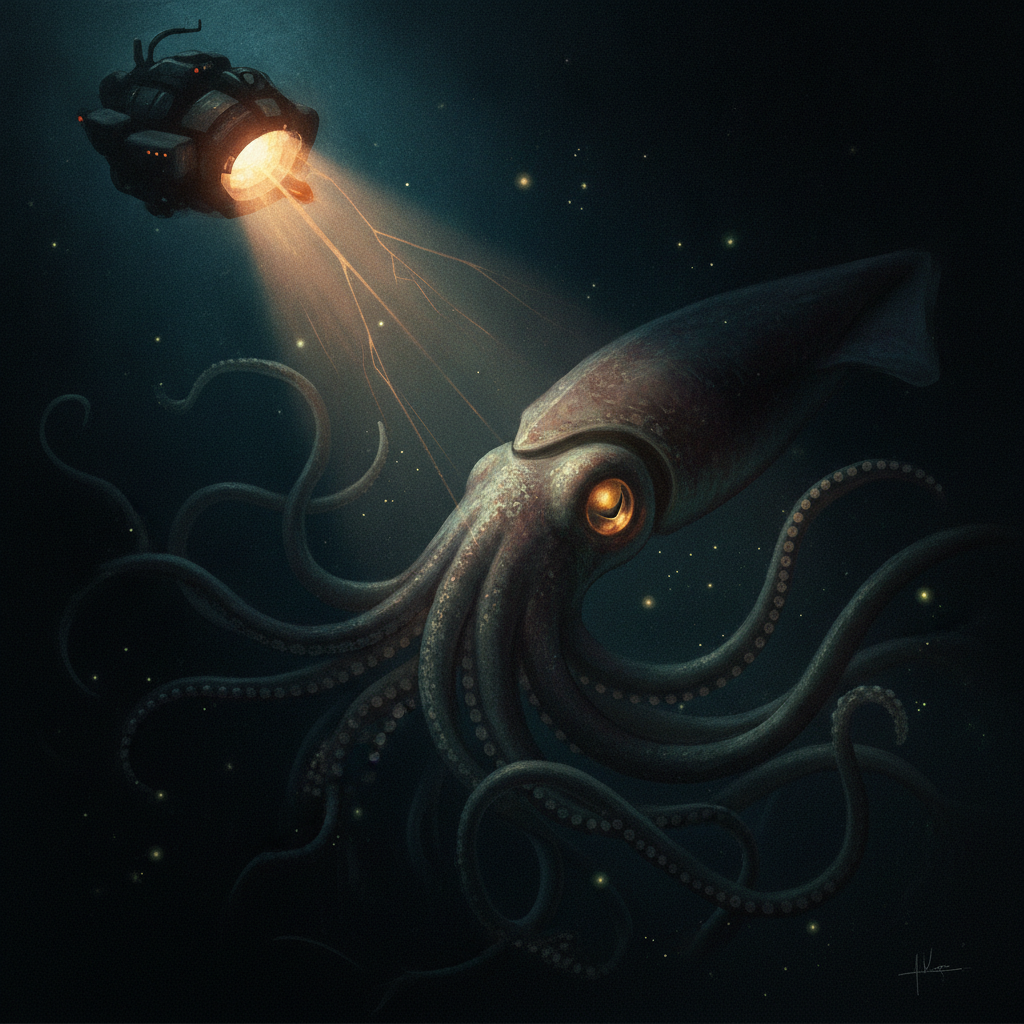
The Kraken Was Real: How the Giant Squid Left Legend for the Record Books
For most of recorded history the largest invertebrate in the ocean existed only as a story. Aristotle wrote of a great teuthos off the Greek coast, and Pliny the Elder described a monster that raided the fish tanks of Roman Spain. But it was in the cold north that the beast took its enduring shape. For centuries the kraken shared a shelf with the mermaid and the sea serpent, a mountain of arms and suckers that rose from the deep to drag a ship under or swamp it in the whirlpool of its own diving.
In 1755 the Norwegian bishop Erik Pontoppidan set the creature down in his Natural History of Norway as the largest and most surprising of all creation, round and full of arms, so vast that fishermen mistook its back for an island. He traced the tale to older Icelandic accounts of the hafgufa, the sea-mist monster. Carl Linnaeus, the great cataloguer of life, had briefly listed the kraken among the cephalopods in an early edition of his Systema Naturae before quietly deleting it. Alfred Tennyson made a poem of it in 1830, a beast sleeping its ancient dreamless sleep on the sea floor until the end of the world.
The first close encounter that reached the scientific record came on 30 November 1861, off the volcanic peaks of Tenerife. The lookout aboard the French corvette Alecton called out that a large body lay half submerged on the surface. Her captain, Frederic Bouyer, brought the ship around and found himself staring at what he would later call a gigantic squid, a reddish mass of writhing arms with two enormous eyes fixed on the vessel. For roughly three hours the crew fired their cannon and drove harpoons into the rubbery flesh, and for three hours the animal dived and surfaced again. At last they worked a noose around its body and heaved, but the weight was so great that the rope cut through the soft tissue. Only the tip of the tail came aboard, a fragment the captain reckoned at some fourteen kilograms. The rest sank back into the black water. Bouyer sent his account to the French Academy of Sciences, where it met the polite scepticism reserved for sailors who had spent too long at sea.
The reckoning came off Newfoundland in the 1870s, when a run of large squid stranded on the shore or fouled the nets of fishermen. In late 1873 a clergyman and amateur naturalist in St John's, the Reverend Moses Harvey, bought a dead specimen from fishermen who had hacked at it in their boat, draped it over a sponge bath and a curtain rail, and had it photographed, producing what is regarded as the first photograph of a giant squid. Those remains, and others like them, reached the American zoologist Addison Emery Verrill at Yale, who described the animal in exacting detail and fixed the legend with a Latin name that has held ever since: Architeuthis. On that same coast, at Thimble Tickle Bay in 1878, a squid often cited as the largest reliably reported was said to have stranded, its body and tentacles together spanning many metres, although the measurement was taken in haste and by no anatomist. Jules Verne had already sent one to attack the Nautilus in his novel of 1870. Now the fiction had a body on a dissecting table.
What the specimens revealed needed no embellishment. The giant squid carries the largest eyes known in the animal kingdom, up to about twenty-seven centimetres across, the size of a dinner plate, tuned to catch the faintest glimmer in a lightless sea. Researchers believe it perceives not colour but the subtlest gradations of tone, and perhaps the glow of large predators disturbing luminous plankton. Its body stays aloft on a solution of ammonium chloride lighter than seawater, which is also why the flesh reeks of ammonia and why it has never fed a fishery. Its eight arms and two long feeding tentacles are lined with toothed, ringed suckers, and their marks turn up as circular scars on the skin of sperm whales. Strangest of all, the animal's throat runs directly through the middle of its brain, so that it must swallow its food in small pieces.
In 2013 geneticists at the University of Copenhagen compared tissue from dozens of specimens gathered around the globe and found the animals so nearly identical, just 181 differing base pairs out of more than 20,000, that they form a single worldwide species, mingling across oceans in a way that is not yet understood.
Almost everything known about how the animal lives came from its chief predator. Sperm whales dive beyond a thousand metres and surface with rings and rakes scored into their skin, and their stomachs hold thousands of indigestible squid beaks. From that grim census biologists have estimated how many giant squid the oceans must hold to feed the whales that hunt them, and the figures run into the millions, a population no one has ever counted alive.
For all of this, no one had seen a living giant squid in its own world. Every specimen was dead or dying: netted, stranded, hauled up limp or found rotting at the surface. That wall stood until this century. On 30 September 2004 the Japanese researchers Tsunemi Kubodera and Kyoichi Mori, reasoning that the surest way to find the squid was to shadow the whales that ate it, lowered a baited camera line about 900 metres down over a whale ground near the Ogasawara Islands, far south of Tokyo. An animal some eight metres long seized the bait. The camera fired more than five hundred frames across four hours as it struggled, and when it finally tore free it left a five-and-a-half-metre tentacle behind, still gripping the line. Those were the first images of a live giant squid anywhere on earth.
In 2012 a team including Kubodera and the American marine biologist Edith Widder captured the first video of one in the deep near the same islands. Widder's lure was an electronic device known as an e-jelly, which mimicked the spinning blue distress flash of an Atolla jellyfish, a signal that in nature means a larger meal is under attack. In June 2019 a team funded by NOAA filmed another, a juvenile, at 759 metres in the Gulf of Mexico, the first ever recorded in United States waters.
The creature is therefore real, named, dissected, sequenced and filmed. The confirmed length record stands near thirteen metres including the outstretched tentacles, well short of the twenty metres and more that sailors swore to, and even that figure rests largely on elastic tissue that stretches after death.
Conclusions and Open Questions
The giant squid is one of the few monsters that walked out of the bestiary and into the catalogue, and yet the questions that remain are about the two things hardest to measure: how big it grows and where the legend came from.
The first reading, argued by many marine biologists, is that the giant squid itself seeded the kraken myth. On this account a genuine animal, glimpsed on the rare occasions it surfaced sick or dying, was magnified by terror and a thousand retellings into a ship killer. Its strength is that the creature demonstrably exists and reaches enormous size, so the legend needs no supernatural spark. Its weakness is that there is not one documented case of a squid pulling down a vessel, so the ship sinking core of the story remains unproven.
A second reading holds that the true giants exceed the record books. One theory argues from the beaks pulled from the stomachs of sperm whales, some of which are larger than the beaks of any squid ever measured whole, from nineteenth century strandings measured hastily on beaches, and from the ammonia-light flesh that lets a carcass drift, bloat and shrink for days before anyone lays a tape to it. Its weakness is equally plain: a claim resting on fragments and inference is not a measured animal, and in a century and a half no successor of Verrill has confirmed a squid of twenty metres.
There is a third caution, quieter but important. The giant squid is routinely confused with the colossal squid, a separate, heavier, hook-armed species of the Antarctic deep that can outweigh it several times over. Some argue that a share of the historic monster reports described the one while meaning the other, or described neither and recorded only the fear of the observer.
What remains unexplained is a short list. No verified specimen has ever approached the sailors' twenty metres, yet oversized beaks keep appearing in whale stomachs. The only population estimates in existence are drawn from counting the digested dead. And the ordinary life of the animal, how it hunts, how it mates and how it dies, has never been observed, because every encounter so far has been with a carcass or with a bait line.
Some argue that the deep still holds size classes met so far only as scars on whales and beaks in their bellies, animals that live too far down and die too far from land to reach a laboratory scale intact. That would explain the gap between the sailor's twenty metres and the scientist's thirteen without requiring anyone to have lied. It is a theory and nothing firmer, since the honest position is that the upper bound of a creature filmed alive only a handful of times is unknown.
The open questions follow. How large does Architeuthis really grow, and what animal produced the largest beaks? How many share the ocean with us? Did a giant squid ever truly seize a ship, as Bouyer half believed his had tried to seize the Alecton, or did the myth borrow the arms and invent the malice? And how much of the deep ocean has to be filmed before the record can be called closed?