Glen and Bessie Hyde: The Honeymooners Who Vanished in the Grand Canyon
On Sunday, 18 November 1928, a wooden boat pushed off from a sandy beach at the bottom of the Grand Canyon.
On board were 2 newlyweds. Glen Hyde was 29. Bessie Hyde was 22. A passenger who had ridden with them for a few kilometres stepped ashore and watched them go. The boat swung out into the current and disappeared around a bend.
Nobody ever saw them again.
A month later a search plane found the boat. It was floating upright, undamaged, with its supplies still tied down. Bessie's diary was on board. Their coats and hiking boots were on board.
The couple was gone.
This is the story of Glen and Bessie Hyde, the honeymooners who vanished in the Grand Canyon. Their boat was found. Their bodies never were. Almost 100 years later, nobody knows exactly where, when or how they died.
A honeymoon on the river
The Grand Canyon is a huge gorge in the state of Arizona, in the south-west of the United States. The Colorado River runs along its floor, through dozens of violent rapids.
In 1928 very few people had travelled the whole canyon by boat. According to one account, only 45 people had done it. No woman ever had.
Glen was a farmer from Idaho, in the north-west of the country. He was an outdoorsman, and he had already run 2 wild rivers in his home state, in 1926.
Bessie came from West Virginia, in the east. She had been a college student, and she wanted to study art. She had never been on a river like this.
They met in February 1927, on a passenger ship sailing down the coast of California. They married in April 1928, a day after Bessie's divorce from a short first marriage became final.
Glen had a plan for the honeymoon. They would run the Green River and the Colorado, all the way through the Grand Canyon. He wanted to set a speed record. And Bessie would become the first woman known to make the journey.
The boat
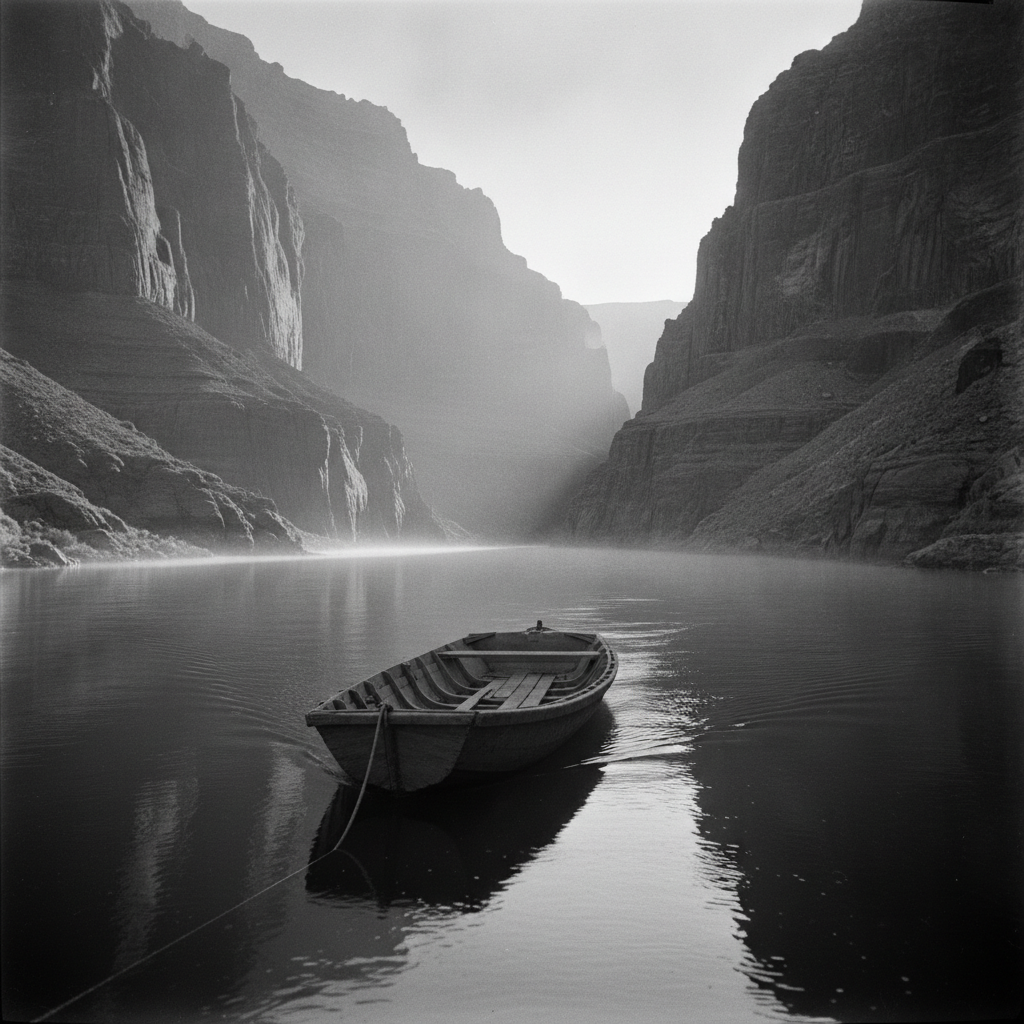
Glen built his own boat, the way it was done on the rivers of Idaho. It was a scow: a flat-bottomed wooden box, about 6 metres long, steered by long oars, called sweeps, at each end. It weighed about 1.8 tonnes. It was very stable, and very hard to turn.
They had no life jackets. Glen did not believe in them, and at the time many river men did not either.
On 20 October 1928 they launched the scow at the town of Green River, in the state of Utah, north of the canyon, and set off downstream.
Every day on the river, someone cut a notch into the side of the boat. One notch for each day.
The last stop
Almost 4 weeks later, in mid-November, the Hydes reached the middle of the Grand Canyon.
There, a trail climbs from the river to the canyon rim, where tourists come to look down. The couple tied up the boat and hiked up the trail to buy supplies.
On the rim they visited a photographer who ran a studio there.
He photographed the couple at the edge of the canyon.
He noticed 2 things, and he told them both later.
The first: they had no life jackets. He urged them to take some. Glen laughed and refused.
The second: Bessie did not seem to want to go back down. She seemed afraid. According to accounts of that visit, she said something that has been quoted ever since: "I wonder if I shall ever wear pretty shoes again."
On Sunday, 18 November, a passenger rode with them for a short stretch of the river, to a big rapid a few kilometres downstream. There he got off.
He was the last person known to have seen Glen and Bessie Hyde alive.
The silence
The Hydes had planned to finish their trip at the town of Needles, in California, at the far end of the canyon, by early December.
By 6 December they had not arrived. Glen's father did not wait. He started a search himself, and pushed the authorities to start one too.
The boat in the river
On 19 December the plane spotted something on the river, far downstream in the lower part of the canyon.
It was the scow. It was floating in a calm stretch of water, held by its rope.
It was about 225 kilometres downstream from where the couple had last been seen.
Searchers had to climb down to reach it. The photographer from the rim and his brother were among them.
The supplies were still tied down in place. The couple's coats were there. So were their hiking boots. So was Glen's gun.
There was about 30 centimetres of water in the bottom. No one could say whether it had splashed in from the rapids, or had been there all along.
The tow rope was hanging down into the river. The other end was stuck under the water on something the searchers could not see. They had to cut it to free the boat.
And on the side of the scow were the notches. There were 42 of them. One for each day on the river, counting from 20 October.
What the diary said
Bessie's diary was on board, and it was the most important thing in the boat.
The last entry was dated 30 November. In it, she wrote that they were ahead of schedule. She wrote that they had reached a place called Diamond Creek.
Diamond Creek is a side canyon on the river, about 20 kilometres upstream from where the boat was found.
There was also a camera on board. The searchers developed the film. The last photograph had been taken in the canyon, probably around 27 November.
So the record is clear up to the end of November. The couple was alive on 30 November. They had passed Diamond Creek, or reached it, and they were doing well.
The 42 notches suggest they were still cutting a mark on the boat on day 42, which is 1 December.
**After that, there is nothing. No entry, no photograph, no witness. From here on, nobody knows what happened to Glen and Bessie Hyde.**
The searchers combed the shores below Diamond Creek. They looked for footprints, for a campfire, for a body caught in the rocks. They found nothing.
The search was called off. The canyon kept its secret.
The woman on the raft
In 1971, a group of tourists was rafting down the Grand Canyon.
One of them was an elderly woman. During the trip, the story of Glen and Bessie Hyde came up.
The woman spoke up. She said she was Bessie. She said Glen had been a cruel husband, that they had fought, and that she had stabbed him and walked out of the canyon to start a new life.
The woman took it back almost immediately. Later checks showed she could not have been Bessie. She was born in 1908 in Ohio, she was about 10 centimetres taller than Bessie, and her records were in order. She died in 1998.
The skeleton in the garage
The strangest twist came after the photographer died, at the end of 1976.
He had lived on the canyon rim for decades. After his death, a human skeleton was found in his garage.
The skull had a bullet hole.
The bones were those of a young man in his 20s, about Glen's height and build. Rumours exploded. Had the photographer, the man who warned them, been hiding Glen's body all those years?
Scientists examined the bones. Laboratory tests in 1985 concluded that the skeleton was not Glen's. A study at a university in Arizona found it belonged to a man who died no earlier than 1932.
In 2008 the mystery of the skeleton was finally closed. Records and photographs linked it to an unidentified man who shot himself in 1933. The photographer had probably kept the bones after serving on a coroner's jury. Why he kept them, nobody knows.
Conclusions and Open Questions
What is documented: the couple was alive on 30 November 1928, near Diamond Creek. Their boat was found intact, about 20 kilometres further downstream. They were never seen again.
**They fell into the river at a rapid, and drowned.** This is what most historians believe. A river historian who studied the case for years argued that they were most likely thrown out of the boat near a rapid a few kilometres below Diamond Creek, where blocks of granite lie hidden under the water. Without life jackets, in a river that cold in winter, they would not have lasted long. The scow, heavy and stable, could have floated on by itself, with everything still tied down. The problem: no body was ever found. But the Colorado River in those years was wild and heavy with mud, and it did not return everything it took.
**They got out of the river, and tried to walk out of the canyon.** Glen's father believed this. He thought they had trouble with the boat, climbed out, and died lost in the side canyons. The problem: their coats and hiking boots were in the boat. In winter, nobody would set out to climb out of the Grand Canyon without them.
**One killed the other.** This is the theory behind the 1971 story, and behind some of the books and films since. The problem: the woman who told it recanted, her identity was checked, and there is no evidence of violence between the couple.
Why was the tow rope hanging in the river, snagged underwater? Was the boat tied up when they left it, or did it drift away from them?
And why, if they had reached calm water near Diamond Creek, did 2 people who had survived 41 days of rapids vanish within a day or two of the end of their journey?
The canyon has given no answer. The National Park Service has recorded dozens of other unsolved disappearances in the Grand Canyon since the 1950s. Glen and Bessie Hyde remain the most famous of them all.