Fifty Minutes Into the Fog: The Vanishing of Glenn Miller
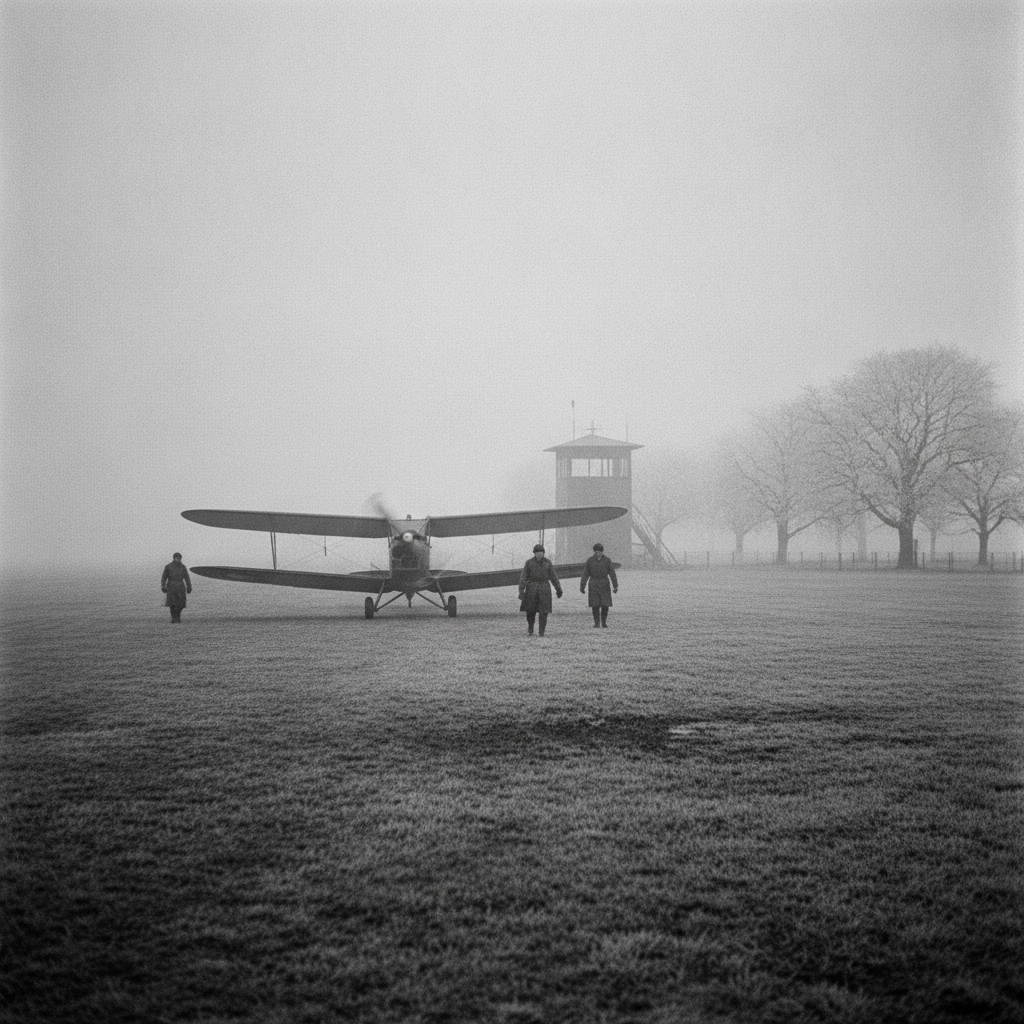
The fog at Twinwood Farm on 15 December 1944 was thick enough that nothing sensible was flying. The airfield sat in flat country north of Bedford, a scatter of huts and a control tower on the edge of a runway that disappeared into grey after a couple of hundred metres. Anyone standing there in the early afternoon would have heard an aircraft before seeing it.
The aircraft was a Noorduyn UC-64A Norseman, serial 44-70285, a single-engine high-wing utility machine built in Canada for bush flying. It carried three men. The pilot was Flight Officer John Morgan. In the cabin sat Lieutenant Colonel Norman Baessell, a supply officer with a reputation for getting places whatever the conditions. The third man was Major Alton Glenn Miller.
Miller was forty years old and, by most measures, the most commercially successful musician alive. In 1939 and 1940 his civilian orchestra had been inescapable: In the Mood, Moonlight Serenade, Chattanooga Choo Choo, Pennsylvania 6-5000. He was earning enormous money. In 1942 he broke up the band, gave up the income, and pushed his way into uniform at an age when nobody was asking him to serve.
What he built in the Army Air Forces was not a novelty. His band was a full string-augmented orchestra of professional musicians, and it worked relentlessly, playing to troops across Britain and broadcasting to a wartime audience in the millions. By late 1944 the plan was to move the whole operation to newly liberated Paris and put on a Christmas programme for the soldiers who had fought their way across France. Miller was flying ahead of his musicians to make the arrangements.
He had been trying to get across for days and the weather had refused to cooperate. Baessell was going, and offered him the seat.
There is a story, repeated by people who were at the field, that Miller looked around the small cabin and asked where the parachutes were, and that Baessell answered him with a joke about wanting to live forever. It may be exactly true or it may be the kind of line that attaches itself to a story afterwards. What is documented is the departure. The Norseman lifted off at about 13:55 and turned south.
Nobody noticed for three days
The Norseman never arrived in France.
The extraordinary part is how long it took anyone to react. Miller was travelling ahead of his unit, on an unscheduled flight, in the middle of a theatre of war. There was no fixed reception committee waiting to log him in. On 16 December, the day after he took off, the German army launched its offensive through the Ardennes, and for the next several weeks every staff officer in northwest Europe had something more urgent to think about than one missing passenger.
When the band flew into Paris on 18 December, its members found that their commander was not there and had not been there. Only then did it become clear that the aircraft was gone.
The public announcement came on Christmas Eve, and it went around the world within hours. Miller was listed as missing. He was later officially declared dead.
Nothing was ever recovered. No wreckage was identified, no bodies were found, no crash position was ever established. There was no distress call. Over the English Channel in December, a light aircraft that goes into the water leaves almost nothing, and there was no organised search at the time because nobody knew where or when to look. Eighty years on, the physical evidence in this case consists of a departure time, three names and an empty stretch of sea.
The theories, and how they have held up
The absence of a wreck has been filled by argument.
The oldest and least interesting explanation, which is also the one most historians now hold, is that the flight simply went wrong. The Norseman was not equipped for the conditions. Its carburettor was known to be prone to icing in exactly the kind of cold, wet air the aircraft was flying through, and the machine had no meaningful de-icing capability. Morgan was flying low, under cloud, in poor visibility. If an iced carburettor starves the engine at a few hundred feet over winter water, the pilot has a handful of seconds and nowhere to go.
The most dramatic explanation surfaced four decades later. In the mid 1980s a former Royal Air Force navigator named Fred Shaw came forward with an account of a mission on 15 December 1944. His Lancaster, part of a large force, had been sent to attack Siegen in Germany and the raid was aborted. Bombers do not land carrying live bombs if they can avoid it, so the aircraft jettisoned their loads into a designated dumping area over the Channel on the way home. Shaw said he looked down through the aircraft and saw a small high-wing monoplane fall into the sea.
The British aviation researcher Roy Nesbit took the account seriously, worked through the records, and published a reconstruction concluding that Miller's Norseman had flown under the jettison area at the wrong moment and been destroyed by falling ordnance or by the blast. For years this was the accepted answer in Britain. It had everything: an eyewitness, a documented raid, and a horrible accidental symmetry.
It has since been challenged in detail. Dennis Spragg of the Glenn Miller Archive at the University of Colorado Boulder went back through American and British operational records for his 2017 study Glenn Miller Declassified, and argued that the timings do not work. His central point is technical and, if correct, decisive: Allied air forces in the winter of 1944 and 1945 were operating on a single time standard, British Summer Time, under directives from Supreme Headquarters, and the earlier reconstruction had shifted the RAF times by an hour. Once the clocks are aligned, according to Spragg, the bombers were already back at their bases by the time the Norseman was out over the water, somewhere between about 14:45 and 15:00, and Miller's aircraft never entered the jettison zone at all.
A third story has circulated for decades and refuses to die: that Miller reached Paris safely and died there, of a heart attack or by violence, in circumstances the Army preferred to conceal, and that the flight was invented as cover. It is a good rumour and it has no documentary support. There are witnesses to the takeoff at Twinwood, there is a paper trail for the aircraft and its crew, and two other men, Morgan and Baessell, disappeared alongside him and have families who were told the same thing.
Conclusions and Open Questions
What is beyond dispute is small. Three men took off from Twinwood Farm at about two o'clock on the afternoon of 15 December 1944 in weather that most people would not have flown in. They did not arrive. Nothing of them or of the aircraft has ever been recovered.
The mechanical explanation is now the mainstream position, and its strength is that it requires nothing unusual. A type with a known icing weakness, no de-icing equipment, a low cruise under cloud, and freezing damp air are a familiar and sufficient combination, and light aircraft were being lost in that theatre in that weather without anybody writing books about them. Its weakness is that it is entirely inferential. There is no wreck to examine, no engine to strip down, and no way to demonstrate that this is what happened rather than what usually happens.
The bomb jettison theory has the only eyewitness in the case, and Fred Shaw appears to have been describing something he genuinely believed he saw. That is its strength, and Roy Nesbit's reconstruction was serious work built on real records rather than speculation. Its weakness is the timing analysis published by Dennis Spragg, which if accepted removes the aircraft from the area entirely. Spragg's account is now widely accepted by historians and by military archives, though it is worth noting that overturning a witness statement on a clock-setting argument, however well documented, is the kind of correction that is hard to test independently forty years after the fact.
The Paris cover-up story has essentially nothing behind it beyond its own appeal, and it is contradicted by the ordinary paperwork of a wartime flight and by the fact that two other families lost men on the same aircraft.
The open questions are practical ones. No search of the Channel has ever produced an identifiable Norseman. Several claimed sightings and snagged wrecks have been reported by fishing crews over the decades, none confirmed. Without a hull number recovered from the seabed there is no way to distinguish between an engine failure, an airframe icing event, pilot disorientation in cloud, or something else entirely.
And there is a question that has nothing to do with aviation. Miller was at the peak of a career that had made him rich, and he walked away from it at thirty-eight to organise music for soldiers. He was not required to be in that aeroplane, in that weather, on that day. He was going ahead of his band to make sure the Christmas broadcast happened. The most likely reason the world lost him is that he was in a hurry to get to work.