The Hill That Should Not Exist: Göbekli Tepe and the Temple Built Before Farming
The limestone ridge north of the Syrian border is not much to look at. In summer the wind comes off the Harran plain carrying dust, and the mulberry tree at the top of the mound gives the only shade for a kilometre in any direction. Farmers around Şanlıurfa called the place Göbekli Tepe, Potbelly Hill, because of the way it swells out of the ridge line. They had been ploughing around it for generations and turning up lumps of worked stone that they broke up or pushed aside.
A joint American and Turkish survey team walked over the mound in 1963. They noted broken limestone slabs, decided the site was probably a medieval cemetery of no great interest, and moved on. The report sat in the literature for three decades.
In 1994 Klaus Schmidt, a German archaeologist who had been digging at nearby Nevalı Çori, read that report and went to look for himself. What the 1963 team had recorded as gravestones he recognised within minutes as something else entirely: the broken tops of enormous worked pillars, surrounded by the flint debris of the Stone Age. He is said to have understood on that first afternoon that he had two options, walk away, or spend the rest of his life on this hill. He chose the hill, and dug there every season until his death in 2014.
What came out of the ground
Excavation began in 1995 and quickly stopped making sense in terms of anything known about the period.
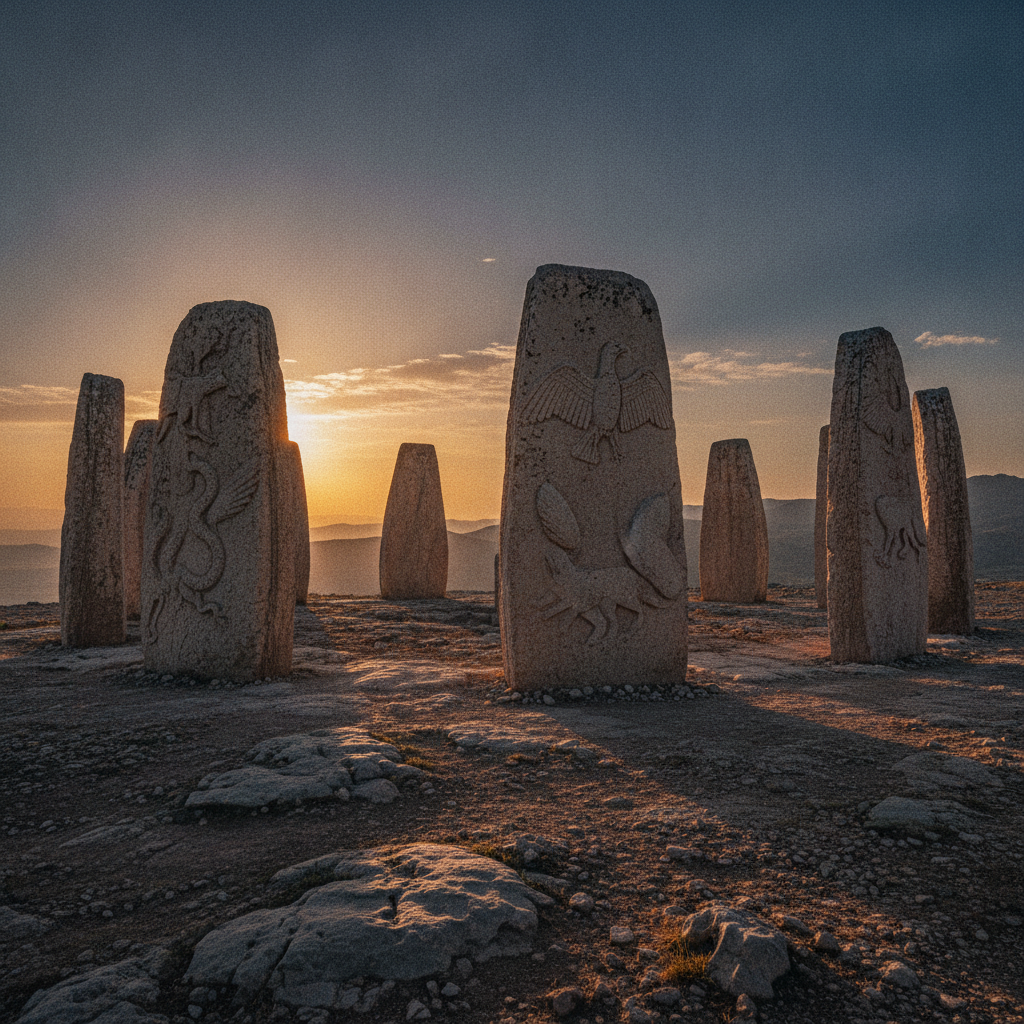
Under the mound sat rings of standing stones. The pillars are T-shaped, cut from the limestone bedrock of the ridge itself, set into sockets and linked by low stone walls and benches. The largest stand about five and a half metres tall and weigh in the region of ten tonnes. Each enclosure has a circle of smaller pillars around the wall and a pair of giants standing free in the centre, facing each other.
Those central pillars are not abstract. They have arms carved in low relief running down their sides, hands meeting over the stomach, fingers picked out in detail. They wear belts with buckles, and below the belt a fox-pelt loincloth. The flat top of the T is a head seen from the side, deliberately featureless. They are people, or something shaped like people, rendered at four or five times life size.
The surfaces around them carry a bestiary. Foxes with bared teeth. Snakes pouring down the stone in columns. Scorpions, wild boar, aurochs, cranes, ducks, a vulture with a wing held out like an arm. Some are in relief, some cut fully in the round and projecting from the shaft. Almost every animal depicted is dangerous, or a scavenger, or both. There are almost no images of the gentle herd animals whose bones fill the site's rubbish deposits.
Then came the dating, and with it the problem. Radiocarbon results from the oldest layer put construction in the Pre-Pottery Neolithic A, roughly 9500 to 8800 BC, with activity continuing on the hill for well over a thousand years afterwards. That is before pottery. Before metal. Before the wheel, before writing, before the domesticated sheep, before the first field of wheat was ever deliberately sown. It is around six thousand years earlier than Stonehenge and seven thousand years earlier than the pyramids at Giza.
The animal bones bear this out. Tens of thousands of them have been recovered, and in the early layers they are all wild: gazelle, aurochs, boar, red deer, wild ass, birds. Nobody who built these circles was keeping livestock. The plant remains are wild too.
Geophysical survey has mapped what is still buried. Ground-penetrating radar and magnetometry indicate at least fifteen further enclosures, and probably closer to twenty, in the unexcavated ground. After thirty years of digging, something like five percent of the site has been opened.
The question that split the field
Schmidt drew a conclusion that made Göbekli Tepe famous well beyond archaeology. In the early years the team found no hearths in the enclosures, no house floors, no domestic rubbish of the ordinary kind. What they found instead was monumental architecture, carved imagery and enormous quantities of butchered wild game.
His reading was that this was a sanctuary, a gathering place built and used by mobile hunting bands who lived elsewhere and came here periodically. And if that were true, it inverted the standard account of how civilisation began. The textbook order runs: agriculture produces surplus, surplus produces settled villages, villages produce leisure and hierarchy, and only then do people build temples. Schmidt proposed the reverse. First the temple, then the town. The need to gather, feed and coordinate large numbers of people at a ritual centre, he argued, was itself the pressure that pushed the region towards cultivating grain. It helps his case that the wild ancestors of einkorn wheat grow on the hills a short walk away, and that some of the earliest domesticated einkorn in the world comes from that immediate area.
Evidence for mass gathering did accumulate. The team excavated limestone vessels with capacities up to about 160 litres. Residue analysis on some of them found oxalate, a compound that forms when cereals are steeped in water, which is consistent with the malting of grain. Large-scale grinding installations were found as well. The picture that emerged was of feasting on a scale that would have required hundreds of people and a reason to bring them together.
Since Schmidt's death the reading has shifted, and it has shifted because of what later seasons found. Under the direction of Lee Clare, with Jens Notroff and colleagues at the German Archaeological Institute, the team has documented cisterns cut into the bedrock, water channels, quarry areas, and buildings of ordinary domestic scale packed in around the great enclosures. There are grinding stones in the thousands. Whatever else the hill was, people appear to have been living on it, at least seasonally.
The team has also complicated the most cinematic detail in the story. It was long said that the enclosures were deliberately backfilled by their builders, ritually buried at the end of their lives. Clare has argued that a substantial part of the fill is better explained as slope wash and the redeposition of debris from higher up the hill over a long period, with intentional filling playing a smaller role than first assumed. The evidence points both ways and the question is not settled.
Conclusions and Open Questions
What Göbekli Tepe proves is not in dispute. Societies without agriculture, without metal and without writing were capable of quarrying, carving, moving and raising ten-tonne monoliths, and of doing it repeatedly across centuries at a coordinated site. That alone rewrote a chapter of prehistory. What the place was for is a genuinely open argument.
One theory, Schmidt's, holds that it was a sanctuary in the strict sense, a purely ritual centre visited by people who lived somewhere else. Its strength is the sheer imbalance of the site: nobody invests that much labour in imagery of vultures and scorpions for practical reasons, and the early excavations really did find no ordinary settlement layer. Its weakness is that the later fieldwork found cisterns, small buildings and everyday tools that look very much like people staying put.
A second theory, argued most forcefully by the Canadian archaeologist E. B. Banning in 2011, holds that Göbekli Tepe was a settlement whose large buildings were communal houses rather than temples. Its strength is that it fits the newer evidence, and that at other Neolithic sites in the region special buildings sit inside villages rather than apart from them. Its weakness is that it does not explain why these particular structures were so vastly larger and more elaborate than anything domestic life required. The German team's current position sits between the two: ritual and daily life were probably interwoven, and the modern habit of separating a temple from a house may simply not map onto the Neolithic.
A third line of argument reads the enclosures as astronomical. Giulio Magli has proposed alignments connected to the rising of Sirius. Martin Sweatman and Dimitrios Tsikritsis of Edinburgh argued in 2017 that the animals on Pillar 43, the so-called Vulture Stone, encode constellations recording a comet impact, and Sweatman extended the claim in 2024 to a lunisolar calendar shared with nearby Karahan Tepe. The strength of this work is that the pillars are demonstrably arranged with care, and that the same motifs recur across the region. Its weakness is severe: the excavating team, in a formal published response, objected that the pillars were selected after the fact to fit the theory, that the enclosures were not all standing at the same time, and that there is no independent evidence the builders read these figures as star groups at all. The dispute has not been resolved in the astronomers' favour.
What nobody can currently answer is how a pre-agricultural society organised the labour. Quarrying, dressing and erecting a ten-tonne pillar is not a task for a hunting band of twenty people. It requires numbers, planning, food for the workers, and some form of authority or shared obligation strong enough to hold them there. Where those people came from, what brought them, who if anyone directed them, and what they believed they were building, are questions the hill has not yet answered. Roughly ninety-five percent of it is still underground.