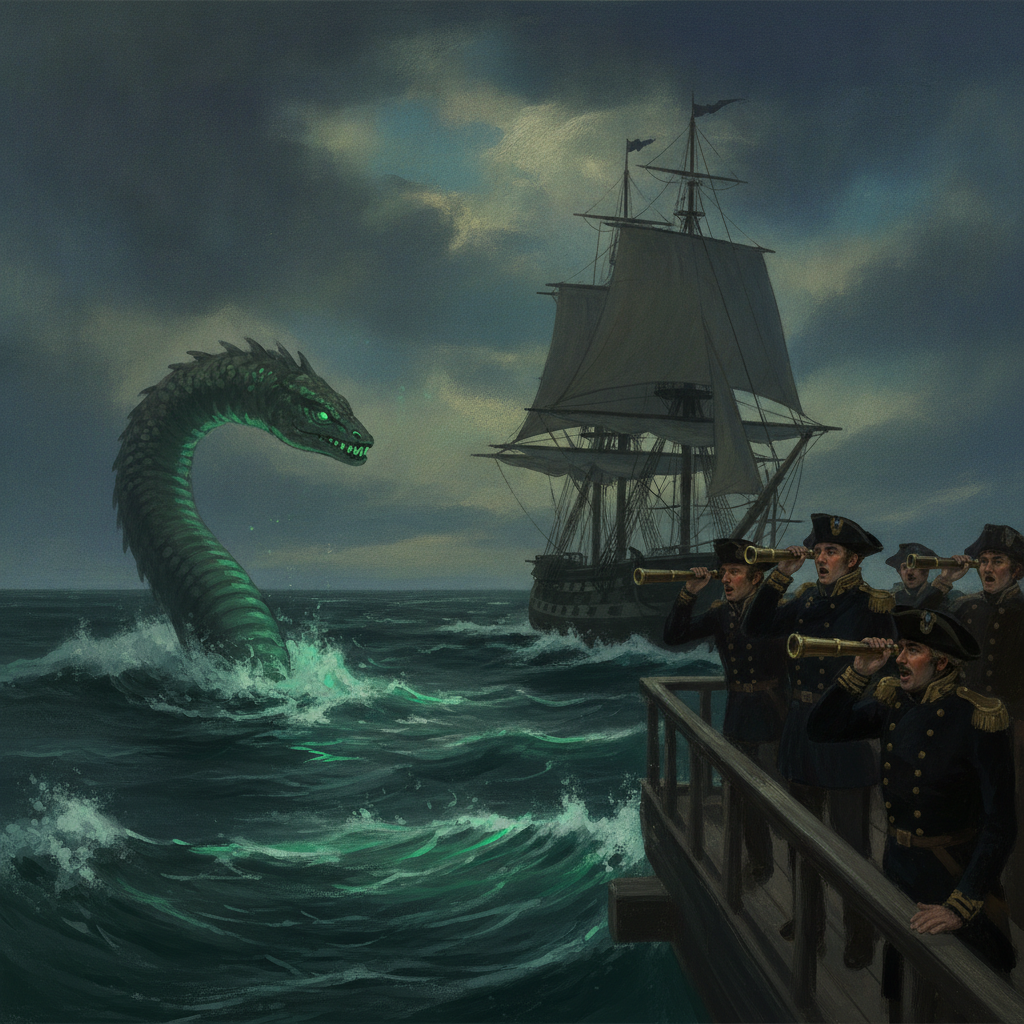
The HMS Daedalus Sea Serpent: A Royal Navy Captain's Monster That Was Never Explained
It was a little before five o'clock in the afternoon of 6 August 1848 when a midshipman aboard HMS Daedalus turned his head toward something in the water. The frigate was homeward bound from the East Indies, sailing up through the South Atlantic between the Cape of Good Hope and the island of St Helena, roughly three hundred miles off the coast of what is now Namibia. Her captain later fixed the position in writing with the flat precision of a man who wanted no argument about where he had been: latitude 24 degrees 44 minutes south, longitude 9 degrees 22 minutes east. The sea was moderate and the sky clear enough to see for miles. Moving toward the ship on a course as steady as a set of rails came a long, dark animal.
Within moments Captain Peter M'Quhae was at the rail. Around him gathered his first lieutenant, the sailing master, a midshipman, the boatswain and the quartermaster at the wheel. Seven men in all watched the animal for about twenty minutes in full daylight, with time to look and with their own ship beside them as a measuring stick.
The Admiralty asked M'Quhae to set down what he had seen, and he did so in the careful language of a naval report. The creature held its head and shoulders about four feet constantly above the surface. At least sixty feet of it lay flush with the water, and no part of that length, he insisted, was used to drive the animal forward by any undulation he could see. It simply came on. Behind the head the body was perhaps fifteen or sixteen inches thick. It was dark brown above, shading to a yellowish white about the throat, and along its back streamed something the captain compared to the mane of a horse, or to a mass of seaweed washing to and fro. The jaws, when the mouth showed, seemed full of large ragged teeth. It passed close under the lee quarter at what he judged to be twelve to fifteen miles an hour, near enough that had it been a man of his acquaintance he would have known the face.
The report did not stay inside the service. M'Quhae's letter to his superiors reached the press, and on 10 October 1848 The Times printed it, turning a frigate's after-action report into a national sensation. On 28 October the Illustrated London News followed with dramatic engravings of the creature rearing beside the ship, images drawn and then corrected under M'Quhae's personal supervision so that the reading public would see precisely what he swore he had seen, with nothing softened. For a serving captain of the Royal Navy to stake his professional reputation on a sea monster was, in that age of scientific confidence, close to reckless.
The answer came from the most formidable anatomist in Britain. Richard Owen was superintendent of the natural history collections at the British Museum and the man who, a few years earlier, had coined the very word dinosaur. Owen did not go to sea to check. He reasoned from his study that no such serpent could exist, and published the view that the officers had seen a large elephant seal, storm-driven far from the southern islands where such animals breed, its body low in the water and its wake mistaken for a trailing tail. It was, he wrote, a case not of a monster but of an honest error by men unschooled in zoology.
M'Quhae was unmoved. In a public reply, again in The Times, he rejected the elephant seal point by point, restated what his officers had recorded, and refused to let his account be quietly explained away. Neither man gave an inch, and the argument was never resolved between them. It hardened instead into a wider Victorian contest over who could be trusted to describe the natural world: the gentleman naturalist reasoning from specimens in a museum drawer, or the practical seaman who had actually been there.
Nothing was ever added to the physical record. No carcass washed ashore to end the debate. No second ship met the same creature and hauled a piece of it aboard. The evidence began and ended with what a handful of men wrote down in August 1848. The testimony itself, however, kept circulating. The Daedalus report became the most celebrated sea-serpent sighting of the nineteenth century precisely because it could not be waved aside as the tale of a superstitious deckhand, and it was cited and re-cited for decades. When the Dutch zoologist Antoon Cornelis Oudemans compiled his great catalogue of sea-serpent reports in 1892, and when the naturalist Bernard Heuvelmans revisited the whole tradition in the twentieth century, the Daedalus case stood near the head of the file.
One further document surfaced long after both M'Quhae and Owen were dead. Lieutenant Edgar Drummond, one of the officers at the rail that afternoon, had kept a private diary. His entry for 6 August was written for no newspaper and shaped for no audience, and it records the same animal, together with rough sketches made on the day he saw it. Drummond described a head long and pointed and flattened at the top, perhaps ten feet in length, with the upper jaw projecting, and put the creature's closest approach at about a hundred yards. His figures for speed matched the captain's almost exactly.
That is the whole of the case. Several trained officers, observing in clear daylight for twenty minutes, filed an official report through the chain of command. The report was published, illustrated under the captain's own eye, defended by him against the leading anatomist of the day, and corroborated decades later by a private diary and same-day sketches from a second witness who had nothing to sell. The engravings printed under his supervision fixed the image of the animal in the public mind for the rest of the century, and the position he recorded remains the only place on any chart where the thing has ever been. There is no specimen, no photograph, no bone and no second encounter. More than a century and a half later, the animal has never been identified.
Conclusions and Open Questions
Every candidate proposed since 1848 answers part of the description and then fails on the rest.
The leading modern explanation was argued in 2015 by the evolutionary biologist Gary J. Galbreath in the Skeptical Inquirer: a sei whale skim-feeding at the surface. A sei runs forty to fifty-five feet, close to the reported length; it is dark above and pale at the throat; and when it feeds it drives forward with its upper jaw angled clear of the water while the lower jaw and baleen stay submerged, so the head reads as long, flat and reptilian, and streaming water along the low ridges of the snout can pass, at a distance, for a horse's mane. It is a genuinely good fit for the shape and for the trailing mane. Its weakness is the witnesses. It asks us to believe that a wardroom of naval officers, men who had spent years at sea, watched a whale feed for twenty minutes and recognised nothing whale-like about it: no blow, no flukes, no roll.
Owen's elephant seal has the strength of being a real animal in the right ocean. Its weakness is scale and behaviour. It cannot be stretched to sixty feet, and it cannot hold a rigid straight course for a third of an hour without ever showing a flipper.
The arm of a giant squid, sometimes offered, might explain a long sinuous shape at the surface but not a head carried steadily four feet above it. An oarfish, or an unusually large eel of some unknown kind, honours the serpentine body but has to invent a species in order to do it. A line of drifting seaweed, or the half-rotted carcass of a basking shark trailing its decayed frame, has also been suggested: plausible for the mane, hopeless for four feet of head held above the swell.
Some argue that the answer is not zoological at all but a matter of viewing angle and of the observers themselves. On this reading, a familiar animal in an unfamiliar posture, seen bow-on and edge-on rather than in profile, would hide the very features that would have given it away, because bow-on there is no spout in view and no flank to roll, and the flukes stay under. One theory holds that the officers' own discipline worked against them: having measured and timed the thing so carefully, they trusted their precision and never entertained the humbler possibility. That reading cannot be tested. The observers are long dead, and the record cannot be re-examined.
What remains unexplained is narrower and harder than the choice between candidates. The animal never dived, never blew and never broke its line in twenty minutes of observation. If it was a whale, no officer recognised the spout that any of them would have known instantly. If it was a seal, a body of a few feet became sixty feet of visible length in the testimony of men who measured it against their own ship. And if they were simply mistaken, their two independent accounts still converged on the same peculiar details: the flat head, the projecting jaw, the mane along the back. Error is common at sea. Error that agrees this closely between separate witnesses is not.
The open questions are the ones the Admiralty never resolved. Was M'Quhae describing an animal science has since catalogued, or one it has not? Did the officers' training sharpen their observation or lock in their conclusion? And what would it take, at this distance in time, to close a file whose only evidence is careful testimony, honestly given and never withdrawn?