Joseph Newton Chandler III: The Man Who Lived 24 Years Under the Name of a Dead Child
On 30 July 2002, police in Eastlake, a small town on the shore of Lake Erie near Cleveland, Ohio, in the northern United States, opened the door of a rented apartment.
Inside was the body of a man in his 70s. He had shot himself with a revolver. Investigators believed he had been dead for about a week. The body was so badly decomposed that they could not take fingerprints.
There was no note.
The man's name, according to every document he owned, was Joseph Newton Chandler III. He was a retired engineer. His neighbours and former colleagues knew him as a quiet loner.
In his bank account was 82,000 dollars.
That money is what turned an ordinary death into one of the strangest identity cases in American history.
A judge looks for an heir
When someone dies with money and no will, a court has to find the family.
The man had listed no relatives. As emergency contacts he had given the names of co-workers. He had once mentioned a sister in Columbus, Ohio, and given her address. When anyone checked, the address turned out to be fictitious.
So the probate judge in charge of the estate hired a private investigator to find the next of kin.
The investigator started where anyone would start: with the name, the date of birth and the identity number that Joseph Newton Chandler III had used all his life.
He found a death certificate.
Joseph Newton Chandler III was born on 11 March 1937 in Buffalo, in New York state. On 21 December 1945, he was in a car with his parents. They were driving from Oklahoma to a town in Texas. About 3 km west of the town of Sherman, Texas, their car hit a truck head-on.
The boy and both his parents were killed. He was 8 years old.
Here is the whole mystery in one sentence: a man had lived for decades under the name of a child who died in 1945, and nobody knew who that man really was, or why he had done it.
The man without a past
Investigators began to piece together what they could about the man who had borrowed the boy's name.
The first trace of him under that name was in September 1978, in a city in South Dakota. That is when he took on the identity of Joseph Newton Chandler III.
Soon after, he moved to the Cleveland area. He worked briefly for a small company. Then he found a job at a large chemical company near Cleveland, and he stayed there for years.
The people who worked with him remembered a man who kept everyone at arm's length. He was polite but closed. He did not talk about his past.
He would sometimes disappear for days or weeks at a time, without explanation.
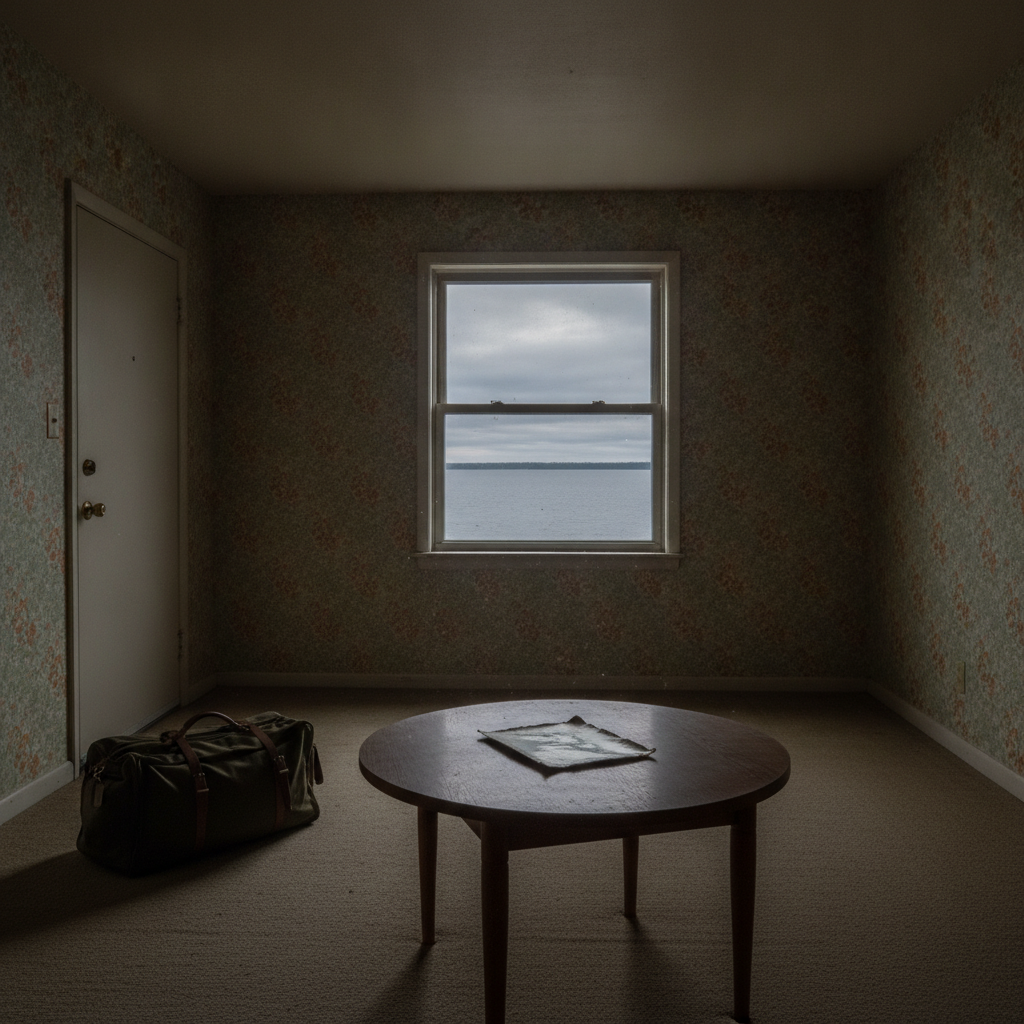
In his apartment, he always kept a bag packed, as if he might need to leave at any moment.
In 1989 he went to a local hospital with cuts. He said a vacuum cleaner had caused them.
In 1992 he went to a Halloween gathering dressed as a gangster. He spoke to no one.
In 1997 the chemical company laid him off. In 2000 he had surgery for colon cancer at a hospital in the same county. That operation, nobody could know it then, would one day give him back his name. The hospital kept a sample of his tissue.
Two years later, he was dead.
A cold case
They had a body with no usable fingerprints. They had a false name that led to a grave in Texas. They had a man who, as far as the records could show, had simply appeared in 1978 at the age of about 50, with no past at all.
Was he a criminal on the run? That was the obvious guess. A man who steals a dead child's identity usually has something to hide.
But they could not find out what. After the first round of research, the case went cold.
It stayed cold for 12 years.
The marshal and the DNA
In 2014, the local police asked for help from the US Marshals Service, the federal agency that hunts fugitives. A marshal in the Cleveland office took the case.
His first step was the tissue from the 2000 surgery. The lab extracted a DNA profile and ran it through the national criminal DNA database.
There was no match. The man had never been entered into the system as a criminal.
The marshal told reporters at the time that there had to be a reason why a man would take the name of a dead 8-year-old boy and hide for so many years.
In 2016, a forensic genealogist joined the effort. She looked at the Y chromosome, the part of DNA that passes almost unchanged from father to son, and usually travels with the family surname. She compared it with public genealogy databases. The result pointed to a surname: Nichols, or Nicholas.
The Marshals Service announced this in late 2016. It was a real clue. But there are thousands of men named Nichols.
The answer
The breakthrough came from a newer method.
In March 2018, a volunteer group called the DNA Doe Project took the case. Instead of the Y chromosome alone, they used a much larger set of DNA markers, inherited from both sides of the family. They compared it with a public database where ordinary people upload their own DNA to find relatives.
The matches led to a family in Indiana. And to a man who had disappeared from that family more than 50 years earlier.
On 21 June 2018, the Marshals Service held a press conference in Cleveland. The man who died as Joseph Newton Chandler III was Robert Ivan Nichols.
One of his sons gave a DNA sample. It matched as father and son.
Who Robert Ivan Nichols was
Robert Ivan Nichols was born on 12 September 1926 in Indiana. He was one of 4 boys.
In the Second World War he served in the US Navy as a firefighter on a destroyer. In May 1945, off the Japanese island of Okinawa, the ship was hit in a bombing attack. He was wounded by shrapnel and received the Purple Heart, the American medal for soldiers wounded in combat.
According to his family, when he came home he burned his uniforms.
In 1947 he married. He and his wife had 3 sons. He worked as a draftsman for a large electrical company.
In 1964, he left. He walked out on his wife and sons and filed for divorce that same year. He lived for a time in Michigan, then in Oklahoma.
In March 1965, he wrote to his parents that he had moved to California. He sent a letter to one of his sons from another town in California.
After that, his family never heard from him again. That year they reported him missing.
According to the tax authorities, he stopped working under his own name around 1976. Two years later, the man called Joseph Newton Chandler III appeared in South Dakota.
**This is where the documented record ends: from the 1965 letters to the 1978 identity, 13 years of his life are blank, and nobody knows why he chose the name of a dead boy.**
Conclusions and Open Questions
The identification answered who he was. It did not answer why.
Several explanations have been put forward over the years. Each has a problem.
**He was a fugitive from a crime.** The evidence: a man who steals a dead child's name, keeps a bag packed and vanishes for weeks looks like a man on the run. This was the first idea of the investigators. The problem: when he left his family in 1964, there was no warrant for his arrest. His DNA matched no crime on file. If he was running from something, nobody has found what.
**He was a war criminal from Europe hiding in America.** The evidence: early on, before anyone knew his real name, this was one of the rumours. The problem: he was an American, born in Indiana, who served in the US Navy and was wounded fighting for his own country. The theory collapsed the day his name was found.
**He was the Zodiac killer, or the plane hijacker known as D. B. Cooper.** The evidence: internet theorists pointed to a resemblance to police sketches of the Zodiac killer, a murderer who terrorised the San Francisco area in the late 1960s, and to the fact that Nichols was living in California in 1965. In 2018 the marshal said he could neither confirm nor rule out a Zodiac link, and that the question had been passed to other authorities. The problem: no evidence has ever tied him to either case. DNA comparisons reported since then argue against the Zodiac link, and the Zodiac was active mainly from 1968 to 1974, years for which Nichols has no documented record at all. A resemblance to a sketch is not evidence.
**He was a damaged man who simply wanted to disappear.** The evidence: a wounded veteran who burned his uniforms, left his family without explanation, lived alone, kept others away and ended his own life. The problem: this explains why a man might leave. It does not explain why he needed a stolen identity, why he waited until 1978, or how he found the name of a boy killed on a road in Texas more than 30 years earlier.
What remains open is almost everything that matters.
Why did Robert Ivan Nichols leave his wife and sons in 1964?
Where was he, and what was he doing, between 1965 and 1978?
How did he choose Joseph Newton Chandler III, a child with no connection to his own family?
What was the packed bag for, and where did he go when he vanished for weeks?
And why, in the summer of 2002, did he end his life?
The Marshals Service said in 2018 that it was still trying to understand why he took the boy's identity. The man who knew the answer took it with him.