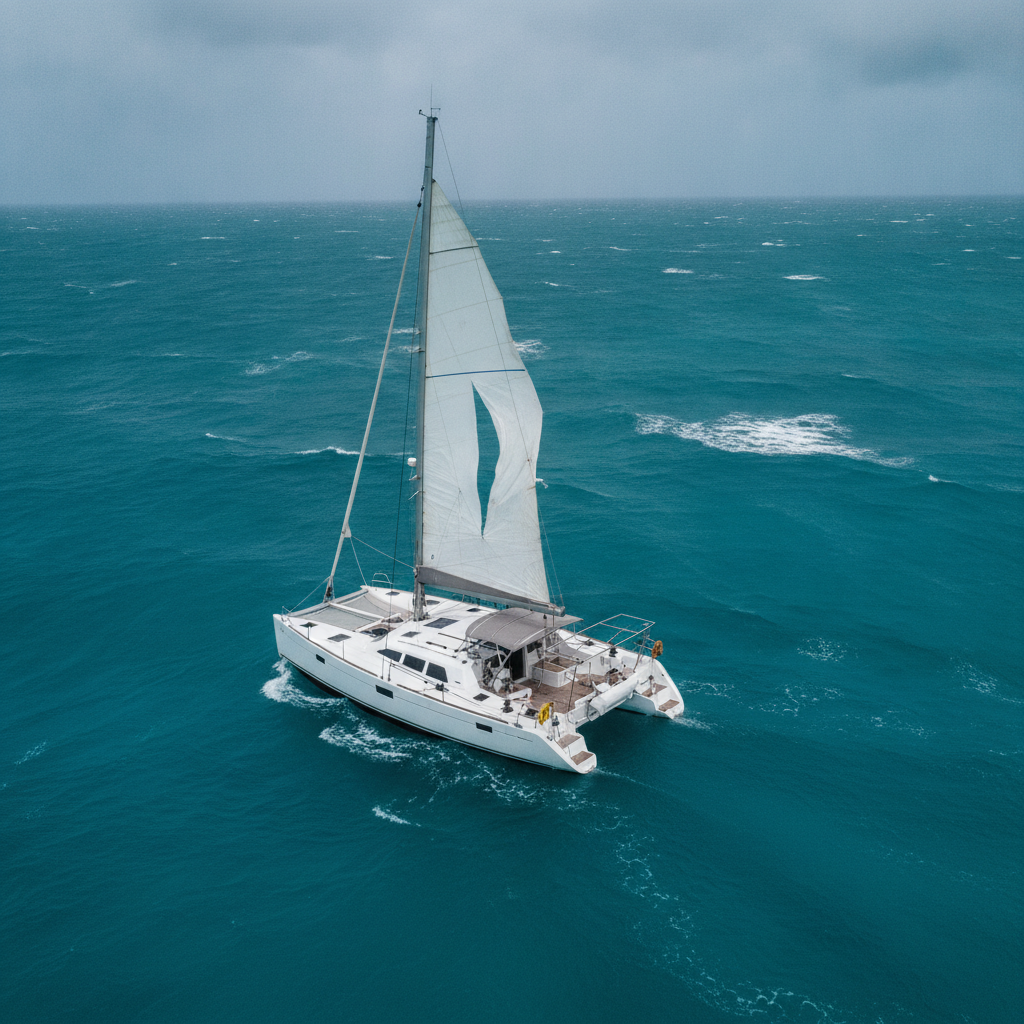
The Engine Was Still Running: The Empty Catamaran of the Kaz II
On the morning of 15 April 2007, three men from Perth motored out of Airlie Beach in a 9.8 metre catamaran called Kaz II. They were at the start of a long trip. The plan was to work north up the Queensland coast to Townsville, then keep going, right around the top of Australia and down the western side, all the way home.
Derek Batten was 56 and owned the boat. He had done a sailing course and had twice taken vessels around the Whitsunday Islands, which by the standards of the Coral Sea is modest experience but not nothing. With him were two brothers, Peter Tunstead, 69, and James Tunstead, 63. They were friends of Batten's and neither had much time on the water. It was, in the way these things usually are, a trip that three men in later middle age had been talking about for a long while.
At around midday they made a radio call near George Point, at the mouth of the Proserpine River. It was routine. Nobody heard from them again.
Three days later, on 18 April, a rescue helicopter on an unrelated task spotted a catamaran drifting off the Great Barrier Reef with nobody visible on deck. Sea conditions kept anyone from boarding for two more days. When crews finally got aboard on 20 April, Kaz II was 88 nautical miles off the north Queensland coast, well outside the reef, and drifting.
What they found on board is the reason anyone still talks about this case.
The diesel engine was running, in neutral. The cabin lights were on. A laptop was on and the navigation software was still going. There was food laid out, and cutlery, as though a meal had been interrupted. The fenders, the inflatable cushions a boat hangs over its side when it comes alongside a dock, were deployed over the rail while the boat was in open ocean. The three men's life jackets were still stowed. So were their personal effects, their wallets, their gear. One sail was set and badly torn, shredded by days of flogging in the wind with nobody to take it in.
There was no sign of the three men, and no sign of anything having gone wrong. No blood, no damage to the cabin, no note, no distress call. Nothing was missing that a person leaving deliberately would take.
The search that followed was one of the largest in Queensland's recent history: aircraft and vessels covering thousands of square kilometres of the Coral Sea for five days. Nothing was found. No bodies have ever been recovered.
Almost immediately the case acquired the vocabulary of the Mary Celeste, and everything that goes with it. Australian and international coverage reached for piracy, for a drug deal, for a staged disappearance, for the idea that another vessel had come alongside, which is where the deployed fenders came in. Queensland Police said early on that they were treating the disappearance as suspicious, which in police usage means only that nothing had yet been excluded, and which the coverage read as a hint.
Then investigators found the camera.
A video camera aboard had recorded footage from that morning. It showed the three men on deck, alive, relaxed, fishing. The engine was off. Trailing in the water behind the boat was a white rope. The footage was ordinary in every respect, which is precisely what made it valuable: it fixed the last hours, established that nobody else was aboard, and showed a line in the water astern.
The inquest opened in Townsville on 4 August 2008 before the Queensland state coroner, Michael Barnes. It ran for days and heard 27 witnesses: police, forensic officers, marine experts, the men's families, sailors who understood exactly what a Bénéteau-rigged catamaran does when you leave the helm in a breeze.
Barnes ruled out foul play. He ruled out a staged disappearance. He then set out, in careful language, a sequence that accounts for what was on the boat.
One of the Tunstead brothers, he found, most likely went into the water to free a fishing line that had fouled the rudder or the propeller, or went in after something dropped over the side. The other brother went in after him. Batten, alone on deck, left the helm to drop the sail and turn back for them. As he did, the boat gybed. The boom swung across the cockpit and knocked him into the sea.
Everything on the boat is consistent with that. The engine idling in neutral is what you get when a man drops the throttle and leaves the wheel in a hurry. The torn sail is a sail that was being lowered when the person lowering it stopped existing. The food on the table is a meal that nobody came back to.
Of the water itself, the coroner was blunt. None of the three were strong swimmers, the sea was choppy, and a catamaran under any sail at all moves away from a man in the water faster than he can follow. He wrote that the end would have been swift, that the men would have quickly become exhausted.
He also wrote something else, which is the reason this is still a mystery and not a closed accident. He said he could not be definitive about the circumstances in which the deaths occurred.
Conclusions and Open Questions
The coroner's reconstruction is the strongest account available, and it deserves to be taken seriously rather than treated as an official brush-off. Its strength is that it explains almost everything physical on that boat with one ordinary chain of events, and it needs no second vessel, no violence, and no plan. Cascading man-overboard incidents, in which a rescuer follows the person they are trying to save and then a third person follows both, are a documented category of maritime death, not a speculative one.
Its weakness is that it is a reconstruction, built backwards from the state of the deck. No part of the sequence was witnessed, and the coroner said so. The gybe that removed Batten is the least supported link in the chain, because there is nothing on the boat that records it. The scenario also requires two men of 69 and 63, neither confident in the water, to enter the sea from a boat that was under way, which experienced sailors did question at the inquest.
The competing explanations survive mainly on the strength of that gap, and each has a problem of its own.
A freak wave or a waterspout would explain the removal of three people at once, and the Coral Sea produces both. But a wave heavy enough to sweep three men off a catamaran leaves marks. It moves gear, floods the cabin, tears loose fittings. The cabin was dry and orderly, the laptop was running, and there was food still sitting on the table.
A grounding on a sandbank near George Point, followed by all three going over the side to push the boat off, has been proposed and fits the geography of the last radio call. It also fits the fenders, which several relatives argued were out because the boat had been alongside something. The counter-argument, offered by marine officers at the inquest, is prosaic: small craft very often leave their fenders out for days after leaving a marina, out of ordinary laziness, and the sight of them at sea proves nothing.
The theories involving another vessel, piracy or a rendezvous have nothing behind them at all. Nothing was taken. Three wallets, personal possessions, a boat itself worth taking, all still aboard. Whoever came, on that account, came for nothing and left everything.
And there is one more thing that the tidiest version of the accident does not fully absorb. The camera showed the men fishing with the engine off and a rope trailing behind the boat. By the time the boat was found, the engine was running. Somebody started it. That is not fatal to the coroner's account, since Batten may well have started the engine after the first man went in, but it does mean the sequence began earlier and less calmly than the flat phrase "an unfortunate series of events" suggests.
Nineteen years on, Kaz II remains the case that Australian sailors bring up whenever anyone underestimates how quickly a small crew can be reduced to none. There is a reconstruction that almost certainly describes what happened. There is no witness, no body, and no proof. The coroner said as much, and it is worth repeating in his own terms: he could say what the sea most likely did to three men on a bright autumn morning, but he could not say it for certain.