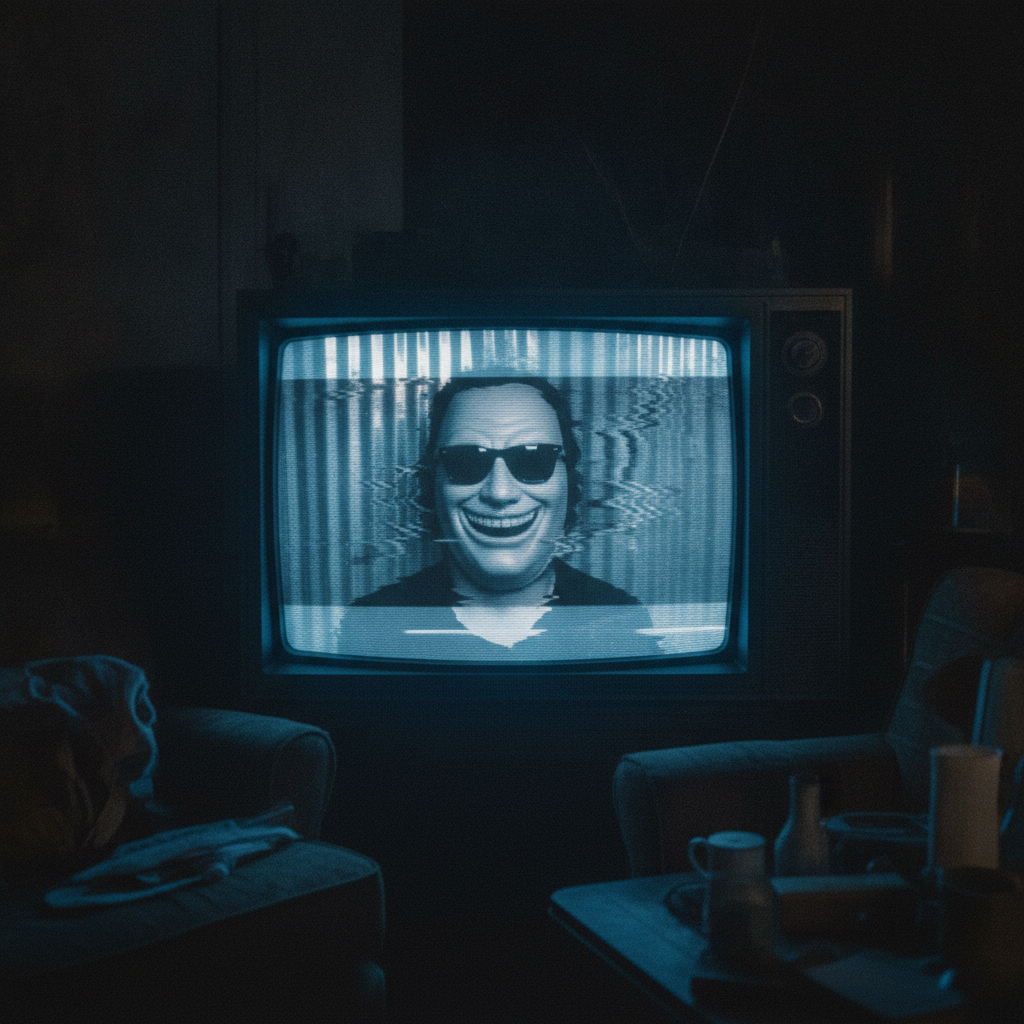
The Face That Hijacked Chicago: 90 Seconds Nobody Has Ever Explained
It was a Sunday night in late November, and the Doctor was on a lighthouse.
In living rooms across Chicago, viewers of WTTW Channel 11 were watching Horror of Fang Rock, a Doctor Who serial about an isolated tower and something unseen coming out of the dark. At roughly 11:15 p.m. on 22 November 1987, the lighthouse vanished. In its place, filling the screen, was a face: a rigid rubber mask moulded into the fixed grin of Max Headroom, the stuttering computer-generated television host who was, that year, one of the most recognisable images in popular culture. Behind the figure a sheet of corrugated metal swayed back and forth, a crude imitation of the digital backdrop from the real character's programme.
The figure moaned. It laughed. It spoke, in a voice pitched and distorted past the edge of comprehension, and the fragments that surfaced through the noise made no sense at all. It held up a can of Pepsi. Near the end it bent forward and was struck several times on the exposed backside with a flyswatter by a second, unseen participant. Then the transmission cut, and the Doctor returned to his lighthouse as though nothing had interrupted him.
The broadcast lasted about ninety seconds. It has never been explained.
What most viewers did not know was that this was the second attempt of the evening. Roughly two hours earlier, at about 9:14 p.m., the same masked figure had appeared during the sports segment of WGN-TV's nine o'clock news. That first intrusion carried no audible sound and lasted only seconds. The sportscaster, mid-sentence, found himself replaced by a swaying rubber grin. Engineers at WGN reacted quickly, switching the frequency of their studio-to-transmitter link, and the station's own signal snapped back into place. On air, the presenter recovered with a line about not knowing what that was, and the newscast moved on.
The intruders, however, had learned something in those few seconds. WGN's engineers had been at their post and had fought back. When the signal was seized again at 11:15, the target was different. WTTW's transmitter sat atop the Sears Tower, and the engineers who might have countered the takeover were not there. There was no one to change the frequency, no one to cut the feed. The intrusion ran until whoever was behind it decided to stop.
To understand how this was possible, it helps to understand how television reached homes in 1987. A station's programming did not travel from the studio to the transmitter through a sealed cable. It was beamed, on a microwave link known as a studio-to-transmitter link, from the studio to the transmitting antenna, often across miles of open city air. That link was a line-of-sight radio path, and it was not encrypted. It did not need to be. The equipment was expensive, the frequencies obscure, and the assumption across the industry was that nobody outside the profession would have either the hardware or the knowledge to interfere.
That assumption was wrong. Anyone positioned within line of sight of the receiving antenna, transmitting on the same frequency with more power than the legitimate signal, could simply overwhelm it. The receiver at the tower had no way to ask which signal was the real one. It locked onto whichever was stronger. For the length of the intrusion, the stronger signal came from somewhere in Chicago, and it was wearing a mask.
The Federal Communications Commission opened an investigation immediately, joined by the Federal Bureau of Investigation. The legal exposure was serious: an FCC spokesman cited a maximum penalty of a hundred thousand dollars, a year in prison, or both. Engineers were interviewed. The recordings were examined frame by frame. Investigators considered who in the Chicago area would possess a high-powered microwave transmitter, understand the city's broadcast infrastructure well enough to know which links were vulnerable, and be able to position equipment where it would reach the right antenna.
That description narrowed the field considerably. It was not a long list of people. And still, nobody was ever charged. No confession surfaced. No equipment was recovered and traced. The five-year window for prosecution opened, ran its course, and closed with the case exactly where it had started.
What makes the silence remarkable is the nature of the act itself. This was not a quiet crime. It was a performance, staged for an audience of hundreds of thousands, by people who went to considerable trouble to be seen. Performers of that kind usually want credit eventually. The intrusion happened before the internet made anonymity easy and boasting easier, and in the decades since, as the recording circulated and became one of the most-watched curiosities of early internet culture, the temptation to claim it must have been substantial. Claims have surfaced from time to time. None has ever been substantiated to the standard of a name and a prosecution, and the FBI never announced one.
There is a further oddity in the material itself. The garbled speech has been slowed, filtered and analysed by enthusiasts for decades. Some phrases are widely agreed upon; others are contested, with different listeners hearing entirely different words in the same second of audio. The references that can be made out point at Chicago broadcasting itself, at a rival station's slogan, at a sportscaster's name. Whoever was behind the mask knew the local television world well enough to make jokes about it, and expected at least some of the audience to follow.
And then there is the ending. The flyswatter, the bared skin, the shrieking laugh. It is the part of the recording that unsettles people most, and it is the part that resists every attempt to read a motive into the event. A political statement would have made a statement. A hacker demonstrating a security flaw would have said so. This ended with a slapstick beating and a scream, and then nothing at all: no follow-up, no manifesto, no second act. Whoever took a city's airwaves twice in one night walked away and, as far as any public record shows, never did it again.
Conclusions and Open Questions
The technical question is largely settled. Broadcast engineers and later analysts agree that the intrusion almost certainly worked by overpowering a studio-to-transmitter microwave link, and the industry response reflected that conclusion: the vulnerability was real, was understood, and was progressively closed in the years that followed. The equipment required was not something a curious teenager could assemble in a bedroom. It was professional gear, and using it demanded professional knowledge.
That is precisely why the human question remains open.
One theory, long favoured by people in the industry, holds that the intruders were broadcast professionals or engineering students with access to surplus equipment. It fits the evidence well. It explains the knowledge of which links were vulnerable, the correct frequencies, the awareness that WGN had staff on duty and WTTW did not. Its weakness is that a small professional community is a difficult place to keep a secret for four decades, and this secret has held.
A second theory treats the event as pure prank culture, a stunt by people from the fringes of the era's phone-phreaking and hobbyist-radio scenes, communities with genuine technical depth and a taste for absurdity. The tone of the broadcast supports this reading: the humour is inside-baseball, the ending is deliberately juvenile, and there is no message to decode because there was never meant to be one. The difficulty is the hardware. Enthusiasm does not by itself produce a transmitter powerful enough to override a commercial link from a workable position in a major city.
A third possibility, harder to argue and harder to dismiss, is that this was someone with a grievance against Chicago broadcasting who buried the grievance under nonsense on purpose. The references to a rival station and to an individual broadcaster hint at a target. But the hints are ambiguous, they were heard differently by different listeners, and building a theory on contested audio is building on sand. It should be said plainly that no person has ever been proven to have taken part, and speculation naming individuals has never been supported by evidence.
The questions that stay open are the ordinary ones, and that is what makes them nag. Why twice in one night, and why stop after the second? If the first attempt was a test, what exactly was being tested? Why choose a mask that was, at that moment, among the most recognisable faces in the world, rather than one that gave nothing away? And how do two or more people share an event this public, this repeatedly rewatched, this often written about, and none of them ever says the words out loud?
Somewhere, most likely, someone knows. The prosecution window closed decades ago; there is nothing left to fear from confessing. That the confession has still not come is, at this distance, the strangest part of the whole affair.