Mothman: Thirteen Months at Point Pleasant
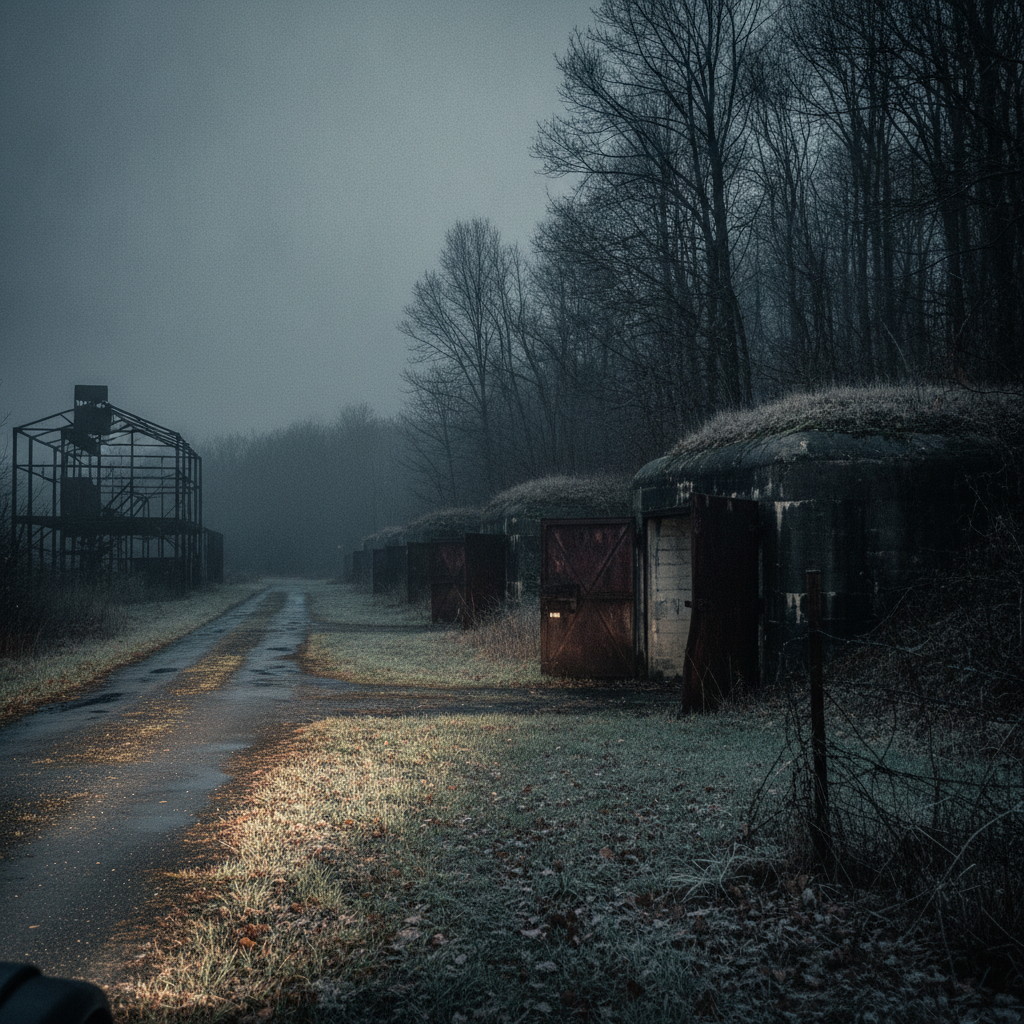
North of Point Pleasant, West Virginia, there is a stretch of ground that local people call the TNT area. During the Second World War it was the West Virginia Ordnance Works, a plant that manufactured explosives, and when the war ended most of it was abandoned in place. What remained was a landscape of concrete storage igloos sunk into the earth, empty buildings, unlit access roads and, around it, dense woodland and marsh. By 1966 it was a place teenagers drove to at night because there was nobody there.
On the night of 15 November 1966, two young married couples were driving through it: Roger and Linda Scarberry and Steve and Mary Mallette. Near a disused power plant building, their headlights picked out something standing at the roadside.
All four described it in similar terms. It was large, roughly the size and shape of a man but taller, standing upright, grey or dark in colour, with wings folded against its back. What they fixed on were the eyes. Two large red discs, set wide, throwing the headlight beam straight back at them. Linda Scarberry later described a slender, muscular figure around two metres tall and said she could not make out a face at all because of the eyes.
They drove. Their account was that the thing followed the car, keeping pace as they headed back toward town at high speed, and that it made a high screeching sound. They said it broke off near the city limits.
They went directly to the Mason County sheriff's office and reported it. A deputy drove back out to the TNT area with them that night. Nothing was found.
The story goes public
The following afternoon, 16 November 1966, the Point Pleasant Register ran the story on its front page under a headline that has outlived everyone involved: "Couples See Man-Sized Bird ... Creature ... Something."
The three dots in that headline are the most honest thing anyone wrote about the case. The newspaper had four young witnesses who were plainly frightened, no photograph, no physical trace, and no word for what they were describing.
Within days there were more reports. Two volunteer firemen said they had seen a large bird with red eyes. Others followed across Mason County and the surrounding area, and they kept coming through 1967. Estimates of the total run to more than a hundred sightings over thirteen months. Most followed the same pattern: a brief encounter at night, near roads or the TNT area, involving something large, winged, and with reflective red eyes.
Local officials responded quickly with explanations. Mason County Sheriff George Johnson suggested people were seeing an unusually large heron. Robert L. Smith, a wildlife biologist at West Virginia University, put forward a more specific candidate that has been the leading natural explanation ever since: the sandhill crane. Sandhill cranes stand nearly as tall as an adult human, have a wingspan of over two metres, and have a patch of bare reddish skin around the eyes. Smith pointed out that a bird straying outside its normal migration route would be entirely unfamiliar to people in West Virginia, who had no reason to recognise it.
The name that stuck came from a newspaper copy editor. Batman was on television at the time, and someone attached the word Mothman to the story. It has never come off.
The bridge
At 4:58 in the afternoon of 15 December 1967, the Silver Bridge, which carried US Route 35 across the Ohio River between Point Pleasant and Kanauga, Ohio, collapsed into the river during rush hour traffic. Forty-six people died. Two bodies were never recovered.
The engineering investigation took more than three years. Its findings, released in 1971, were precise. The collapse began with a cleavage fracture in the lower limb of the eye of an eyebar numbered 330, at a joint in the north suspension chain on the Ohio side span. A tiny flaw, probably beginning at a corrosion pit, had grown to critical size over the bridge's forty-year life through the combined action of stress corrosion and corrosion fatigue. The bridge's design gave the chain no redundancy, so when that one component failed, the structure came down in under a minute. The flaw was in a location that could not be seen without dismantling the joint. The disaster led directly to the creation of national bridge inspection standards in the United States.
Nothing in that account is unexplained. The Silver Bridge is one of the best understood structural failures of the twentieth century.
The sightings around Point Pleasant stopped at about the same time.
The book
In 1975 the American journalist John Keel published The Mothman Prophecies, in which he combined the Point Pleasant reports with material on unidentified flying objects, mysterious visitors, telephone interference and premonitions, and presented the bridge collapse as the event the whole sequence had been building toward. The book was widely read and was adapted in 2002 into the film The Mothman Prophecies, starring Richard Gere.
It is important to be clear about what the book did. The connection between the sightings and the bridge is retrospective. It was made after December 1967, in print, by an author writing a narrative. No contemporaneous document from 1966 or 1967 records anyone predicting that the Silver Bridge would fall.
Point Pleasant now has a metal statue of the creature, a museum and an annual festival. The town has built an economy on thirteen months in the 1960s.
Conclusions and Open Questions
The sandhill crane hypothesis is the strongest explanation for the first sighting, and it does more work than it is usually given credit for.
Its strengths are the specific ones. The size is right: a sandhill crane standing upright reaches roughly the height reported. The wingspan is right. The bare red facial skin sits exactly where the witnesses described red eyes, and in headlights it would be the brightest thing on the animal. Cranes do stray off migration routes, and a West Virginian in 1966 had no reason to have ever seen one. The original newspaper headline itself called it a man-sized bird, which is what a crane in a road at night would look like.
Its weaknesses are equally specific. A crane does not keep pace with a speeding car. Cranes are not silent and their call, a loud rolling bugle, does not match the screech described. And a single lost bird cannot account for more than a hundred reports spread over more than a year.
The owl explanation, put forward chiefly by the investigator Joe Nickell, addresses the later wave better than the first sighting. Owls have highly reflective eyes that throw a torch or headlight beam back as a bright red or orange glow, they fly in near silence, they are aggressive near nests, and the abandoned TNT area is good owl country. There is also a documented local case: a snowy owl was shot in the area in 1966 and described as a giant owl, and it is now on display in the town's museum. The weakness is scale. No owl is two metres tall, and the first four witnesses were looking at their subject in headlights at close range.
Against every version of a large flying creature stands basic physics. An animal of the reported dimensions, roughly two metres tall with a three-metre wingspan, cannot fly. Mass rises with the cube of length while wing area rises with the square, and the largest flying birds sit far below that threshold. Whatever was seen, it was not a two-metre flying animal.
That leaves the question of how one frightening encounter became a hundred. The pattern is a documented one. A vivid report is published, the public is primed to look, ambiguous night-time sights are reinterpreted, and reports multiply for as long as the press keeps printing them and then stop. The sightings around Point Pleasant fit that curve closely. The complication is that the first encounter preceded the coverage, and it involved four adults who went to the sheriff at once and gained nothing from it. No evidence has ever been produced that they invented it.
Two questions remain genuinely open, and neither is about a creature.
The first is what the Scarberrys and Mallettes actually saw on 15 November 1966. Their account is consistent, was given immediately, and has never been retracted or explained to their satisfaction. Something was at the roadside. A crane and an owl are both plausible; neither is proven, and nobody who has proposed them was there.
The second is why a town's tragedy became a supernatural story at all. Forty-six people died in a bridge collapse whose cause was determined down to a single steel eyebar. The prophecy came later, from a book, and it has now outlived nearly everyone who was on that bridge. The most unsettling thing about Point Pleasant is not what was standing in the road. It is how quickly a well-understood disaster was absorbed into a legend that no record from the time supports.