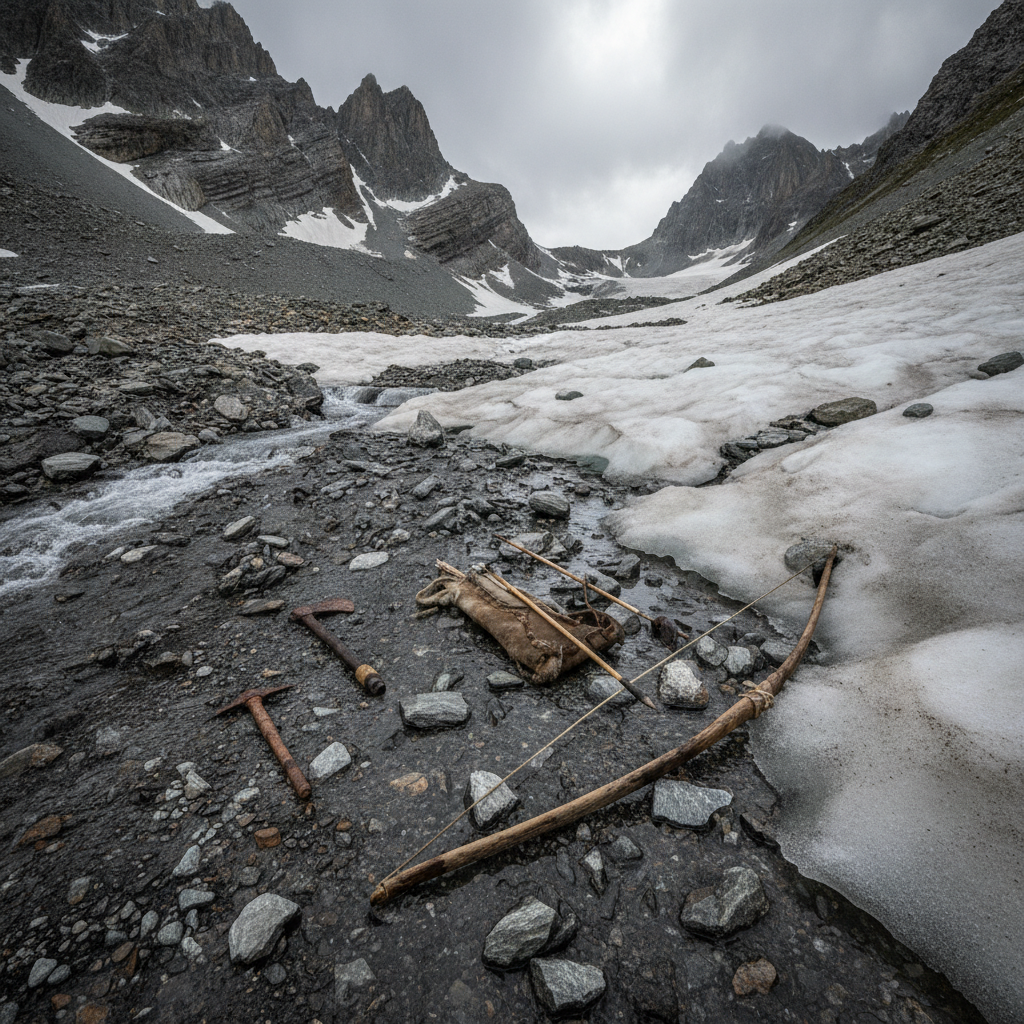
The Arrow in His Back: The 5,300-Year-Old Murder of the Iceman
On 19 September 1991, two German hikers named Helmut and Erika Simon came down off the Similaun ridge in the Ötztal Alps and decided to leave the marked path. At about 3,210 metres, in a rocky gully filled with meltwater, they saw something brown breaking the surface of the ice. Their first thought was rubbish left by climbers. Then they made out a head, and shoulders, and a back.
They assumed they had found a mountaineer who had died in a storm some years earlier. So did everyone else. Over the following four days the recovery was carried out with the urgency, and the care, appropriate to a recent accident: a pneumatic drill, an ice axe, ski poles used as levers. The body's left hip was damaged in the process. Equipment lying around it in the ice was picked up loose and carried down in bags. Only when the corpse reached Innsbruck did the archaeologist Konrad Spindler look at the axe that had come out of the gully with it, recognise the shape of the blade, and say that the thing on the table was at least four thousand years old.
Radiocarbon dating put it closer to five thousand three hundred. The man had died around 3230 BC. He is the oldest known natural human mummy in Europe, and, as it turned out, one of the oldest murder victims anywhere on record.
He was about 45 years old, 160 centimetres tall, and had weighed perhaps 50 kilograms in life. By the time he came down the mountain the dried body weighed under 14 kilograms. He was carrying a load that has done more for the understanding of the Copper Age than any settlement excavation: a bow of yew, unfinished, taller than he was. A quiver holding fourteen arrow shafts, of which only two were finished and flight-ready. A small flint dagger with a woven grass sheath. Two birch-bark containers, one of which had held embers wrapped in maple leaves. Lumps of birch fungus threaded on leather strips. A grass cloak, a coat of goat hide, leggings, a bear-fur cap with a chin strap, and shoes with bearskin soles, deer-hide uppers and a netting of tree bast to hold the grass insulation in place.
And an axe. The blade was copper, almost pure, hafted in yew and bound with leather. Analysis has traced the ore to southern Tuscany, hundreds of kilometres to the south, which tells us something about trade in 3200 BC that nobody had expected. In his own community the axe would have been an object of real status. It was still lying beside him when the Simons found him.
His skin carried 61 tattoos, made not with a needle but by rubbing pigment of soot or fireplace ash into fine cuts. They are not pictures. They are lines and crosses, and they cluster on the lower back, the knees, the ankles and the wrist, which is to say on exactly the joints where his skeleton shows heavy degenerative wear. Whatever they meant, they look less like decoration than like treatment.
Then there was the question of where he belonged. The gully sat almost exactly on the modern frontier, and Austria and Italy each had a claim. A formal survey settled it: the body had been lying 92.56 metres inside Italy. After seven years in Innsbruck he was moved in 1998 to Bolzano, where he lies today in a cold cell held near minus six degrees at high humidity, visible through a small window, sprayed periodically with sterile water to maintain the layer of ice that keeps him from decaying.
For ten years everyone assumed he had died of exposure. The reconstruction that circulated in the 1990s came from Konrad Spindler and was known as the disaster theory: a fight in his home valley in the autumn, a flight up into the mountains carrying damaged gear, exhaustion and cold at the top of the pass.
In June 2001 a radiologist in Bolzano named Paul Gostner went back over the X-rays and saw something everyone had missed for a decade. There was a flint arrowhead in the man's left shoulder, under the shoulder blade.
It had entered from behind and slightly below, which places the archer downhill and some distance away. It cut the subclavian artery. A wound like that empties a body in minutes, and there is nothing anyone in 3230 BC could have done about it. He was shot in the back while moving, and he bled to death where he fell.
The arrow shaft was gone. It had been pulled out of him, and it was not in the gully.
More followed. There is trauma to the back of the skull, either from the fall or from a blow. There is a deep cut on his right hand, in the web between thumb and index finger, the classic wound of a man grabbing at a blade. That injury had begun to heal, which places the fight that caused it several days before the shooting, not on the same afternoon.
And in 2019 a detailed study of his stomach contents established what he had eaten in the last half hour of his life: ibex meat and a great deal of ibex fat, red deer, einkorn wheat, and traces of bracken fern. It was a heavy, fatty, unhurried meal. Thirty to sixty minutes later he was dead.
Conclusions and Open Questions
The forensic picture is unusually clear for a body five millennia old, and it is the meal that makes it so uncomfortable. A man being hunted through the high Alps does not stop at 3,200 metres to eat a large helping of fat and meat. He ate, and then, within the hour, someone put an arrow through his back from below and behind. Whatever he was afraid of days earlier, when he grabbed a knife blade with his right hand, he was not afraid at the moment he sat down to eat.
The missing shaft is the detail that has driven most of the argument since 2001. Somebody came up to the body afterwards and pulled the arrow out. The most common reading, argued by researchers at Bolzano and elsewhere, is that arrows were identifiable: fletching, binding and point were as personal as handwriting, and removing the shaft removed the name of the man who fired it. That reading has real force, but it also has a weakness that is rarely acknowledged. If concealment was the motive, the killer stood over a corpse next to a copper axe, an object of obvious value and obvious rarity, and left it. Nothing was taken. The bow, the quiver, the dagger, the axe were all still there in 1991.
That absence of theft is the strongest evidence against the simplest explanation, robbery, and it pushes most researchers towards something personal: a feud, a killing over status or a woman or a debt, carried out by someone who wanted this particular man dead and did not want to be identified afterwards. It is a plausible story. It is also, and this is worth saying plainly, a story. No evidence in the gully names a motive.
A ritual explanation has been proposed more than once, on the grounds that the body may have been deliberately placed. It has never gained wide acceptance, because the arrangement of the remains and the equipment is at least as well explained by a man collapsing where he was hit and by five thousand years of ice movement.
Spindler's original disaster theory has largely fallen. It required an autumn death, and the pollen evidence in his gut, particularly hop hornbeam, points to spring or early summer. A separate reappraisal published in 2022 by a team including the glacial archaeologist Lars Pilø argued that the celebrated freak preservation was never as freakish as claimed: rather than being sealed instantly and permanently, the body most likely lay in a protective hollow that filled and refilled with ice, thawing partially at times. If they are right, the conditions that preserved him are ordinary enough that other bodies of similar age may be waiting in other gullies.
Two further claims sit in the uncomfortable middle. An analysis in the early 2000s reported traces of blood from four separate people on his knife, an arrowhead and his coat, which would suggest he had been fighting and possibly carrying a wounded companion. It has never been independently replicated, and it is treated with caution. And a running dispute continues over whether the arrow killed him outright or whether the head injury did, with radiologists reading the same scans and reaching different conclusions.
What did change beyond argument is who he was. A high-quality reworking of his genome published in 2023 by a team including Johannes Krause found that more than 92 percent of his ancestry came from early Anatolian farmers, an unusually pure signal for fourth-millennium Europe. The steppe ancestry reported in the first genome study turned out to be modern contamination. The same work found he was going bald and that his skin was considerably darker than the reconstructions in every museum shop.
So the oldest cold case in the world stands roughly where a modern one would after a good investigation and no suspect. Cause of death, established. Time of death, established to within an hour of a meal. A prior violent encounter, established. A killer who stayed long enough to retrieve his arrow and refused a copper axe worth more than most people in his valley would own in a lifetime, and who left behind no name, no motive, and nothing at all to identify him except the point of his arrow, still lodged where he put it.