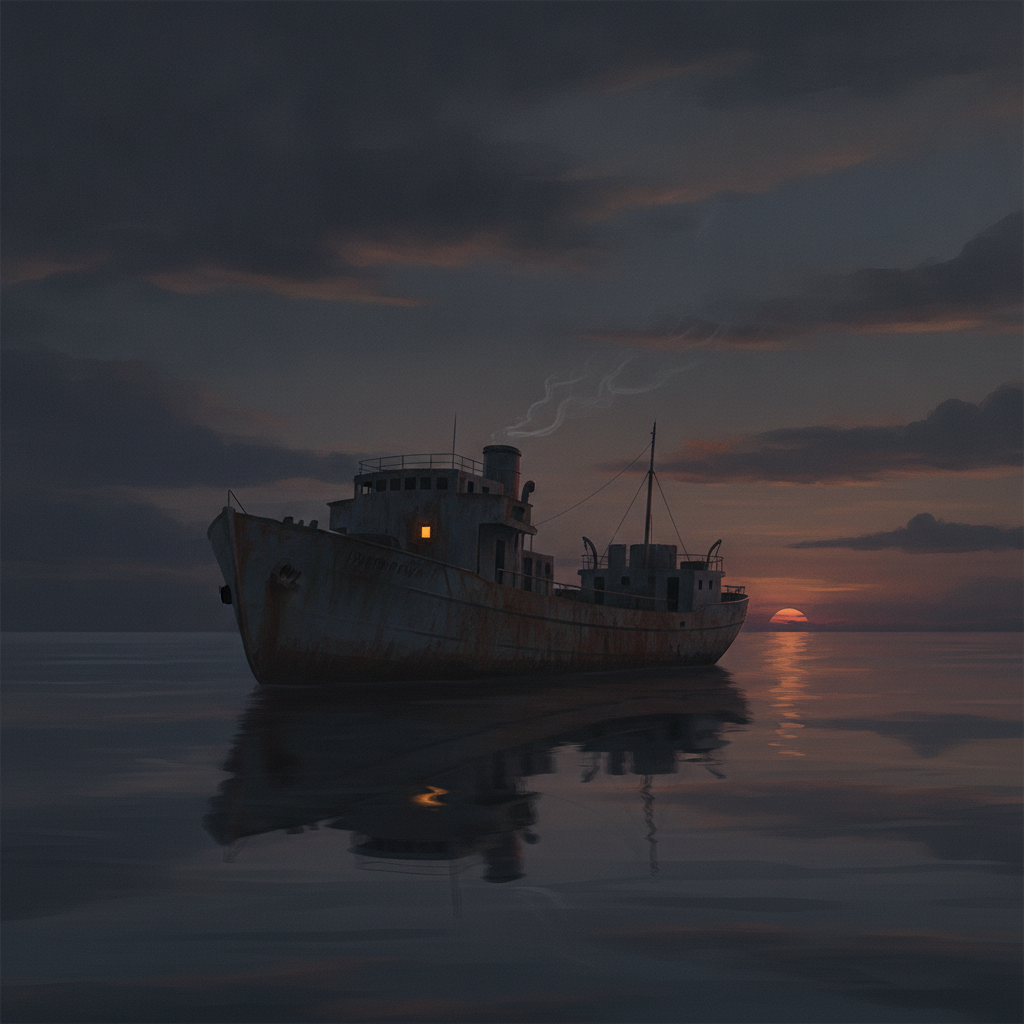
The Ourang Medan: The Death Ship That May Never Have Sailed
The Ourang Medan is one of the most widely repeated horror stories in maritime folklore, and it is also one of the least documented. No shipping registry lists the vessel. No archive holds a crew list. What survives is a chain of newspaper articles, the earliest printed in 1940, and two later documents that reprinted the tale without investigating it. What follows is the case as it has been told, and then the record of what happened when people tried to check it.
The account opens in the waters off Sumatra, in the Strait of Malacca. Radio operators, the story says, picked up a Morse distress call. It came from a Dutch freighter named the Ourang Medan. All officers including the captain dead, the message read; probably whole crew dead. Then came a stretch of garbled code, as though a hand were still striking the key without control. Then, breaking the conventions of maritime radio, three plain words: I die. After that the channel fell silent.
The nearest ship is usually named as the American merchantman Silver Star. It altered course and found the freighter adrift in the swell, showing no lights and apparently undamaged. A boarding party climbed aboard.
What they are said to have found has been repeated almost word for word for three quarters of a century. The crew lay dead where they had fallen, across the decks, the bridge, the wheelhouse and the passageways. Their eyes were open. Their arms were flung out. Their faces were fixed in expressions of terror, mouths open. There were no wounds, no blood and no sign of struggle or disease. The ship's dog was said to lie dead as well, frozen in mid-snarl. Below decks, the account adds, the air was strangely cold. These are reported deaths rather than verified ones. Not one victim has ever been named. No next of kin, inquest, death certificate or insurance claim has ever been produced.
The boarding party is said to have decided to take the freighter under tow. Before they could, smoke began to rise from the number four hold. The men went back to the Silver Star and cut the line. Minutes later the Ourang Medan exploded with enough force to lift in the water before sliding under, carrying its dead and every particle of physical evidence to the floor of the strait. The wreck has never been located, and nothing attributable to it has ever been recovered.
That is the story in full. What follows is the record of what investigators found when they went looking for it.
They began where a merchant ship cannot hide. Lloyd's Register, the vast and pedantic catalogue of the world's merchant shipping, lists no vessel named Ourang Medan. Dutch maritime registries, which would have recorded a Dutch freighter, show nothing. A working cargo ship of that era generated owners, insurers, a home port, tonnage certificates, crew agreements and cargo manifests. No such document has been found for the Ourang Medan in any archive yet examined.
The Silver Star did exist as a name in American shipping. But no log, port record or company file connects any Silver Star to a rescue of this kind on the claimed dates.
The dates themselves will not hold still. Some versions place the event in June 1947. Others place it in February 1948. The ship's supposed position also moves between retellings, from the Strait of Malacca to the Marshall Islands to the Solomon Islands.
Nor is the setting a neutral one. The Strait of Malacca in the late 1940s was among the busiest and most closely watched waterways on earth, crowded with postwar shipping, naval patrols, colonial harbour authorities and insurance surveyors. A freighter that broadcast a distress call, was boarded and then exploded there would have generated paperwork in several jurisdictions at once. None has been found.
The paper trail that does exist runs in a direction few expect. The earliest known version of the tale appeared in October 1940, in a series called I drammi del mare, the dramas of the sea, published by the Trieste newspaper Il Piccolo and written by a man named Silvio Scherli. Within weeks, British papers including the Daily Mirror and the Yorkshire Evening Post printed their own versions, the material attributed to the Associated Press. In 1948 the Dutch-Indonesian newspaper De Locomotief ran the story across three installments and named its source outright: Silvio Scherli of Trieste. The final installment closed with the paper's own admission that it could vouch for nothing and possessed no further data on the mystery.
The chronology is the central documentary problem in the case. A story describing a catastrophe dated to 1947 was already in print in 1940, under the byline of the same man who reappeared as the source in 1948.
Two later documents gave the tale an official appearance. In May 1952 the Proceedings of the Merchant Marine Council, a publication of the United States Coast Guard, printed the story. In 1959 a writer named C. H. Marck Jr. wrote to the Central Intelligence Agency asking about the case, and a copy of that correspondence survives in the agency's public reading room. Neither document is an investigation. Neither adds a single verified fact. Both simply repeat, in dry official prose, the account a Trieste journalist had published. The letterheads carried weight all the same, and much of the story's later authority rests on them.
Researchers also went beyond the registries. The name itself has been read as Malay, roughly man of Medan, after the Sumatran port, which is not how Dutch owners named their ships. Attempts to trace it through colonial shipping lists, or to identify any freighter lost in the region on either candidate date, have produced a candidate for neither the ship nor the incident.
The contrast with a genuinely documented ghost-ship case is instructive. The Mary Celeste, found abandoned and seaworthy in the Atlantic in 1872, has a documented owner, a named captain and crew, salvage-court testimony and insurance records. Why her people left her remains unanswered, but that the ship and the people existed is beyond dispute. The Ourang Medan presents the reverse profile: a detailed drama attached to a vessel that appears in no record at all.
Conclusions and Open Questions
One point commands near-unanimous agreement among maritime historians: no evidence has been found that the Ourang Medan existed. The competing explanations therefore split in two, those explaining how the crew died and those explaining how the story was made.
The most cited physical theory, argued by the maritime writer Roy Bainton and others, holds that the ship was a smuggler carrying an illicit chemical cargo, perhaps a combination of potassium cyanide and nitroglycerin, or wartime stocks of a nerve agent, carried without papers because it was contraband. Seawater seeping into the hold could have reacted with the cargo and released poison gas that killed the crew quickly and without a mark, while the volatile part later ignited and destroyed the vessel. Its strength is that it accounts for two hard details at once, unmarked bodies and a sudden explosion. Its weakness is that it still requires the ship to have existed. There is no manifest, no registry and no owner, so it explains a death that cannot be shown to have occurred.
A milder variant proposes an accidental fire smouldering in a hold and flooding the vessel with carbon monoxide, which suffocates without violence and could touch off an explosion. Carbon monoxide poisoning is real and does leave the dead unmarked, which is the theory's strength. It fits poorly with faces fixed in terror and with a reported cold below decks, and it too depends on a ship that no document confirms.
Beyond these sit the wider claims promoted by fringe writers over the decades: invisible sea gases, ball lightning, even visitors from elsewhere. One theory holds that the case was an early chemical or biological weapons accident later covered up, and treats the 1959 CIA file as a sign of official interest. That reading is an open theory rather than a finding. The file is a letter from a member of the public, not a report, and nothing in it indicates that any investigation took place. All these proposals share a structural flaw: they are elaborate solutions to a puzzle that may have no factual core.
Against them stands the sober majority verdict, that the Ourang Medan is folklore, a newspaperman's sea drama that slipped its moorings and drifted into the record. The evidence is strong: the missing registry, the impossible dating, the single traceable source. Its only weakness is the standing caution that absence of evidence is not, strictly, evidence of absence, and that the real Silver Star leaves a thread nobody has quite cut.
Some argue for a middle position, that the truth is a fusion rather than a pure invention: that Scherli built his drama around a kernel of something real, a half-heard account of a genuine shipboard poisoning somewhere in the East Indies during the war years, and attached to it an invented name, an invented rescue and the operatic details. Rumours do often grow that way. But there is no evidence of a real gassing behind the tale, only the shape of one.
What remains unexplained is not the deaths but the persistence. A story with no ship, no crew, no date and no wreck has outlived almost every verified maritime disaster of its period, and it is still retold as history by sources that should know better.
The open questions are these. What was Silvio Scherli's source in 1940, and did he ever claim one? Why did the Associated Press attribution appear on the British reprints, and is there an agency wire behind it or only an editorial convention? Why did the United States Coast Guard reprint an unverified newspaper story in an official journal, and did anyone there attempt to check it? Is there an unexamined Dutch colonial, British or Japanese wartime archive in which a comparable poisoning at sea is recorded under another name? And if the answer to all of these is nothing, why does the Ourang Medan refuse to sink?