The Princess Who Never Lived: A Forged Mummy and the Woman Nobody Has Ever Named
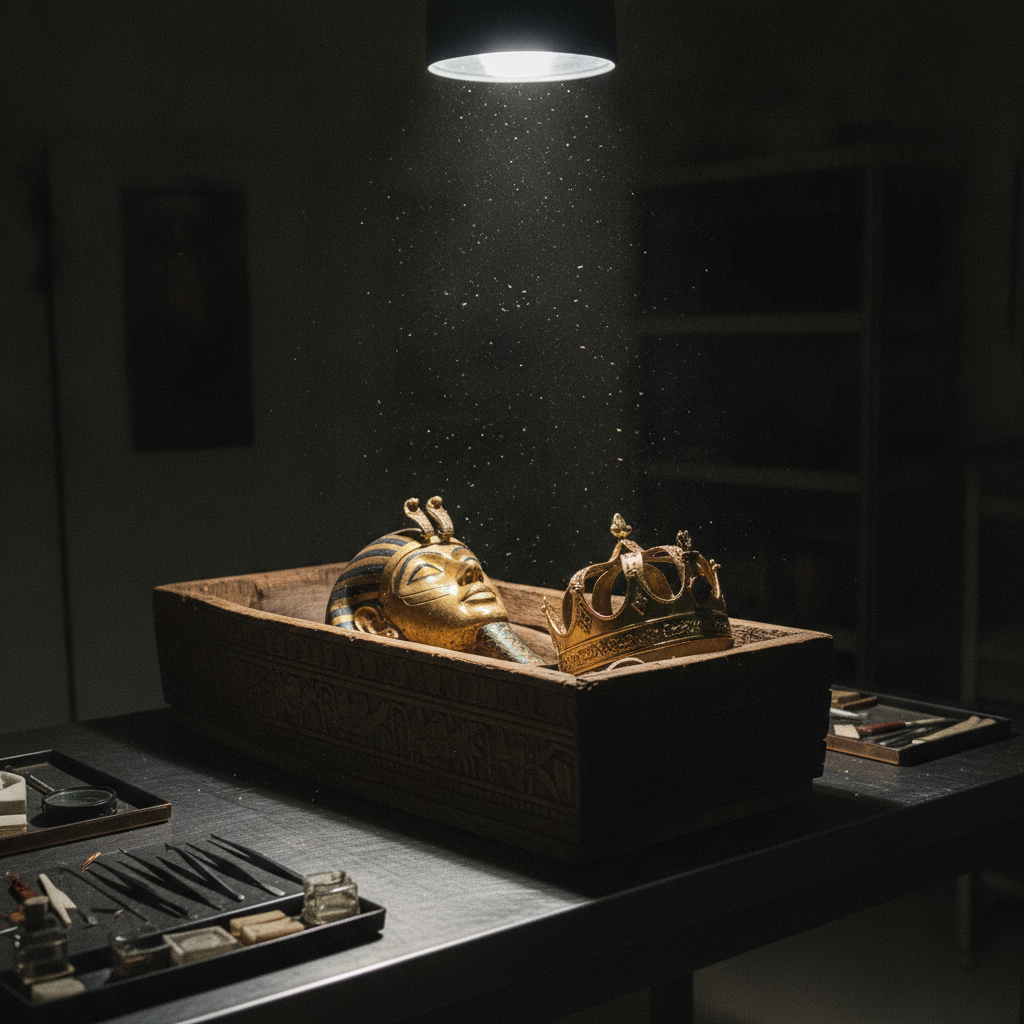
The videotape arrived in Karachi in October 2000. A Pakistani journalist watched it and understood almost at once that he was looking at something extraordinary, or at something extraordinarily wrong. The camera moved along a carved wooden coffin. Inside lay a body wrapped and wound in the old manner, the face covered by a gilded mask, a golden crown resting above it, and across the chest a sheet of gold worked with cuneiform.
The tape had come from Kharan, in Balochistan, near the Afghan border, from the house of a tribal figure named Wali Mohammed Reeki. The asking price was 600 million Pakistani rupees, roughly eleven million United States dollars at the time. Reeki said the mummy had come to him from a man who found it after an earthquake near Quetta.
Police moved before any sale could be completed. On 19 October 2000 the coffin was seized and taken to the National Museum of Pakistan in Karachi, and the story went around the world within days.
The daughter of Xerxes
The inscription on the gold breastplate was the heart of it. Translated, it read as a first-person declaration: the speaker was the daughter of the great king Xerxes, she asked a deity for protection, and she gave her name as Rhodugune.
Xerxes I ruled the Achaemenid empire from 486 to 465 BC. No Persian royal mummy had ever been recovered. Persian burial practice was not Egyptian, and the idea of an Achaemenid princess embalmed and gilded in the Egyptian style would have forced a rewrite of what was known about the dynasty's funerary customs. The eminent Pakistani archaeologist Ahmad Hasan Dani examined the coffin and put the date at around 600 BC. At a press conference on 26 October the mummy was presented to the world as a Persian princess, and the National Museum found itself holding what was being described as one of the archaeological finds of the century.
The diplomatic consequences were immediate. Iran declared that the mummy had certainly been looted from Iranian soil, probably from the Hamadan region, and demanded her return. Pakistan disputed the claim. The Taliban administration in Afghanistan then asserted that the body had come from Afghan territory and belonged to Kabul. Three claims, one corpse, and a great deal of noise.
The curator who kept asking
Asma Ibrahim, the archaeologist and curator who ran the museum's conservation work, was uneasy from early on. She was the one who had to care for the object, and caring for it meant looking closely.
She assembled a team and worked through the evidence piece by piece, over roughly a year. The body was X-rayed and put through a CT scanner. The wooden coffin and the stone sarcophagus were examined technically. Samples were taken from the reed mat on which the body lay. And the cuneiform text was sent for proper philological review.
The scans came first, and they were damaging. Ancient Egyptian embalmers removed the internal organs but left the heart in place, because the heart was needed in the judgement of the dead. This body had been emptied out completely, heart included. The techniques did not match any known mummification tradition, Egyptian or otherwise. The cavity had been packed with powder that turned out to be modern desiccant, bicarbonate of soda and common salt. The body and the hair had been bleached.
Then came the anatomy. The remains were those of a woman aged roughly 21 to 25. She was not an ancient body at all. And there was damage that had nothing to do with burial: a fracture in the neck and injuries to the spine consistent with a heavy blow from a blunt object.
The dating closed it. Radiocarbon analysis of the organic material associated with the burial pointed to a death around 1996, four years before the mummy appeared on the market.
The inscription failed independently. Rüdiger Schmitt, a German specialist in Old Persian, examined the cuneiform and found it grammatically wrong in several places. Worse, the name on the breastplate was Rhodugune, which is the Greek form. A genuine Achaemenid inscription would have used the Old Persian name, Wardegauna. Schmitt also identified passages that had been lifted from the Behistun inscription, the great royal proclamation of Darius the Great carved into a cliff in western Iran and available in any library. The forger had copied from a textbook and had copied badly.
In April 2001 the museum announced the conclusion in public. The Persian princess was a fabrication, and the case had turned from archaeology into a homicide inquiry.
What happened next, and what did not
The forgery had been elaborate and expensive. Someone had built a stone sarcophagus and a carved wooden coffin, cut and inscribed a gold breastplate, made a mask and a crown, sourced the linen, and applied a mummification process convincing enough at a glance to fool experienced people on first sight. That is not the work of one person in an afternoon. It implies a workshop, money, and a plan to sell into the international antiquities market.
The criminal side went nowhere useful. Men were charged in Pakistan under antiquities and related legislation in connection with the attempted sale, and it should be stated plainly that being charged is not being convicted, and that anyone accused is presumed innocent unless a court finds otherwise. No one has ever been convicted of killing her. No one has ever been shown to have known her.
Nor was she identified. Investigators could not attach a name, a family, a village or a missing persons report to a young woman in her early twenties who died somewhere in the region in about 1996. Her body had been bleached, hollowed out and wrapped in cloth, which removed much of what a forensic examination normally works with. Whatever documentation existed about her life was never found.
She remained in the museum for years, an exhibit that had become evidence and then became a problem nobody wanted. In 2005 the courts directed that the body be handed to the Edhi Foundation, the Pakistani charity best known for burying the unclaimed dead. In 2008 the foundation gave her a funeral and buried her with full rites, as an unidentified woman.
Conclusions and Open Questions
Two things are settled beyond argument. The mummy is a modern forgery, demonstrated independently by radiocarbon dating, by CT imaging, by chemical analysis of the packing materials and by linguistic analysis of the inscription. And the woman inside it died in the mid 1990s with a broken neck and spinal injuries.
What is not settled is how she died, and that gap has produced two readings.
One holds that she was murdered specifically in order to be turned into a saleable antiquity. Its strength is the sheer coldness of the operation and the presence of severe blunt force injury to the neck. If you are building a mummy to sell for eleven million dollars, a fresh body is more useful than a decayed one, and the forgery required a corpse in good condition. Its weakness is that no evidence has ever linked a specific killing to a specific forger, and the theory rests on inference rather than on anything proved in a courtroom.
The other holds that she died by accident or by violence unconnected to the fraud, and that her body was afterwards obtained, perhaps stolen from a grave or bought from someone with access to the dead, and then used. Its strength is that this requires fewer assumptions and fits the way forgery rings usually work, taking what is available rather than manufacturing a victim. Its weakness is the timing and the injury pattern, which sit uncomfortably close together, and the fact that a stolen grave normally leaves a trace somewhere.
Asma Ibrahim, who did more than anyone to expose the fraud, has said publicly that she considers it a murder case that was never pursued as one. The Pakistani police investigation into the death, as opposed to the smuggling, effectively stalled. The obvious lines of inquiry, which forger, which workshop, which supplier of the body, were not run to a conclusion that has been made public.
Several practical questions also remain open. Nobody has ever established where the physical components came from: the stone sarcophagus, the gold work, the carved coffin. Nobody has established who wrote the cuneiform, a person who had access to a published edition of the Behistun inscription and enough training to copy signs, but not enough to avoid basic grammatical errors and the wrong form of a royal name. And nobody has established whether other objects from the same workshop were sold successfully and are sitting today in a private collection somewhere, unexamined.
The largest open question is the simplest one. A young woman died. She was stripped of everything that identified her, bleached, packed with baking soda, dressed as a princess of an empire that fell two and a half thousand years ago, and offered for sale. She was studied by scientists on three continents, argued over by three governments, photographed for the world's newspapers, and buried eight years later under no name at all. Somewhere there is a family that stopped hearing from a daughter in about 1996 and has never been told what became of her.