Peter Bergmann: The Man Who Erased Himself Before He Died
Just after dawn on 16 June 2009, a man and his young son walked out onto the sand at Rosses Point, a quiet strand a few miles northwest of Sligo town, on Ireland's Atlantic coast. Near the tideline they came upon the body of an elderly man, fully dressed, lying as if he had simply lain down to rest. There were no obvious signs of violence and no marks of a struggle in the sand. The Gardai, Ireland's national police force, began what appeared at first to be a routine case of sudden death. After five months of investigation they were unable to establish the fact that normally comes first: the name of the man on the beach. Sixteen years later, they still cannot.
His final days can be reconstructed almost hour by hour. On the afternoon of Friday 12 June 2009, the man stepped off a bus that had travelled down from Derry and got into a taxi at the Sligo bus station. He asked the driver, quietly and politely, to take him somewhere inexpensive to stay. The first guest house did not work out. The second, the Sligo City Hotel on Quay Street, had a room available.
He checked in under the name Peter Bergmann and gave an address in Vienna: Ainstettersn 15, 4472. Every element of that address is wrong. No street of that name exists in Austria. The postcode is unassigned, and Vienna's postal codes in any case begin with a 1, not a 4. He paid cash, as he would pay cash for everything during his stay, and he asked for a room with a view of the sea. Staff later described him as polite, reserved and entirely unremarkable, apart from a faint German or Austrian accent.
What the town's security cameras recorded over the following days is what turned an ordinary death into a genuine mystery. Again and again the man left the hotel carrying a full purple plastic bag, and again and again he returned with it empty. He was filmed doing this more than a dozen times, taking a different route on each occasion. Detectives later traced those routes and searched the public bins along them. They recovered nothing that could be tied to him. The Gardai concluded that he had disposed of his possessions in small, deliberate increments, using the gaps between the cameras, and that on his final walk he had folded the empty bag and put it in his pocket. The bag was never found.
On the morning of Saturday 13 June he walked into the post office in Sligo and bought eight 82-cent stamps and a set of airmail stickers. No letter connected to him has ever surfaced, anywhere in the world.
On Sunday 14 June he took another taxi and asked the driver where a man might find a quiet beach to swim. The driver suggested Rosses Point and drove him out to see it. Bergmann looked at the water for a few minutes and asked to be taken back to town.
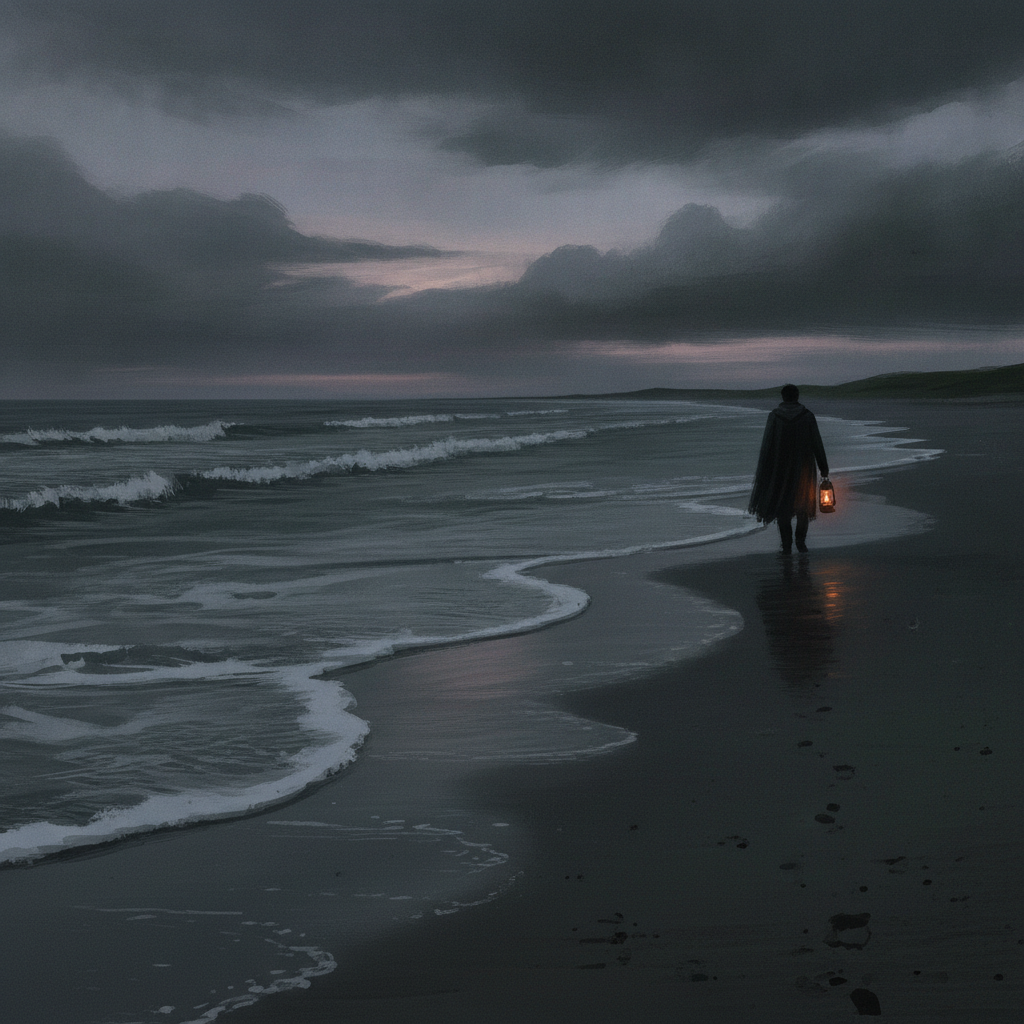
On the evening of Monday 15 June he checked out of the hotel, walked to the bus station and took the afternoon bus to Rosses Point. Perhaps a dozen people saw him on the beach that evening: an elderly, softly spoken man in a jacket, walking near the shoreline as the light failed. Several noticed him close to the water as darkness came on. No camera and no witness ever saw him enter the sea. He was found the following morning.
The post-mortem examination established that he had been a seriously ill man. He had advanced prostate cancer that had spread into his bones. He had survived several previous heart attacks. One of his kidneys had been removed at some earlier point in his life, and he had a single gold tooth. Reports of the case state that he was receiving no treatment for the cancer. The pathologist found none of the signs associated with a typical saltwater drowning and no indication of foul play, and recorded the cause of death as acute cardiac arrest. The labels had been cut out of every item of his clothing. He carried no wallet, no papers and no keys.
The investigation ran for five months and drew in Interpol. His fingerprints matched no record in Europe. His DNA matched nothing. No missing-person report anywhere in the world corresponded to him. In October 2021, and again in August 2023, the Gardai renewed their public appeal with fresh imagery and further DNA work, and on each occasion the silence held.
He was buried in an unmarked grave in Sligo. Four Gardai attended the funeral of a man they had never been able to name. His last days were later reconstructed in a short documentary, The Last Days of Peter Bergmann, directed by Ciaran Cassidy and selected for the Sundance Film Festival in 2014, which is how much of the world first came to know the case.
He is not the only unidentified body in Europe. Hundreds of unidentified dead are recorded across the continent every year, most of them casualties of poverty, migration or misfortune, and most of those cases turn on the absence of records rather than on their deliberate destruction. This case is the reverse: a man who spent his last four days removing every trace of himself, in a town where cameras and people were watching without knowing what they were watching.
Conclusions and Open Questions
No verdict has ever been reached in this case, and the file remains open. What exists instead is a set of competing explanations, each of which accounts for part of the evidence and none of which accounts for all of it.
The leading interpretation, favoured by the investigating Gardai and by most researchers who have worked through the file, is also the simplest and the saddest: that a terminally ill man decided to end his life far from home and to take his identity with him, and that he carried out that plan with unusual discipline. It fits most of what is documented, including the illness, the erasure, the calm and the absence of any sign of violence. Its weakness is that it does not explain the false name and the invented address. A man who only wishes to die unrecognised does not need to check into a hotel under an alias, which has led some to argue that he was concealing himself not only from the future but from someone in the present.
A second theory holds that he was fleeing something: a creditor, a scandal, a past life he intended to bury with himself. This reading makes sense of the cut labels and of the careful use of the camera blind spots, which do resemble the habits of a man practised in not being followed. Its weakness is that no evidence has ever emerged that anyone was looking for him. No creditor, no enemy and no relative has come forward in sixteen years.
A third and more speculative reading, raised by various commentators over the years, is that the thoroughness of the erasure points to a former intelligence officer, someone trained to disappear. Some argue that the discipline on display is professional rather than merely determined. The objection is obvious: a known operative would be expected to surface eventually in exactly the databases that came back empty, and nothing in that theory explains why Interpol found nothing at all.
A fourth possibility centres on the stamps. One theory holds that he came to Sligo in order to write final letters, to a family or to someone he had loved or wronged, and that the whole careful performance served a last private act of communication. The stamps and the airmail stickers are its evidence. Its weakness is stark: no letter has ever appeared. Either the letters were never written, or they were received by someone who has chosen, for sixteen years, to say nothing.
Several things remain unexplained whichever theory one prefers. Nobody knows what was in the purple bag or where its contents went. Nobody knows why a dying man in real pain travelled to the far northwestern edge of a country that was not his own, to a town he appears to have had no connection with. The address has never been explained either: a man careful enough to cut the labels from his clothes is unlikely to have invented one at random, and Ainstettersn 15, 4472 has the near-miss quality of something built to sound plausible rather than something chosen carelessly.
The open questions are therefore still the ones the Gardai began with. Who was he? Where did he come from, and how did a European in the age of passports, medical records and DNA databases leave no retrievable trace? Were the eight letters ever written, and if so, who received them? And is there someone, somewhere, who knows the name and has decided that his wish to vanish deserves to be honoured?