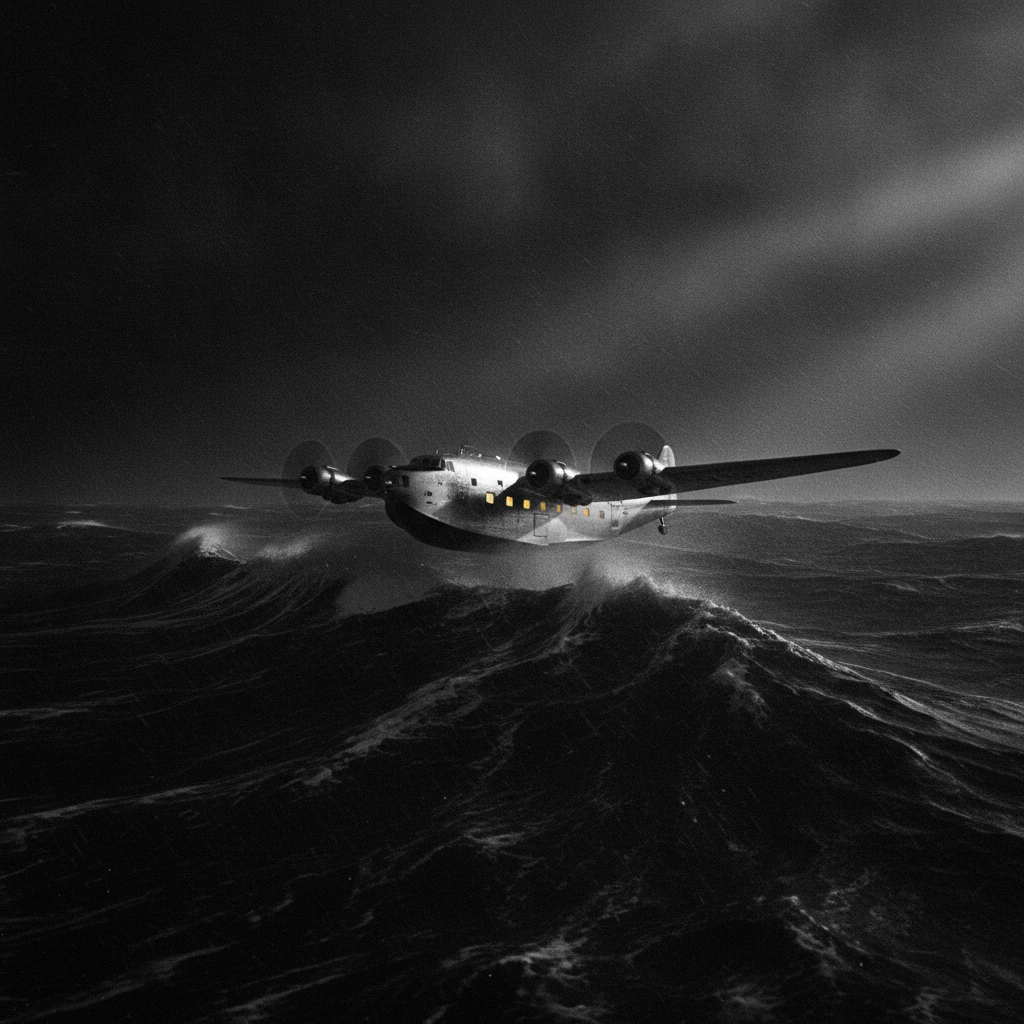
Star Tiger: The Airliner That Said All Was Well, Then Vanished
At 03:15 in the morning of 30 January 1948, a radio operator on the island of Bermuda heard a routine call from an airliner somewhere over the dark Atlantic.
The crew asked for a bearing, a direction to steer by. The operator worked it out and sent it back: 72 degrees.
At 03:17 the aircraft confirmed it had received the bearing. The crew expected to land at about 05:00.
Nothing in the voice or the messages suggested any trouble.
At 03:50 the operator called the aircraft again. There was no answer.
The aircraft was called the Star Tiger. It was carrying 31 people. Not one of them, and not one piece of the aircraft, was ever found.
This is the mystery in one sentence: a modern airliner, flown by an experienced crew, sent a calm message about 2 hours from its destination, and then disappeared without a distress call and without leaving a single trace.
The flight
The Star Tiger was a new British passenger aircraft with 4 propeller engines. It belonged to a British airline that flew between London and South America.
That winter, the route to the Caribbean ran from London to Lisbon, then to the Azores, a group of Portuguese islands in the middle of the Atlantic, about 1,500 km west of Portugal. From there came the longest and hardest leg: more than 3,000 km of open ocean to Bermuda, a small British island about 1,000 km off the east coast of the United States.
On board were 6 crew and 25 passengers. Some newspapers of the time gave different totals, but the official inquiry counted 31.
One passenger was famous: a senior air marshal of the Royal Air Force, a commander of British air power in North Africa and in the invasion of France during the war. When his death was reported, it appeared on the front page of a major American newspaper on the same day as the news of the assassination of India's independence leader.
The journey had problems from the start. On 28 January the departure from Lisbon was delayed for about 2 and a half hours while mechanics worked on one of the engines.
When the aircraft reached the Azores, the weather over the ocean was bad. The crew stayed the night.
On the afternoon of 29 January, at 15:34, the Star Tiger took off from the Azores for Bermuda.
A low, rough night
Another aircraft of the same airline was flying the same route that night, carrying cargo. It had left a little earlier. The 2 crews could compare notes by radio.
The Star Tiger's captain chose to fly very low, at about 600 metres above the sea.
The sources do not agree on why. The inquiry record describes it as a way to avoid the strongest headwinds higher up. A later account says it was to deal with a problem in the cabin pressure system. Both may be true. Either way, the aircraft spent the night flying close to the waves.
The weather was rough. There was heavy rain and strong wind, and the wind forecasts turned out to be wrong, especially at low altitude.
At 01:26 the Star Tiger was about 240 km behind the cargo aircraft. By then it had passed what pilots call the point of no alternative. From there on, it could no longer turn back to the Azores or divert to Newfoundland. It had to reach Bermuda.
At about 02:00 the navigator fixed the aircraft's position from the stars. The wind had pushed it about 100 km off its planned course. He corrected it, and the arrival time was pushed later.
At 03:04 the radio operator on board asked Bermuda for a bearing. The signal was too weak to take one.
At 03:15 he asked again. This time it worked. Bermuda sent back 72 degrees, accurate to within about 2 degrees.
At 03:17 the Star Tiger acknowledged the message.
That was the last time anyone heard from it.
The silence
At 03:50 the Bermuda operator called the Star Tiger. No reply.
At 04:05 he tried again. At 04:11 the cargo aircraft landed safely in Bermuda. Its crew reported that, in the last part of the flight, they had met no turbulence, no ice, no fog and no thunderstorms.
At 04:40 Bermuda tried a third time. Then the emergency was declared.
**This is where the documented record of the Star Tiger ends: a message received at 03:17, about 550 km from Bermuda. Everything after that is guesswork.**
The search
A large search began the same morning.
For 5 days, despite worsening weather, 26 aircraft flew a total of 882 hours over the ocean around Bermuda. Ships joined them.
They found no survivors. They found no bodies, no wreckage, no life rafts and no oil on the water.
On 1 February the crew of an American bomber reported boxes and an oil drum floating about 520 km northwest of Bermuda. Nobody could connect them to the Star Tiger.
There was one other report. The crew of a merchant ship said that during the night they had seen a low-flying aircraft with blinking lights, roughly halfway between Bermuda and the coast of the United States. If that was the Star Tiger, it was far to the north of its course. Nobody was able to confirm it.
The airline immediately grounded all its aircraft of the same type.
The inquiry
In April 1948, a public inquiry opened in London. It sat for 11 days. A senior judge led it, with an aircraft engineer from the government's aviation research centre among his advisers.
The report was published on 21 August 1948.
It found some "want of care and attention to detail" in how the flight had been planned. But it found nothing serious enough to explain the loss. It stressed that the crew were highly experienced.
Its conclusion was blunt. It said that no more baffling problem had ever been presented for investigation, and that "the fate of Star Tiger must remain an unsolved mystery."
The head of the airline objected strongly to the way the inquiry was run. Soon afterwards, the airline dismissed him.
And then it happened again
On 17 January 1949, almost a year later, another aircraft of exactly the same type and the same airline took off from Bermuda for Jamaica. It was called the Star Ariel. It carried 20 people.
The weather was excellent. Not long into the flight, the captain sent a routine message saying he was changing radio frequency.
Nothing was heard from it again. Ships and aircraft searched a huge area of ocean. They found nothing.
The second inquiry also concluded that the cause was unknown.
After the loss of the Star Ariel, this version of the aircraft never carried passengers again.
So the story ends with what is known and nothing more. The Star Tiger was flying low, in strong wind, a little late and slightly off course, with fuel for about 3 and a half hours. It sent a normal message. And then it was gone, along with the 31 people on board.
Conclusions and Open Questions
The inquiry itself said it could only suggest possibilities, none of which reached the level of probability. Here are the main ones, each with its strength and its weakness.
**The fuel ran out.** The evidence: the aircraft carried a heavy load for its fuel reserve. On 2 earlier flights on similar routes, this very aircraft had been forced to divert for fuel. 2 months earlier, another aircraft of the same type had landed with less than 450 litres left. The strong headwind could have burned more fuel than the crew calculated. And the valves for the reserve tanks were in the passenger cabin, so a crew member had to walk back to switch them. The problem: at 03:15 the crew sounded calm, and by later estimates they should still have had fuel to spare for the last stretch.
**A mistake with the altitude.** The evidence: every position report the crew sent gave the altitude as about 6,000 metres, 10 times higher than the 600 metres they were really flying at. One theory holds that a tired crew lost track of their real height and, while descending toward Bermuda, flew into the sea. The altimeters of the time were known to be easy to misread in exactly this way. The problem: the aircraft also had a radio altimeter, which measured the real height above the water. And this was an experienced crew.
**A sudden failure, too low to recover.** The evidence: at only 600 metres, a fire, an engine failure or a problem with the controls would leave the crew seconds, not minutes. That would explain why there was no distress call. The problem: there is no physical evidence at all for any particular failure.
**Sabotage.** The evidence: the airline's dismissed chief claimed that both the Star Tiger and the Star Ariel had been sabotaged, and that a known saboteur had been seen near the aircraft before its last take-off. The problem: he never produced proof, and no investigation ever found any.
**Something unexplained in the "Bermuda Triangle".** The loss of the Star Tiger and the Star Ariel later became 2 of the best-known stories behind the legend of the Bermuda Triangle. The problem: the legend was created years afterwards. The aircraft was flying over a very large and stormy ocean, in rough weather, near the limit of its range. None of the inquiries saw any need for an unusual explanation.
What remains open:
Why did a crew that was calm at 03:17 never send a single word after that?
Where did the aircraft go into the water, and why did not one piece of it ever float to the surface?
And was the second disappearance, a year later in perfect weather, a coincidence, or a sign of a hidden fault in the aircraft itself, one that nobody ever found?