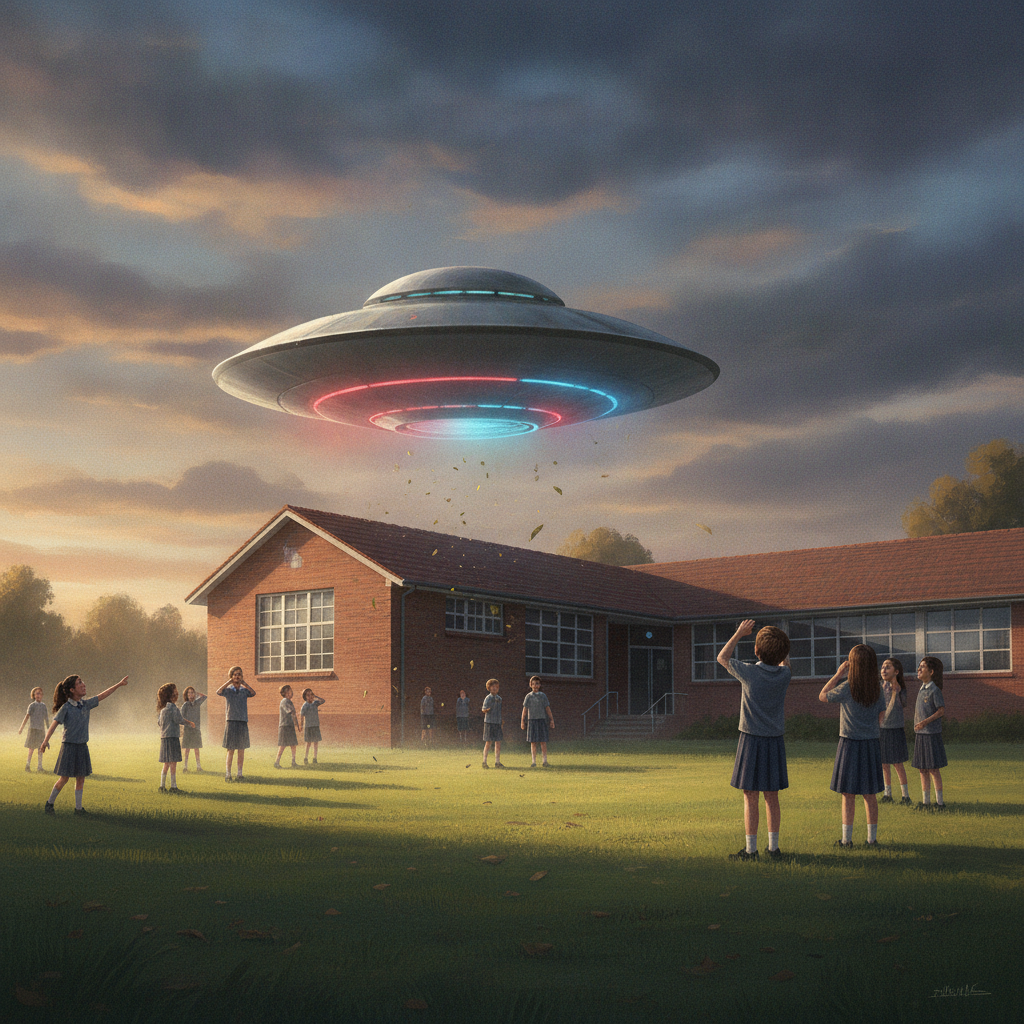
Recess at Westall: The Morning 200 Australian Schoolchildren Watched Something Land
Wednesday, 6 April 1966 was an ordinary autumn school day in Clayton South, a flat, half-built suburb on the southeastern edge of Melbourne. Westall High School stood beside Westall State School, the local primary, with playing fields between them and, beyond the fence, a stretch of rough grassland and market gardens known locally as The Grange.
Shortly before 11 a.m., a class of girls was running laps on the school oval when several of them stopped and pointed. Above the pine trees at the far end of the field, in clear daylight, was an object.
Descriptions of it are unusually consistent for a mass sighting. Most witnesses described something round or saucer-shaped with a raised dome on top, grey, silver or dull white, with no wings, no tail and no visible markings. Estimates of its size clustered around twice the length of a family car. Several people mentioned a faint purple tinge along one edge. It made little or no sound. Shaun Matthews, who was staying near The Grange rather than at the school, gave one of the few accounts from outside the school grounds and described an object of much the same size and colour.
Word travelled through the school the way news travels through a school. Within minutes classrooms were emptying. Students climbed the fence. Teachers followed, some to look and some to herd children back inside. Next door, pupils and staff at Westall State School were watching the same thing. Estimates of the total number of witnesses that morning have ranged from about 200 to more than 350; the figure most often cited is over 200 students and staff across the two schools.
Many witnesses also reported aircraft. The number most frequently given is five light planes, described as circling or crossing near the object without ever closing on it. Some witnesses described the object moving off, being followed, and then returning.
Then it descended. Witnesses watched it drop behind the stand of pines at the edge of The Grange, out of direct sight from the school grounds. Accounts of what happened next differ in detail but not in shape: after a period on or near the ground, remembered variously as seconds and as several minutes, it rose again and left at a speed that everyone present described as far beyond anything they had seen an aircraft do.
Dozens of students ran across the paddock. What they found, and what they later described, was a roughly circular patch of grass, flattened and swirled. The descriptions varied. Some remembered it as scorched or burnt, some as boiled, others simply as pressed down. Some recalled one circle, others two or three.
The school's reaction is, for many witnesses, the part of the day that has never made sense. Students were ordered back inside. A special assembly was called, at which pupils were told they had seen nothing of consequence and were not to discuss it. Several former students have said they were disciplined for speaking to reporters. At least one teacher reported that a camera or film was taken. Multiple witnesses have described unfamiliar men arriving at the school within a day or two, some in dark suits and some in blue uniforms that staff did not recognise, conducting interviews behind closed doors. The science teacher Andrew Greenwood, one of the adult witnesses, later said he was warned in blunt terms not to talk about what he had seen.
The event was not hidden at the time. The Dandenong Journal, the local paper, put it on the front page on 14 April 1966 and followed it up a week later, quoting students and residents by name. The Age, on 7 April, offered the first explanation: the Weather Bureau had released a balloon from Laverton at 8.30 that morning, and westerly winds could have carried it toward Clayton. On 9 April, Royal Australian Air Force personnel and civilian UFO enthusiasts inspected the site and reported finding nothing of interest. Sightseers kept arriving until the landowner burned the paddock off to discourage them.
And then, for more than thirty years, the case effectively disappeared. No substantial official file on Westall has ever been produced. The event survived as a private memory shared by several hundred adults who had once been children together on a single morning.
It resurfaced in the early 2000s, when Shane Ryan, a Canberra-based academic, began systematically tracing former Westall pupils and staff. Over several years he collected accounts from more than 100 witnesses, many of whom had never spoken publicly and most of whom had had no contact with one another in the intervening decades.
On 8 April 2006, forty years after the event, a witness reunion was held at the Westall Tennis Club hall in Clayton South. Former students who had not met since 1966 compared what they remembered. The documentary that grew out of Ryan's research, Westall '66: A Suburban UFO Mystery, first screened on Australian television on 4 June 2010, brought witnesses together again and returned the case to national attention, prompting a further wave of people to come forward.
Clayton South has since made a kind of peace with the story. The City of Kingston built a playground at Grange Reserve, on the open ground where the object was seen to descend, featuring a silver flying saucer and red slides. The documentary has been used in Australian classrooms as a case study in how to weigh popular accounts of historical events.
The witnesses are now in their seventies. Their accounts, recorded across sixty years by journalists, researchers and film-makers, have changed remarkably little.
Conclusions and Open Questions
Sixty years on, Westall has a documented core and a contested edge, and almost every argument about it is an argument over where the line falls.
The oldest explanation is the simplest. The Age proposed within a day that the object was a weather balloon released from Laverton that morning. Its strength is that a balloon is silver, roughly the right shape at a distance, silent, and undeniably in the sky that day. Its weakness is that a weather balloon does not depart at high speed, does not explain the reported aircraft, and cannot easily account for hundreds of people at two schools converging on the same description.
The most substantial explanation came from the Australian researcher Keith Basterfield, who located material in the National Archives relating to HIBAL, a joint Australian and American high-altitude balloon programme that monitored atmospheric radiation after British nuclear testing at Maralinga. HIBAL balloons were launched from Mildura, carried instrument payloads, and had a white-silver appearance with a parachute and a gas tube trailing from the top, which is a reasonable match for a domed disc seen at a distance. A stray HIBAL flight would also explain a rapid, discreet recovery and official reluctance to discuss it. The weakness is that Basterfield did not find a document placing a specific HIBAL flight over Clayton South on 6 April 1966, and a descending balloon does not climb away again.
The American sceptic Brian Dunning has suggested that at least part of the event was a nylon target drogue, a windsock-like sleeve towed behind an aircraft for gunnery practice and in use by the RAAF at the time. That would explain the circling planes. Dunning has been explicit that he offers it as a partial answer covering one portion of the sighting rather than the whole.
A fourth line of argument concerns memory rather than objects. The Australian researcher Richard Saunders has pointed out that the systematic interviews were conducted some thirty-six years after the fact, in a decade saturated with space-race imagery and newspaper flying-saucer stories, and that memory contagion between witnesses who by then knew each other could have smoothed hundreds of vague recollections into one shared narrative. Its weakness is that it does not touch the contemporaneous record: the 1966 newspaper coverage, and above all the school's own immediate response.
Some argue that what came down at The Grange was a classified aircraft, human-made, and that the secrecy is the ordinary secrecy surrounding a recovered prototype. One theory holds that the object was not of terrestrial origin at all, which is what a large share of the witnesses themselves have always believed. Neither can be tested, because nothing was kept: no photograph of the object is known to survive, no soil sample was taken, and no file has surfaced.
What remains unexplained is not really the object. It is the response. If several hundred children saw a weather balloon, there was no reason to convene an assembly, no reason to warn a science teacher, and no reason for a camera to be confiscated. If nothing of interest was found on 9 April, there is no obvious reason for the case to be absent from the official record entirely.
The open questions are these. Where are the RAAF and Department of Supply files for that week, and were they ever created? Who were the men in unfamiliar blue uniforms, and on whose authority did they interview minors? Was a HIBAL flight airborne over Victoria that morning, and if so, why has no flight record been produced? And why, sixty years later, do witnesses who have never met still describe the same domed silver shape sinking behind the same line of pines?