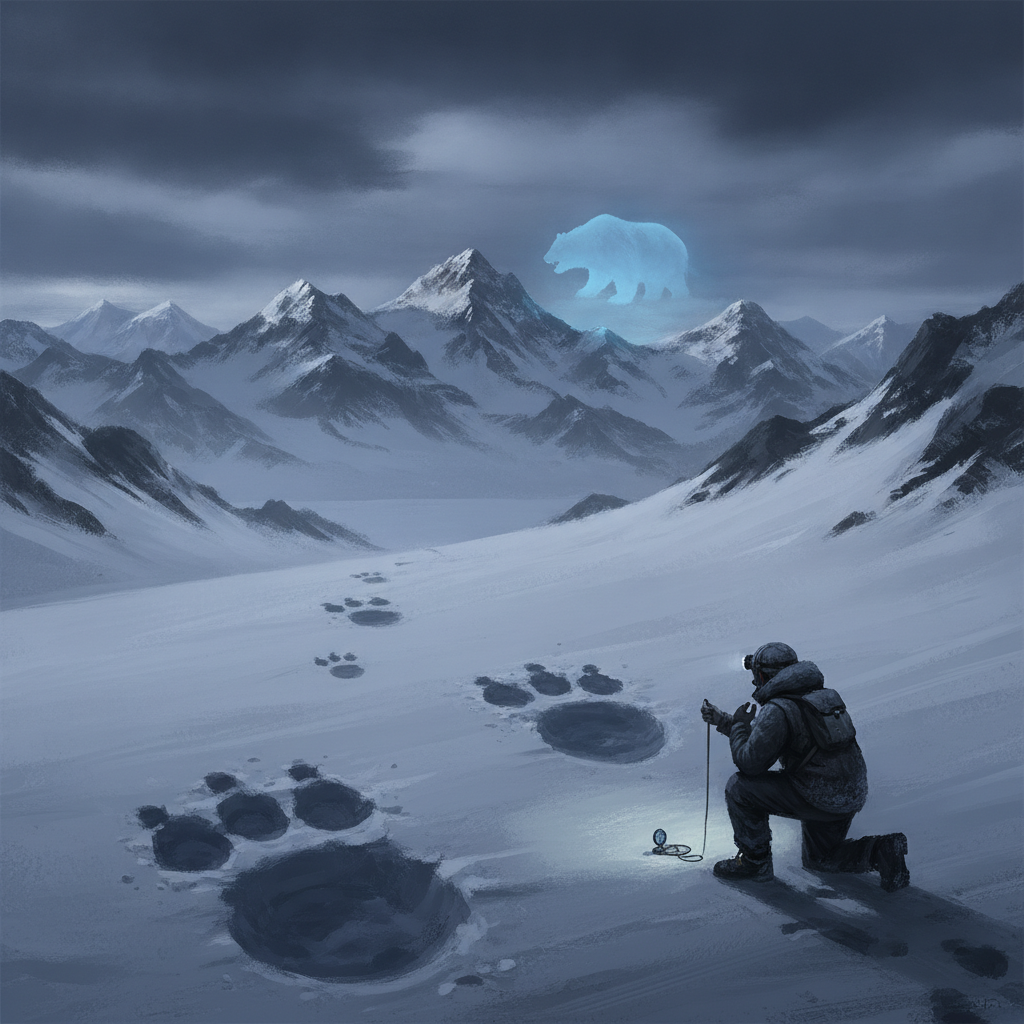
The Yeti Under the Microscope: How DNA Quietly Closed the Case
On the morning of 8 November 1951, two exhausted men were picking their way down a glacier below the Menlung La, a high pass on the border of Nepal and Tibet, when the snow in front of them stopped being empty. Eric Shipton, one of the most experienced Himalayan climbers alive, and his companion the surgeon Michael Ward had spent weeks probing the southern approaches to Everest. Now, at somewhere between 5,000 and 5,500 metres, a line of tracks ran across the fresh snow ahead of them and vanished over the ice. They were large and they were clear, and in the clearest of them a broad, splayed toe pressed into the crust. Their Sherpa companion Sen Tensing had no doubt what had made them. Shipton, who carried no ruler, laid his ice axe alongside one print, set Ward's boot beside another, and took four photographs before the sun could melt the evidence away.
Those photographs went around the world. Published in The Times that December, one image in particular, a single print with an ice axe for scale, became the most famous piece of physical evidence the yeti has ever produced. Here at last was something that could be measured: not a traveller's tale, not a monk's story, but a mark in the snow captured on film by a man whose competence nobody questioned. Shipton himself never claimed to know what had made the track.
The belief was far older than any camera. In the villages of the Everest region the yeti, a word that in Sherpa carries the sense of a rock-dwelling wild man, was not a monster of legend but a fact of the mountains: dangerous, elusive and real. And there was more than talk. Several monasteries kept relics said to be its remains: conical, hairy scalps brought out for festivals, and, at the monastery of Pangboche, a mummified hand said to be the yeti's own. For centuries these objects sat where no laboratory could reach them, protected by altitude, by faith and by the simple absence of anyone able to test them. They were the hard core of the mystery, the physical things that believers could always point to when the sceptics grew loud.
The hand at Pangboche has a stranger history than the yeti itself. In 1958 the explorer Peter Byrne, obsessed with the creature, talked his way into the monastery and, by his own later account, quietly removed one of the hand's fingers, wiring a human finger in its place so the monks would not notice the gap. The stolen finger was smuggled out of Nepal, and the story that has attached itself to it, hard to prove but persistent, is that the actor James Stewart carried it onward hidden in his wife's luggage. For half a century it was lost. Then, in 2008, a finger bone labelled as coming from the Pangboche hand turned up in a box in the Hunterian collection of the Royal College of Surgeons in London. At last there was something to test. In 2011 Rob Ogden, working in Edinburgh, sequenced it. The result was unambiguous: human, closely matching the people of that very region.
What finally moved the yeti from folklore toward forensics was not a braver expedition but a quieter revolution: the ability to read DNA from a scrap of hair or a fragment of bone. In 2012 the Oxford geneticist Bryan Sykes issued an open invitation to museums, collectors and monster-hunters worldwide to send him samples they believed came from unknown apes. Thirty-six proved usable. One by one they resolved into the mundane: bears, a horse, a porcupine, a raccoon, cows, a human being. But two hairs, one from Ladakh in India and one from Bhutan, returned something odd. Their closest genetic match was to an ancient polar bear. Sykes, publishing in the Proceedings of the Royal Society B in 2014, raised the possibility that an unrecognised bear, perhaps a brown and polar hybrid, still walked the Himalaya.
It did not survive contact with other geneticists. Within months researchers including Ceiridwen Edwards and Ross Barnett re-examined Sykes's sequences and showed that the match was an artefact of the short fragment he had used; the very same DNA fit an ordinary Himalayan brown bear perfectly well. There was no ancient polar bear in the Himalaya, only a living brown one that nobody had bothered to suspect. The yeti-bear evaporated almost as quickly as it had appeared, a demonstration of how easily a fragment of data can be made to say something marvellous.
The firmer answer came in 2017. Charlotte Lindqvist of the University at Buffalo and her colleagues assembled nine specimens long attributed to the yeti, comprising bone, tooth, skin, hair and a scrap of faeces, gathered across the Himalaya and the Tibetan Plateau, and read their mitochondrial DNA. The verdict was almost monotonous in its consistency. Eight were bears: one Asian black bear, one Himalayan brown bear and six Tibetan brown bears. The ninth, a supposed yeti tooth, belonged to a dog. There was no unknown primate anywhere in the collection, and no polar bear either.
So the case, as far as physical evidence goes, is closed. Every relic that has ever reached a laboratory has come back as a bear, a dog or a human being. And in a turn the monster-hunters could hardly have wanted, the hunt produced real science along the way. Lindqvist's genetic work sharpened the picture of how the Himalayan brown bear, an isolated and endangered animal, split from its Tibetan cousins during the ice ages. The chase for a creature that was not there had illuminated one that was, and one badly in need of protection.
What remains is not the DNA but the snow. The relics have all confessed, the laboratories have done their patient and unglamorous work, and the answer they return is bears, dogs and men. Yet the Menlung print still sits in its old photograph, sharp and strange. The Himalaya are still vast and still, in their higher reaches, barely walked.
Conclusions and Open Questions
The oldest sceptical answer belongs to Edmund Hillary, who held that the footprints are ordinary animal tracks distorted by the sun: a fox, a bear or a snow leopard walking in soft snow, the prints melting and merging until they swell into something monstrous. Its strength is that it needs nothing exotic and matches how snow actually behaves in mountain sunlight. Its weakness is that it asks us to believe the sharp, toed detail in Shipton's best photograph is pure accident of melt.
The zoologist's answer, now well supported by the genetics, is the bear. One theory holds specifically that a Himalayan brown bear walking on its hind legs, setting its hind foot partly over its fore print, leaves a track a frightened traveller could read as bipedal and manlike. Its strength is that the DNA agrees and the anatomy works. Its weakness is that it strains to account for the size and clarity of the very best prints, and for the insistence of hunters who knew bears intimately.
A third theory treats the sightings rather than the tracks. Some argue that Himalayan encounters borrow from creatures glimpsed at the edge of the range, langurs, or bears reared up in silhouette, fused with imagination, cold and thin mountain air. Its strength is its psychological honesty about how an exhausted brain fills in gaps. Its weakness is that it explains the witnesses without quite explaining the footprints they photographed.
At the far end sits the cryptozoological claim that a genuine unknown hominid survives, perhaps a relict population of something like Gigantopithecus, the giant ape that really did once live in Asia. Its strength is that it takes the consistency of the reports seriously. Its weakness is close to fatal: not one bone, tooth or hair has ever, under test, belonged to such a creature, and a breeding population of large apes could hardly leave no trace at all.
Two things genuinely remain unexplained. The first is cultural. People who had lived among Himalayan bears for countless generations, who hunted them, feared them and knew their tracks in the snow, nonetheless insisted the yeti was something else. If the animal behind the legend is simply the brown bear, it is not obvious why the very people who knew that bear best drew so firm a line between it and the thing they called the yeti. The second is evidential. Lindqvist tested nine objects that happened to survive and happened to be collected. A negative result on nine relics is powerful, but it is not the same as searching a mountain range the size of the Himalaya and finding nothing.
The open questions follow from that gap. The genetics has shown, beyond reasonable doubt, that the relics are not a new primate; it has not shown, and cannot show, that every strange track and every startled sighting across two thousand kilometres of the least-explored terrain on Earth was a bear. Why does the Menlung print, examined and re-examined for seventy years, still resist an entirely comfortable explanation? Was the yeti ever a single thing at all, or a very old and useful name that the mountains hung on several different realities at once: a bear on its hind legs in failing light, a track bloated by the noon sun, and a folk memory of the real dangers of the high country?