Sixty-Two Children, One Story: The Ariel School Landing
The Ariel School sat on a quiet stretch of farmland near Ruwa, a small town roughly twenty two kilometres southeast of Harare, Zimbabwe. It was a private primary school, well kept and unremarkable, the sort of place where the biggest event of a normal week was a sports fixture. On Friday, 16 September 1994, at about ten in the morning, the bell rang for the mid-morning break and roughly two hundred pupils spilled out onto the playground. The teachers were in a meeting in another building. For about fifteen minutes, the children were effectively on their own.
What a large group of them then reported has never been satisfactorily explained.
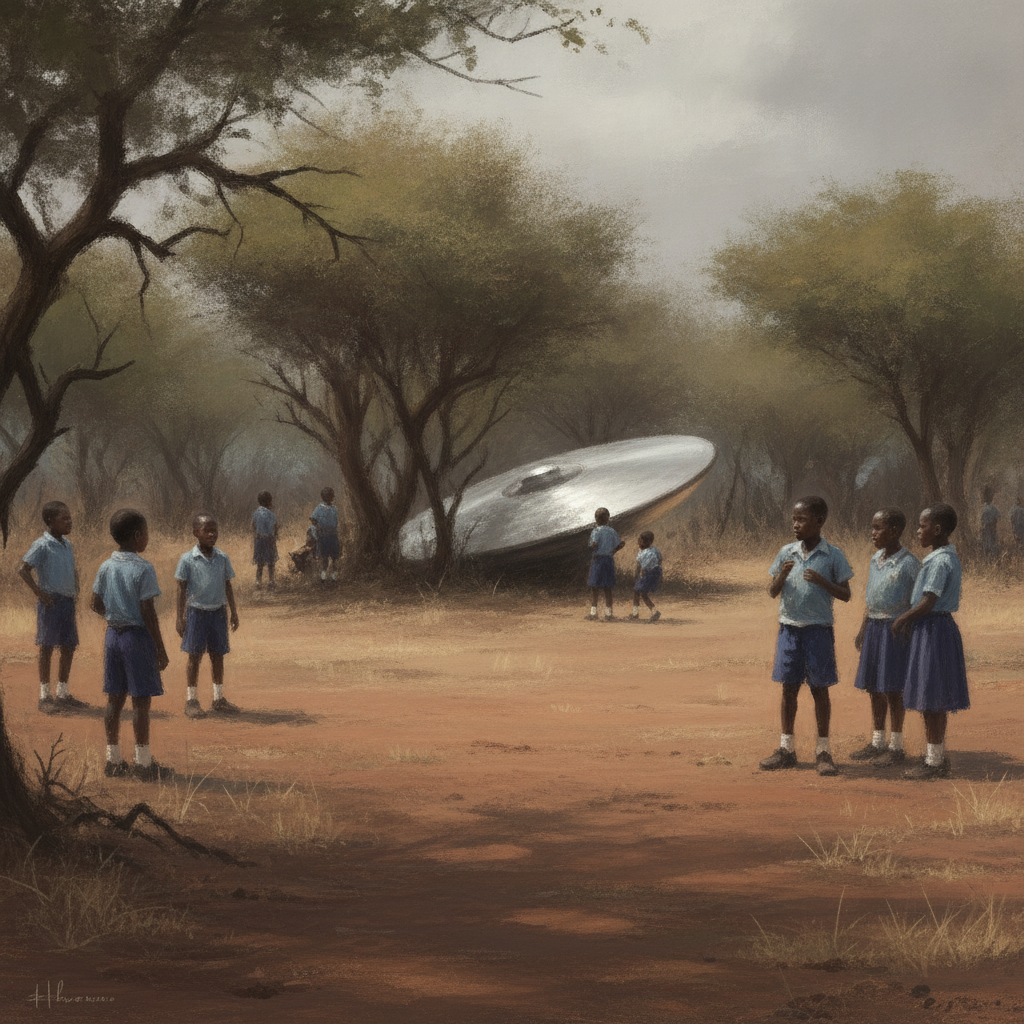
Children playing near the edge of the schoolyard said they noticed something in the sky above the rough scrubland that bordered the property, an area of thorn bush and long grass that the pupils were not allowed to enter. They described one silver, disc-shaped object, and in several accounts two or three smaller ones, descending and coming to rest just beyond the fence line. The object was close enough that the children argued afterwards about how large it was, and close enough that some of them said they could see it clearly settling onto the ground rather than hovering.
Then, according to the children, figures appeared. The descriptions given in the days that followed were unusually consistent for a group of witnesses aged roughly six to twelve. They spoke of one small being, with several children reporting a second one on or near the craft. The figure was short, perhaps the height of a small child, dressed in a tight black one-piece suit. It had a thin neck, a large head out of proportion to its body, long black hair, and very large black eyes with no visible whites. Several children specifically described how it moved, saying it walked strangely, as though it were bouncing, or moving in slow motion, and that it seemed to be watching them.
The reaction on the playground was not wonder. It was panic. Younger pupils screamed and ran. Some of the older ones stayed and watched. A few children later said the figure looked directly at them and that a message entered their minds without being spoken, a message about the Earth, about pollution, about human beings destroying their own planet. Children ran to the tuck shop and to the school buildings shouting that there were monsters in the bush. The adults who first heard them, understandably, did not take it seriously.
There was a background to that morning. Two nights earlier, on 14 and 15 September 1994, a spectacular string of lights had crossed the night sky over Zimbabwe, Zambia, Botswana and South Africa, watched by thousands of people and discussed on radio and in newspapers across the region. Astronomers later identified it as the re-entry of a spent Zenit-2 rocket stage associated with the launch of the satellite Cosmos 2290. For two days, southern Africa had been talking about strange things in the sky.
By the following Monday, the story had reached the press. The headmaster, faced with dozens of agitated pupils and worried parents, took a straightforward step: he asked the children to write down and draw what they had seen, separately, in their own words.
On 19 September, Tim Leach, the BBC's correspondent in Zimbabwe, came out to the school and filmed interviews with the children. Leach was a veteran journalist who had covered conflict in the region. The footage he shot, in which children calmly and repeatedly describe the craft and the figure to a sceptical adult, became the single most-viewed piece of evidence in the case. Leach was shaken by it. He later said he could handle war zones, but that he could not handle this, and he largely stepped away from the story afterwards.
The next day, 20 September, Cynthia Hind arrived. Hind was Zimbabwe's best known UFO researcher and the editor of the newsletter UFO Afrinews, and she was the first investigator on the ground. She spoke with the children in small groups of four to six, took written statements and asked each of them to draw what they had seen. The drawings are the core of the archive: dozens of crayon sketches, made by children of very different ages and drawing abilities, showing a silver disc on or just above the ground and a small dark figure with an oversized head and enormous black eyes.
Hind also recorded something that is often left out. Not every child interpreted the figure as a visitor from another world. Some of the pupils, drawing on Shona and Ndebele folklore, thought immediately of the tokoloshe, a small malevolent creature from local tradition. The children were not working from a single shared script.
In November 1994, about two months after the event, John Mack flew to Zimbabwe. Mack was a professor of psychiatry at Harvard Medical School and a Pulitzer Prize winner for his biography of T. E. Lawrence, and by then he was also a deeply controversial figure for his clinical work with people who reported alien encounters. At Ariel School he interviewed roughly a dozen children individually, with parents present and with the headmaster's cooperation, and he filmed the sessions. He pressed the children on details, invited them to say they had made it up, and reported that none of them would. Mack concluded that the children were describing something they genuinely believed had happened to them and that they showed the emotional signature of real experience rather than invention. It was in Mack's interviews that the telepathic environmental message became a prominent feature of the account.
Afterwards, the school and the town wanted the matter closed. Many of the children learned quickly that talking about it invited ridicule, and most of them stopped. Mack was killed by a drunk driver in London in 2004, ten years after the case, and never published a full account of it.
The story returned in adulthood. The American filmmaker Randall Nickerson spent more than a decade tracking down the former pupils, now scattered across several continents, and his documentary Ariel Phenomenon was released in 2022; several witnesses also appeared in the 2020 film The Phenomenon. One former pupil, Emily Trim, exhibited paintings she described as connected to what she experienced that morning. In the 2023 Netflix series Encounters, a former pupil named Dallyn said the whole thing had grown out of him calling a shiny rock a spaceship, an account that contradicts both his own filmed testimony from years earlier and the statements of dozens of his classmates.
Conclusions and Open Questions
Nothing about the Ariel School case has been proven, and several conventional explanations have been put forward, each with a real weakness.
The most widely cited belongs to the sceptic Brian Dunning, who argues that the Zenit-2 rocket re-entry two nights earlier had primed the whole region for UFO talk, and that a schoolyard rumour then did the rest. The weakness is timing and kind: the re-entry was a night-time light in the sky, while the children described a daylight object on the ground at close range and a figure walking beside it. Priming can explain why children reached for the word spaceship. It does not obviously produce a shared description of a walking creature.
The writer Gideon Reid suggested the children had confused a touring puppet show, of the kind used at the time for AIDS awareness and literacy campaigns, with an alien encounter. No documentation has surfaced placing such a show at Ruwa that week, and the children were not describing a performance. Another sceptic, Oliver D. Smith, proposed a dust devil in the scrubland. That may account for a moving shape at a distance, but not for figures with faces and eyes.
The strongest conventional candidate is mass social contagion: one child sees something ambiguous, shouts, and within minutes a crowd of excited children has converged on a single story that each then remembers as their own. Supporting it is the fact that not every pupil on the playground reported seeing anything. Against it is the speed and the detail. Statements and drawings were collected within days by two independent adults, and they agree on specifics that a rumour does not usually deliver, including the figure's proportions and its peculiar gait.
The interview methods themselves have been fairly criticised. Hind spoke to children in groups, where each could hear the others, which risks contamination. Mack arrived two months late, and some argue that a well-known environmentalist asking children about a message from the visitors is likely to receive one. That criticism has force regarding the ecological message specifically, which is far more prominent in Mack's material than in Hind's earlier notes. It does not touch the core description, which was on paper before Mack landed.
What remains unexplained is the persistence. Most childhood fabrications collapse under adult scrutiny, especially after decades of social cost. Here, with one exception, the former pupils interviewed as adults on three continents have not recanted, and several describe lasting distress at not being believed. Some researchers argue this points to a genuine anomalous event; others hold that a vivid shared childhood memory, reinforced by repeated retelling and by the identity it created, can become permanently indistinguishable from experience. Both positions remain open.
The unanswered questions are simple and probably unanswerable now. What was the original trigger that the first child saw? Would individual, same-day interviews by a neutral investigator have produced the same convergence? And why, in a case with so many witnesses, is there not one photograph, not one adult witness, and not one confirmed piece of physical evidence from the ground beyond the fence?