The Belgian Wave: The Night F-16s Chased Something the Air Force Never Named
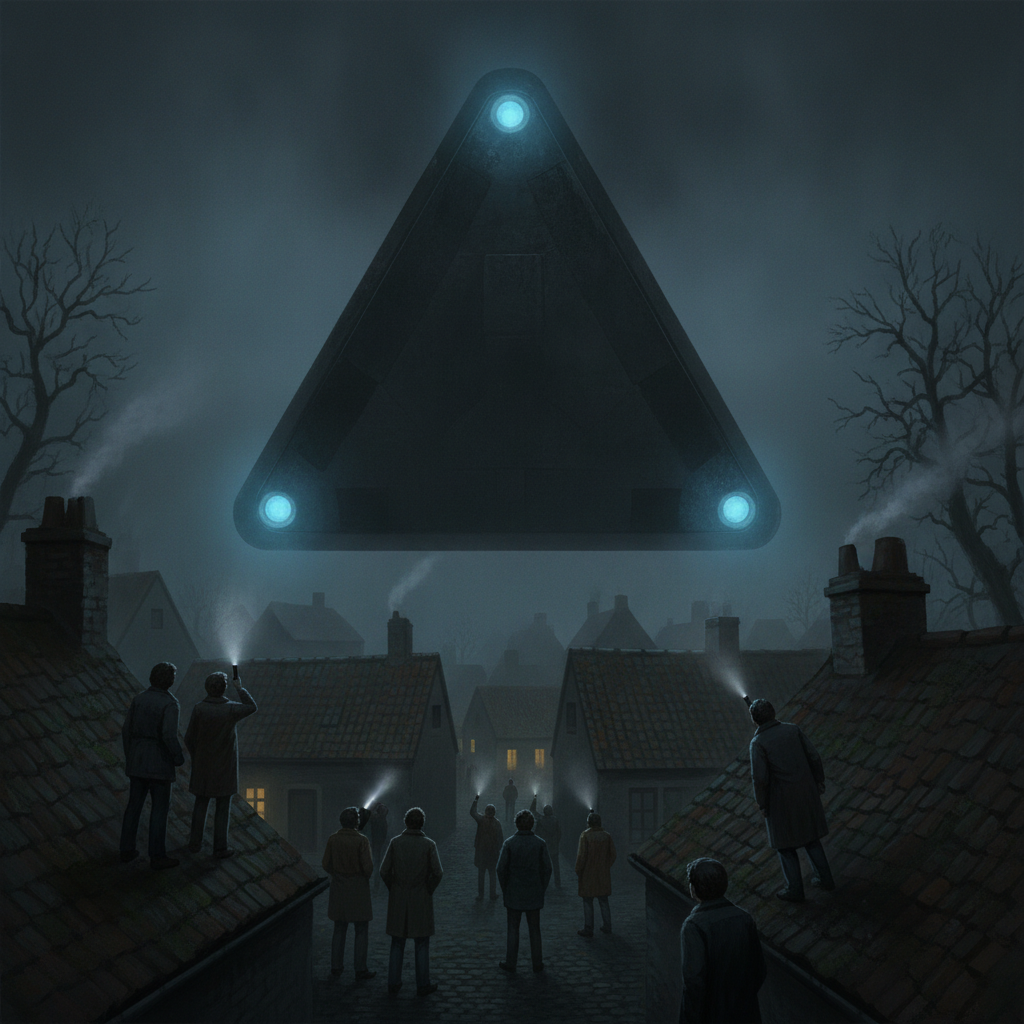
It was just after half past five on the evening of 29 November 1989 when two gendarmes on patrol near Eupen, a small town on Belgium's border with Germany, radioed in something they could not explain. Hanging low over a field was a huge dark platform, roughly triangular, three brilliant white lights burning at its corners and a pulsing point of red at its centre. It drifted slowly, almost without sound, then swung away toward a nearby reservoir. The object did not simply flash past; it lingered, drifting over the fields and then holding near the water, in view long enough for the two men to radio a full description, to be told to keep watching, and to keep watching still. The encounter lasted long minutes, not the fraction of a second a meteor allows. Within hours their report was one of around a hundred and forty that reached the gendarmerie that single night, from lorry drivers, families at their windows and off-duty policemen.
It was the opening night of what came to be called the Belgian wave. For months, from that November evening into the following spring, witnesses across the country described the same thing with unsettling consistency: a large, dark, silent triangle, flying low and slow, its corner lights unmistakable, sometimes hanging motionless as though parked in the air. By the time the reports finally thinned, an estimated 13,500 people said they had seen it. The civilian research society SOBEPS, working hand in hand with the gendarmerie, gathered some 2,600 written statements and later poured them into two thick volumes. Of the cases it examined in real detail, it judged that several hundred resisted any ordinary explanation.
The witnesses were not, on the whole, the people the subject usually attracts. They were gendarmes filing formal reports, engineers, teachers, whole families who pulled over on dark country roads and stood in the cold watching the thing pass. Many described not a distant light but a structure: a flat, dark underside, three or four steady lamps at the points of a triangle and a red beacon throbbing at the centre, moving so slowly and so low that several insisted no helicopter could have stayed airborne at that speed. A few heard a faint humming; most heard nothing at all, and it was the silence, more than the lights, that seemed to unsettle them most. Belgium was not the first place to report a giant triangle in the night sky, nor the last; similar dark, slow, silent wedges had been logged over the United States and would be again for years. But here the same basic shape was reported not in isolation but in an avalanche, over a small, densely populated corner of Europe crossed by more military and civil radar than almost anywhere on Earth.
For all the months of scattered sightings, the case turns on a single night: 30 to 31 March 1990. Shortly before eleven o'clock, the supervisor at the Control Reporting Centre at Glons began taking calls describing three unusual lights moving toward Thorembais-Gembloux, southeast of Brussels. A military radar at Semmerzake picked up an unidentified contact in the same sky. When the returns held and the ground reports kept coming, the order was given to scramble two F-16 fighters from Beauvechain air base. It remains, to this day, the only night of the entire wave on which jets were actually sent up.
Over roughly the next hour the two aircraft attempted nine separate interceptions. Several times their onboard radar achieved a lock, and each time the recordings seemed to capture something behaving impossibly: a target leaping from around 150 kilometres per hour to well over a thousand, and plunging thousands of feet, in a matter of seconds, accelerations no human crew could have survived. Then the lock would break, the contact would slide away, and the whole sequence would begin again. Through all of it, the two pilots, eyes on the sky the entire time, never once saw anything where their instruments insisted something was. And it was not only the pilots. On the ground that same night, a gendarme patrol reported watching lights overhead shift colour and formation, while the tower crews followed the whole drama live on their screens. Three separate radar systems, at Glons, at Semmerzake and aboard the fighters themselves, were drawn in before dawn.
What set Belgium apart from almost every other case in the files was the openness of the official response. Colonel Wilfried De Brouwer, then chief of operations of the Belgian Air Force, set up a small unit to work alongside the gendarmerie and SOBEPS, held a press conference while the wave was still in progress, and released the radar recordings for anyone to examine. He has never claimed the objects were alien; even now, as a retired major general, he says only that the core sightings remain genuinely unexplained. The Air Force's own eventual assessment was more cautious still, concluding that the technical evidence, radar included, was not solid enough to prove that anything abnormal had flown at all.
For twenty years the wave also had a face: the Petit-Rechain photograph, a crisp black triangle with a glowing lamp at each corner, taken in April 1990 and reprinted around the world. It was examined by analysts linked to NASA, to the French national centre for scientific research, and to the Belgian Royal Military Academy, and none could find the tell-tale signatures of a fake. Then, on 26 July 2011, a man named Patrick Marechal went on Belgian television and calmly explained that he had made it himself, years earlier, from a piece of painted polystyrene and a few small lamps, to play a joke on his workmates. He later muddied even that confession, telling one researcher he had been paid to disown the picture, a claim nobody has ever substantiated. Either way, the single most famous piece of hard visual proof had collapsed under its own author.
Conclusions and Open Questions
Strip the story down and the hard questions remain. How does a rumour, however contagious, march thousands of ordinary people into describing the same specific shape, corner lights and all? Why, if the March contacts were solid machines, did two trained fighter pilots see nothing where their radar swore something sat? If there was genuinely nothing in the sky, what were the ground station at Glons, the military radar at Semmerzake and the airborne sets aboard the jets all agreeing about? And if there truly was something, how did it shed a radar lock nine times in an hour and never once betray itself to a human eye?
The most serious skeptical answer comes from the Belgian physicist Auguste Meessen, who worked through the radar tapes in detail. He argued that rare cells of warm, humid air layered over colder air could bend radar beams and throw back false echoes, the phantom returns pilots have long called 'angels', and that the impossible speeds were an artefact of Doppler processing misreading motion relative to the fast-moving jets. Tellingly, some of the locks recorded negative altitudes, targets apparently below ground level. The strength of his account is that it explains the radar without needing any craft in the sky at all; its weakness, which Meessen never hid, is that it says almost nothing about the people on the ground, police among them, who described a solid, structured triangle passing slowly over their heads.
The rival explanations each light one corner of the case. Some researchers pointed to helicopters or secret prototype aircraft, perhaps American machines tested near a militarised border; but helicopters are not silent, no government has ever admitted flying anything over Belgium that winter, and nothing there explains a triangle hanging dead still. Others blamed the press, arguing that once the newspapers were full of triangles, thousands of people were primed to reinterpret bright planets, stars and distant aircraft as something stranger; the difficulty is that the very first Eupen reports came in before any publicity began. And the hoax explanation, tempting after Marechal's confession, founders on arithmetic: his was one photograph among thousands of independent accounts, and its exposure tells us nothing about the people who never saw it.
One theory holds that there was never a single thing to explain at all. On this reading the 'wave' was several unrelated phenomena braided together by circumstance: a genuine atmospheric oddity that fooled the radar on the worst night, a steady background of misidentified aircraft and planets, and a jittery national mood, primed by headlines, that stitched them into one story with one shape. That is speculation, not a finding, and nothing in the SOBEPS files proves it, though it would explain why every neat single-cause theory keeps leaving something left over. What the file will not do is close. More than thirty years on, the most haunting thing about the Belgian wave is the paperwork: a NATO air force that chased something across its own sky, recorded it on radar, showed its working to the public, and still wrote 'unidentified' at the bottom of the page.