The Squadron That Flew Into Nowhere: The Last Flight of Flight 19
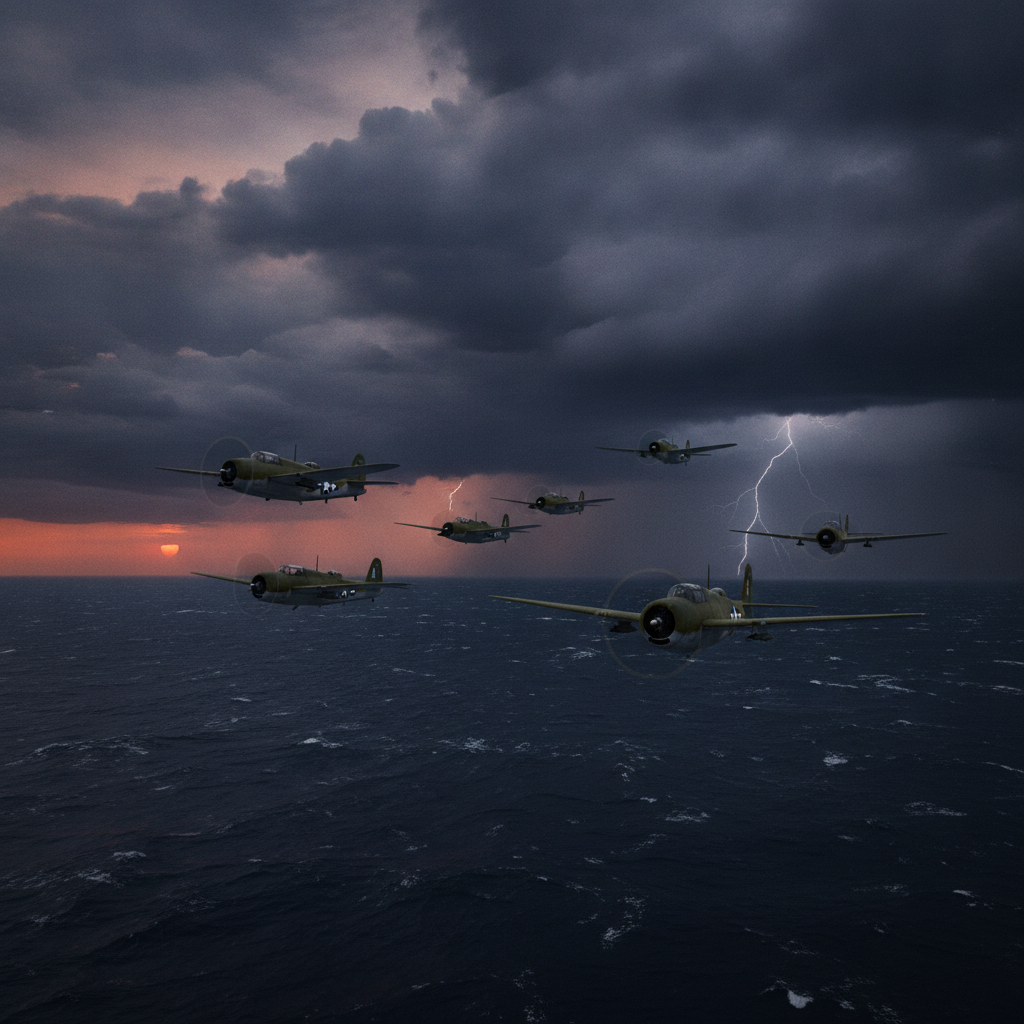
At ten past two on the afternoon of 5 December 1945, five Grumman TBM Avenger torpedo bombers lifted off the runway at Naval Air Station Fort Lauderdale and turned east over the Straits of Florida. The exercise, logged as Navigation Problem No. 1, was routine to the point of tedium: fly out to the Hen and Chickens Shoals in the Bahamas, drop practice bombs, run two more legs of a triangle, and be back on the ground before dark. Fourteen airmen were aboard the five aircraft. Not one of them, and not a single confirmed piece of their machines, has ever been found.
The flight leader was Lieutenant Charles C. Taylor, a combat veteran with roughly 2,500 hours in the air. He had flown torpedo bombers in the Pacific from the carrier USS Hancock, and he had arrived at Fort Lauderdale only recently from Naval Air Station Miami, where he had also served as an instructor. He was experienced, but he was new to this particular stretch of coast. Behind him flew four trainees with only about 300 hours each, roughly 60 of those in the Avenger. For the students this was the third and final time they would fly a basic navigation problem before qualifying.
The aircraft carried tail codes that still read like a roll call. Captain George W. Stivers of the Marines flew FT-117. Ensign Joseph T. Bossi of the Navy flew FT-3. Captain Edward J. Powers of the Marines flew FT-36. Second Lieutenant Forrest J. Gerber flew FT-81, and Taylor himself flew FT-28. Behind each pilot, in most of the planes, sat a gunner and a radioman, ordinary sailors and Marines whose names have largely slipped out of the legend even as Taylor's endured. In FT-28 alone were Aviation Ordnanceman George Devlin and Radioman Walter Parpart. Gerber's aircraft flew a man short: Corporal Allan Kosnar had asked to be excused from the exercise, and the request was granted. He stayed on the ground, and he lived.
About an hour and a half into the flight, radio operators ashore began catching fragments of an emergency. A student was heard saying, "I don't know where we are. We must have got lost after that last turn." A senior instructor, Lieutenant Robert Cox, was airborne near the base under the call sign FT-74. He picked up the traffic and tried to help, asking the confused voices to identify themselves. Then Taylor came on the air as FT-28 with the line that has defined the case ever since. Both of his compasses had failed, he said, and he was certain he was over the Florida Keys. "I don't know how far down and I don't know how to get to Fort Lauderdale."
He was wrong, and the error proved fatal. Taylor had in fact led the flight out over the Bahamas exactly as the exercise required, and the formation was somewhere north of them over the open Atlantic. Convinced instead that he was southwest of Florida over the Gulf of Mexico, he ordered the squadron onto a northeasterly heading, the one direction that carried the aircraft farther out to sea. Later he settled on a plan that reads, in hindsight, like a slow walk off the edge of the map: "We are heading 030 degrees for 45 minutes, then we will fly north to make sure we are not over the Gulf of Mexico."
Several of the students appear to have judged the situation better than their leader. Voices on the recording urge a turn to the west, toward the setting sun and the mainland. "If we would just fly west," one says, "we would get home." The formation nevertheless held together under Taylor, who kept doubting the westward course and at one point reversed it outright: "We didn't go far enough east. We may as well just turn around and go east again." In 1945 a student pilot did not abandon his flight leader, and Taylor was the only man in the group with real overwater experience.
Ground stations asked Taylor to switch to the emergency search and rescue frequency so that they could fix his position. He refused, unwilling to break up his flight in the failing light. "I cannot switch frequencies," he said. "I must keep my planes intact." The decision carried a measurable cost. On the crowded training channel no clean bearing could be taken, and the aircraft identification transponder was never picked up. By nightfall the shore stations still had no reliable position for the flight.
As dusk came on, the weather turned foul, with rising seas and hard wind over water that runs thousands of feet deep. In one of the last transmissions heard, Taylor told his men to close up and to ditch together the moment the first aircraft dropped below ten gallons of fuel. The Navy's investigators concluded what the physics demanded: the five Avengers, flown far past their endurance, ran their tanks dry and went into a black, storm lashed ocean. A ditching in daylight and calm water was survivable in a TBM. A night ditching into heavy swell, with exhausted crews and no fix on their position, very nearly was not.
Then the search itself turned tragic. That evening two Martin PBM Mariner flying boats went out from Naval Air Station Banana River to hunt for the squadron. One of them, PBM-5 number 59225 with thirteen men aboard, radioed a routine message minutes after takeoff and was never heard from again. At 9:15 that night the tanker SS Gaines Mills reported a burst of flame at sea, roughly a hundred feet high, burning for some ten minutes. The ship later passed through an oil slick near the Mariner's last known position and found no survivors. The type was notorious for leaking fuel vapor, and crews called it the "flying gas can." Six aircraft and twenty-seven men were gone in a single night.
What followed was one of the largest search operations the region had ever seen. For five days, hundreds of ships and aircraft combed roughly a quarter of a million square miles of ocean and swampland, from the Bahamas across the Florida peninsula and into the Gulf. They found floating debris that led nowhere and patches of oil that could have come from anything. Nothing recovered could be tied to Flight 19 or to the lost Mariner.
The Navy's board of inquiry ran to hundreds of pages, and it first laid the loss on Taylor's disorientation. When his mother protested that no wreckage had ever proved her son was at fault, and pointed out that a dead man cannot defend himself, the finding was amended to "cause unknown." Eighty years after the takeoff, the Atlantic has not returned one confirmed bolt of the five Avengers, or of the Mariner sent to find them.
Conclusions and Open Questions
The Navy's own investigators reached the first and still the most widely accepted conclusion: Taylor became disoriented, mistook the Bahamas for the Florida Keys, and led four inexperienced crews away from land until the fuel ran out. Its strength is that every link is documented, from the radio transcript to the weather reports. Its weakness is human rather than physical. It asks us to accept that a combat pilot with 2,500 hours could be so completely and stubbornly turned around, with the sun setting plainly in the west, and could carry four other aircraft with him.
Some aviation writers have refined this into a psychological argument: that Taylor suffered a fixation so strong that contradicting evidence simply did not register, the tunnel vision that has killed pilots before and since. One theory holds that his failure was never really about compasses but about authority, and that the same confidence which made his students trust him made him trust himself long past the point where the sky should have turned him around. It is plausible, and by its nature it cannot be tested.
The exotic readings begin with Vincent Gaddis, whose 1964 article in Argosy magazine coined the phrase "Bermuda Triangle" and gathered Flight 19 into it. Later retellings embroidered the record with lines Taylor never spoke, about white water and a strange sky, which appear in no contemporary log. From there some argue for magnetic anomalies beneath those waters, and others for something stranger still. The weakness is total: no physical trace, no instrument record, and no need for any of it, since aircraft flown past their endurance over open water run out of fuel for the most ordinary reasons.
What remains genuinely unexplained is the absence of wreckage. In 1991 five Avengers were found on the seabed off Fort Lauderdale and the story briefly reignited, until their serial numbers proved they were five unrelated wrecks from other accidents. The sea keeps offering false matches. Some argue that Flight 19 lies scattered and buried under silt far east of where anyone thinks to search, dragged and dispersed by the Gulf Stream in the hours before it settled. Nobody has tested that idea against the seabed.
The open questions are narrower than the legend suggests, and harder. Why did Taylor trust two failed compasses over the setting sun? Why did he cling to a channel that could not save him rather than the one that might? Why, when his students had the right instinct, did none of them break formation to save himself? And where, in a quarter of a million square miles, did fourteen airmen and thirteen would be rescuers come down? Until something is recovered, the plainest answer, an ocean and the dark, remains the only one with evidence behind it.