The Bermuda Triangle of Transylvania: What the Record Really Says About Hoia-Baciu
Drive west out of Cluj-Napoca for ten minutes and the city simply stops. The apartment blocks give way to a low hill carrying a wood of roughly 250 hectares of beech, oak, hornbeam and wild cherry. This is Hoia-Baciu: a municipal forest with a bus stop at its foot and a bike park inside it. It is also, according to a small library of books, television specials and travel features, the most haunted forest on Earth.
The wood takes the second half of its name from Baciu, the commune on its northern side. The Romanian word baci happens to mean shepherd, and that coincidence feeds the best known local story: a shepherd is said to have walked into the trees with a flock of some two hundred sheep and never walked out again. No parish register, no police file and no chronicle records the event. It survives purely as oral tradition, and it is the template for almost everything that followed.
The modern reputation of Hoia-Baciu begins with one man and a camera. Alexandru Sift, a biologist from Cluj with a serious amateur interest in photography, started walking the forest in the late 1950s and photographing it systematically. His method was mundane: hundreds of frames of empty clearings, tree lines and open sky, developed at home. What kept him going was what he said he found on the negatives: luminous shapes, geometric forms and occasional humanoid silhouettes in frames where he had seen nothing through the viewfinder. He kept at it for more than a decade and published some of the results in Romanian journals.
The case that carried the forest beyond Cluj was recorded on 18 August 1968, at 1:23 in the afternoon. Emil Barnea, a forty-five year old construction technician and former army officer, had gone out to a clearing about 4.7 kilometres west-southwest of the city with Zamfira Mattea, a thirty-four year old charity worker, and a second couple who later asked to stay anonymous. Barnea had walked off to gather firewood when he saw a bright disc high above the treeline. He shouted, ran back for his camera, a Soviet FED 2 with an f/2.8 lens loaded with ORWO film, and exposed four frames in the roughly two minutes the object stayed visible before it climbed away.
Three of the four photographs were published in Romanian newspapers on 18 September 1968. The fourth was held back because the anonymous couple appeared in it. What happened next is unusual for a UFO photograph of that period: the negatives were actually examined. A staff photographer at a Cluj newspaper, a photographic specialist at the Agerpres state news agency and a commercial laboratory all looked for signs of tampering and reported none. Technicians at the University of Cluj built scale models to reconstruct the geometry and concluded that the object was emitting its own light rather than reflecting sunlight. The investigator Florin Gheorghita reconstructed the sighting on site against the witnesses' accounts, and the Belgian analyst G. Delcorps later put the object's diameter at roughly 22.3 metres, again finding no sign of fakery.
The reaction closer to home was less generous. The director of the Cluj observatory dismissed Barnea in print as ignorant and, without offering any evidence, as an alcoholic. Popular accounts often add that Barnea lost his job over the affair; the detailed case files record the public ridicule but not the dismissal, so that claim should be treated as unverified. What is not in dispute is that he had nothing obvious to gain: no book, no lecture tour, no money from the most famous photograph ever taken over a Romanian forest.
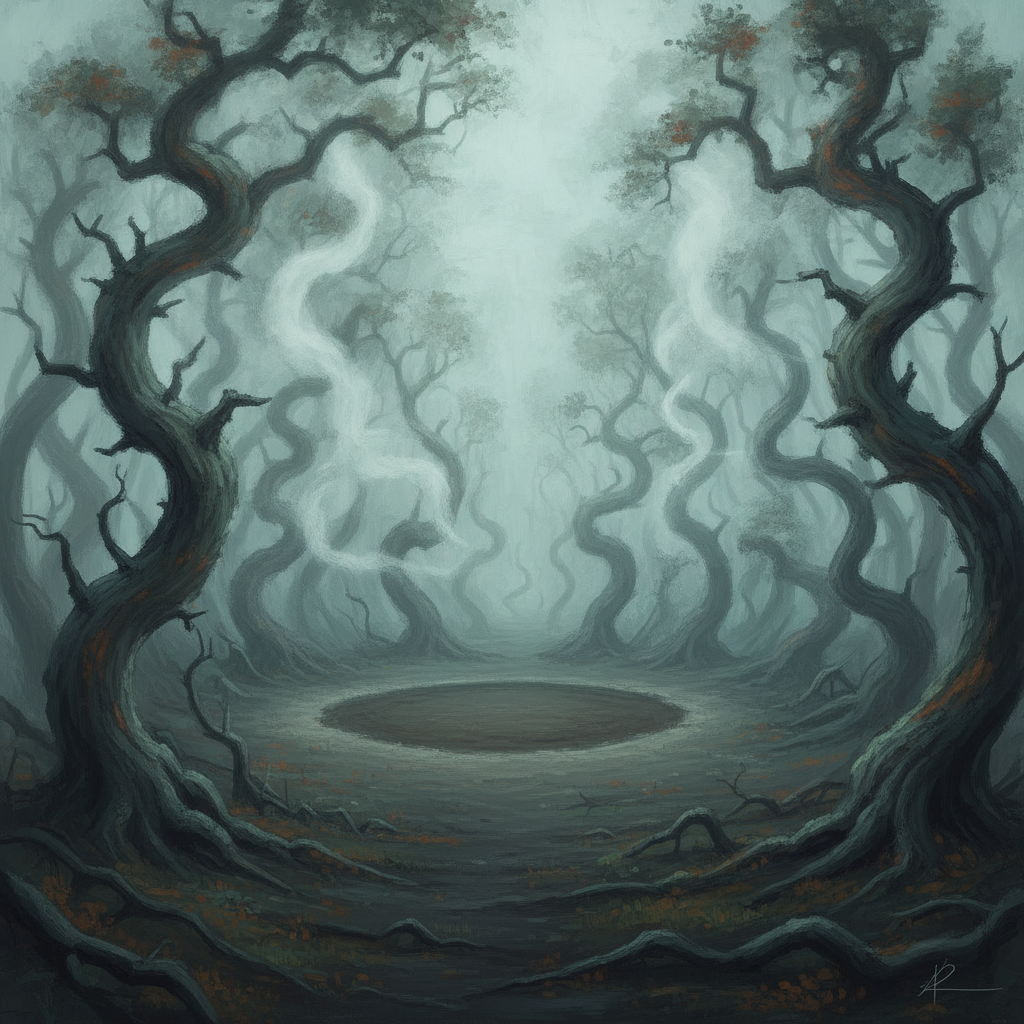
By the 1970s the forest had a resident investigator with scientific credentials. Adrian Patrut, a chemist at Babes-Bolyai University in Cluj, began a programme of soil sampling, magnetometry and radiation readings that he continued on and off for decades. His attention settled on Poiana Rotunda, the Round Clearing: an opening in otherwise dense forest, close to circular, in which, according to local accounts, trees simply do not take. Patrut reported localised electromagnetic anomalies concentrated around it, and said that soil taken inside the clearing differed from soil taken a short distance outside. Those results circulated widely in Romanian popular science and paranormal publications. They have never appeared in a peer-reviewed journal, and the clearing's own dimensions are quoted in the literature at anything from a few dozen metres to a full kilometre across, which tells you that the people arguing about it have not been working from the same measurement.
The forest's most photographed feature needs no instruments at all. Along parts of the northern slope the trees grow crooked: trunks that rise, bend sharply sideways and then correct upward again, some with pronounced spiral twists. It is the detail that convinces people before they have read a word of the history.
Against that background, visitors began reporting effects on themselves. The recurring list is remarkably stable across decades and languages: rashes, nausea, headaches, sudden anxiety, a feeling of being watched, and the sense of having lost time. There are stories of disappearances too, the most repeated being a five year old girl said to have walked into the trees and emerged five years later in the same unworn clothes with no memory of the gap. It carries no name, no date, no police record and no newspaper report. Journalists and researchers who have gone looking have not found a single verified death, disappearance or unexplained injury inside the forest. The symptoms are genuine reports, but self-reported, uncounted and never clinically studied.
What the forest does have, in quantity, is visitors. Foreign television crews arrived in the 2000s and fixed on it the label it now carries everywhere, the Bermuda Triangle of Transylvania. Guided day and night tours have run since 2013. On the same ground, often on the same afternoon, the wood functions as an ordinary city amenity: marked mountain bike trails, paintball and airsoft grounds, archery, joggers from the neighbourhoods below. It is entirely normal to pass a tour group hearing about vanished shepherds while a rider in a full face helmet drops past down a bermed descent.
Conclusions and Open Questions
Almost everything that makes Hoia-Baciu famous was assembled within living memory. That does not make it false, but it does mean the lore can be dated, and most of it dates from after 1968.
The most economical explanation is psychological. Researchers of anomalous experience point out that expectation shapes perception. A person who enters a wood already advertised as the most haunted on Earth, usually at night, in unfamiliar terrain where dense canopy distorts sound and light, is primed to read ordinary sensations as significant. Anxiety produces nausea and racing thoughts; nettles, ticks and plant sap produce rashes. The weakness of this account is chronological. Sift was photographing the forest before it had any reputation to speak of, and Barnea walked into that clearing in 1968 to have a picnic, not to hunt ghosts.
One theory holds that the cause is geophysical. Patrut's position, and that of researchers who followed him, is that the hill carries localised magnetic and electromagnetic anomalies capable of affecting instruments and, more speculatively, human perception. The idea has a long pedigree in parapsychology: the late Michael Persinger argued for decades that weak magnetic fields can generate a sensed presence, and his laboratory results repeatedly failed independent replication. In the Hoia-Baciu case the problem is more basic. The measurements have not been published where other scientists can check them, no independent team has repeated them, and a magnetometer will happily register buried iron or a forgotten pipeline as an anomaly.
For the bent trees, foresters offer an undramatic mechanism. On a slope, saplings pressed over by heavy winter snow and by the slow downhill creep of the soil bend while still flexible, then straighten upward as they grow, leaving a permanent knee in the trunk. Repeat that across a stand and you get a hillside of crooked trees, a common effect on European slopes. Its weakness here is that nobody appears to have published a survey of this particular stand, so a general explanation is applied to a specific case without a specific study.
Poiana Rotunda invites the same treatment. The mundane candidates are a pasture opening kept clear by generations of grazing and burning, compacted or shallow soil over rock, or the footprint of an old settlement. Any of them would explain a treeless circle. None has been tested. The clearing has never been excavated, and the soil analyses everyone cites have never been set out in full with methods and controls. Until they are, the statement that the soil is different is a claim, not a measurement.
The Barnea photographs are the hardest item to dismiss and the hardest to confirm. Sceptics reasonably note that a small object thrown or suspended near a camera can look like a large object far away, and that 1968 was not short of hoaxes. Supporters note that four separate examinations found no tampering and that the witnesses gained nothing. Both positions would benefit from something nobody has produced: the original negatives, re-examined with modern methods.
Some argue for stranger readings. One open theory treats the hill as a window area, a place where anomalous events cluster for reasons unknown. Another proposes that what Barnea photographed was a classified aircraft or high altitude balloon over Warsaw Pact airspace, which would explain both the object and the official eagerness to ridicule the witness. Neither has been demonstrated, and both are best held loosely.
What is left unexplained is narrower than the legend, but it is not empty. Nobody has identified the object on Barnea's four frames. Nobody has published a controlled soil study of the Round Clearing. And nobody has explained why the same short list of symptoms recurs among visitors who have never met one another. The open questions are equally concrete. Where are the 1968 negatives, and will whoever holds them release them for modern analysis? Will anyone survey the crooked stand and excavate the clearing? And how much of what visitors feel in Hoia-Baciu did they carry in with them, printed in a guidebook?