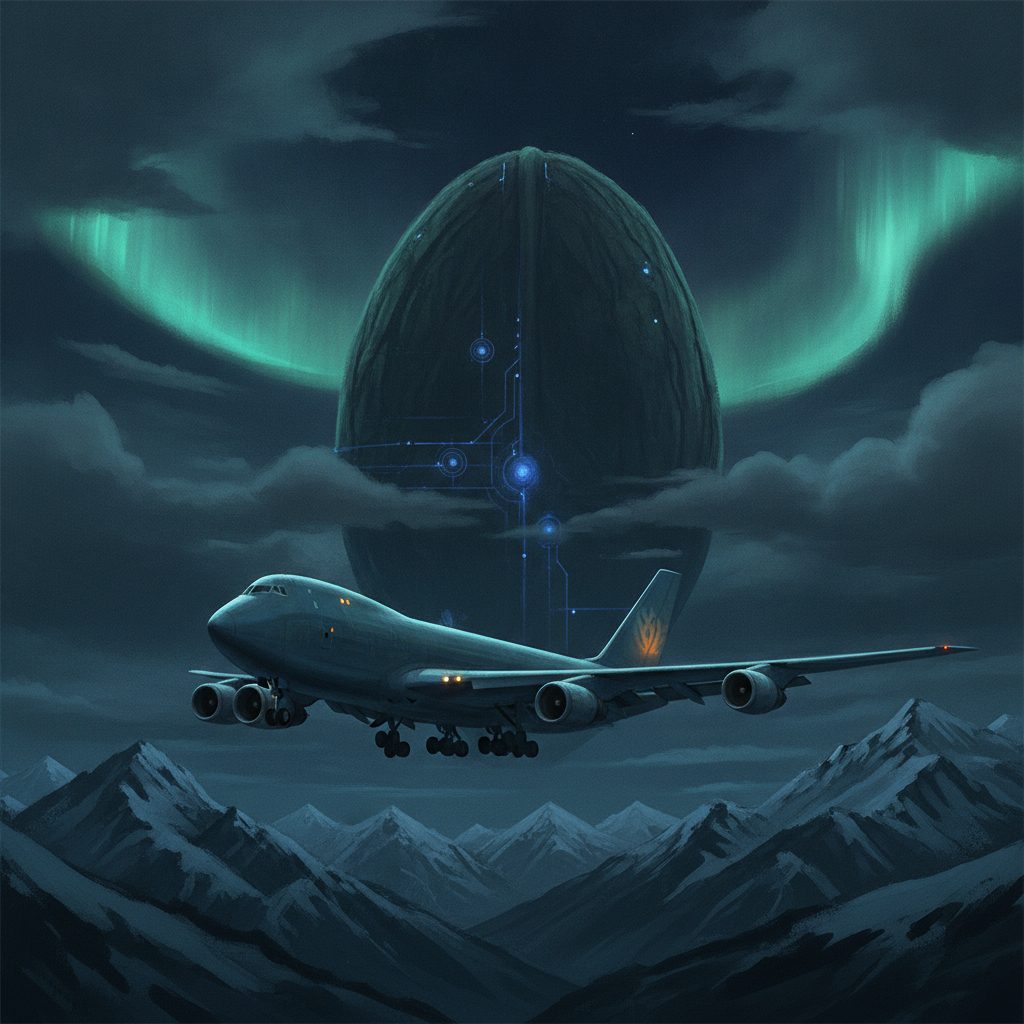
JAL 1628: Fifty Minutes Over Alaska With Something the FAA Could Not Confirm
The sun had already slipped below the horizon when Captain Kenju Terauchi first mistook the glow ahead of him for the running lights of another aeroplane. It was a few minutes past five in the afternoon on 17 November 1986, and Japan Air Lines cargo flight 1628 was cruising at 35,000 feet over the frozen interior of eastern Alaska. The aircraft was a Boeing 747-246F freighter, loaded with French wine and flying the long polar routing that carried European cargo to Japan by way of Alaska: out of Paris, down to a refuelling stop in Anchorage, then on to Tokyo. It was passing near the small settlement of Fort Yukon when the lights appeared.
Terauchi was not a nervous novice. He was a former fighter pilot with more than 10,000 hours in the air. In the cockpit with him were two other experienced men: First Officer Takanori Tamefuji, at the controls beside him, and Flight Engineer Yoshio Tsukuba, at the engineer's panel behind.
Two clusters of lights had appeared below the freighter and off to its left, and they were holding station with the jumbo jet as it flew. For several minutes Terauchi took them for military traffic, of which there is no shortage over Alaska, and said nothing about them on the radio. Then, by his account, the lights moved.
The two arrays of glowing points darted upward and stopped dead in front of the 747, hanging in the air perhaps a few hundred metres ahead. They were close enough, the captain said afterwards, that he felt warmth on his face and had to squint against the flare. Tamefuji saw the lights as well, and likened their flicker to flames, or to the bulbs on a Christmas tree. Tsukuba saw them too. On this much the three men agreed.
What Terauchi reported next belongs to him alone. As the smaller lights drifted away, he said he made out a far larger shape against the last grey light in the west: an enormous dark silhouette, rounded like a walnut, which he judged to be twice the size of an aircraft carrier. He described a faint band of lights around its rim and a texture on its surface, and he used the word that would follow the case forever, calling it the mothership. Neither Tamefuji nor Tsukuba ever reported seeing that hull. They reported lights.
By Terauchi's account the objects stayed with the flight for a long stretch of the route, pacing the freighter for something like 400 miles across the Alaskan dark. His radio reports went to Anchorage Air Route Traffic Control Center, whose airspace covers a vast and thinly populated region, and which was following JAL 1628 on radar. The exchanges were recorded on tape.
The controller working the flight, Carl Henley, reported that for portions of the encounter he saw an intermittent second return on his scope near the 747's blip. The United States Air Force Regional Operations Control Center at Elmendorf, watching the same patch of sky, logged a handful of brief primary hits close to the airliner. A primary hit is an echo off an object itself rather than a coded reply from an aircraft transponder, so in principle it can mark something that is not announcing its presence. In neither case, however, did the returns build into a solid, continuous track. They came and went.
Anchorage then cleared Terauchi to do what a pilot does when he wants to know whether something is really behind him. He was authorised to change altitude and to fly a full 360-degree turn, a manoeuvre that leaves any fixed light in the sky behind while carrying a genuine follower around with it. He came all the way around the circle, and the lights, he reported, were still with him.
Controllers also looked for other eyes. A United Airlines passenger jet climbing out of the area and a USAF C-130 transport were both directed to take a look at JAL 1628 as they closed on it. By the time each was near enough to see, there was nothing beside the Japanese freighter but empty sky. Neither the United crew nor the C-130 crew saw anything at all.
One instrument aboard the 747 did register something. The crew reported that the aircraft's own weather radar painted a target of its own: a green return roughly seven or eight miles off, in the direction where the lights hung. Weather radar is built to find rain and ice rather than metal, and it is not designed to detect other aircraft, so the reading was unusual on its face. It went into the file with everything else.
The encounter ended without incident. The lights were gone as the freighter neared Anchorage, and JAL 1628 landed normally with its cargo intact. The crew were interviewed, and the Federal Aviation Administration opened an investigation that ran for months. It gathered the crew statements, the radar data from Anchorage and from Elmendorf, and transcripts of the radio traffic between the 747 and the ground. In 1988 the three crewmen were interviewed again, this time separately.
The agency's public conclusion was a careful one. Its spokesman, Paul Steucke, told reporters that the FAA could not confirm the existence of any object, and reminded them that the agency had no charter to investigate unidentified flying objects in the first place. On the men in the cockpit, though, the investigators were willing to vouch. The crew, they found, were normal, professional and rational, with no drug or alcohol involvement of any kind.
Terauchi paid a price for speaking. After he described the encounter to the press he was quietly moved off flying duties, and he returned to the cockpit only years later. He never withdrew his account. The paperwork survived him: the voice tapes, the radar plots, the transcripts and a thick FAA case folder that has been photocopied and pored over for nearly four decades, all of it describing fifty minutes of an ordinary cargo run that the United States government recorded in detail and then declined to explain.
Conclusions and Open Questions
The most economical reading of the radar is the one the investigators themselves reached on review. Going back over the tapes, the FAA came to believe that the extra target on the Anchorage scope was a split image of the 747 itself, an artefact of radar processing, and the brief military hits were reinterpreted as ordinary clutter. That kind of artefact is well documented, and that is the strength here. Its weakness is arithmetical: it asks three separate sources, two ground radars and one airborne weather radar, to have produced innocent oddities in the same place at the same time.
The best known sceptical case was made by the aviation writer Philip J. Klass. Klass noted that Jupiter was blazing unusually bright and low in the sky that evening, some ten degrees above the horizon and almost exactly in the direction where Terauchi first saw his lights, with Mars close by. To a pilot at 35,000 feet, he argued, a brilliant planet low on the horizon can seem to hang at the aircraft's own altitude and to follow the plane for hours, because it does not fall behind the way a nearby light would. Klass also pointed to the 1988 interviews, in which the crewmen's recollections had drifted apart. The strength of the planetary theory is that Jupiter really was there. Its weakness is equally plain: a planet does not dart in front of a cockpit, does not radiate felt warmth, and does not produce a radar return of any kind.
Some argue for ice crystals in very cold air, or for reflections of ground lights and gas flares from the Alaskan oil fields, refracted into a rare atmospheric mirage. Each accounts for a piece of the night; none, so far, for all of it.
The optical physicist Bruce Maccabee examined the reports and concluded that the sighting could not be dismissed as planets alone, while stopping well short of declaring it a solid craft. His position, that something remains unexplained once the mundane candidates are subtracted, is harder to attack than either certainty, and harder to test, since it names no cause.
One theory holds that the record was deliberately buried. John Callahan, who had been the FAA's Division Chief for Accidents, Evaluations and Investigations, began saying publicly around 2001 that he had personally handled the JAL 1628 data, and that at a briefing in Washington people who identified themselves as CIA officials declared the event had never happened and took the material away. The strength of the claim is Callahan's genuine seniority. Its weakness is that it stands alone: no released document corroborates a confiscation, and he told the story only many years after the fact.
Others argue that no single cause is needed, only several ordinary ones landing on the same evening: a bright planet, a faint reflection, a straining mind, and coincidental radar artefacts. That is a reconstruction offered to fit the pieces, not something the record establishes.
What is left unexplained is narrower than the legend, and real. Why did an experienced captain, whose job was to identify lights in the dark, spend most of an hour certain that a solid object was pacing his aircraft, while the two men beside him saw only lights and no hull? What did the 747's weather radar paint seven or eight miles ahead, in the same direction as the lights, on an instrument not built to see aircraft? How did three independent radar sources produce returns near the right place at the right time, each needing its own separate innocent explanation?