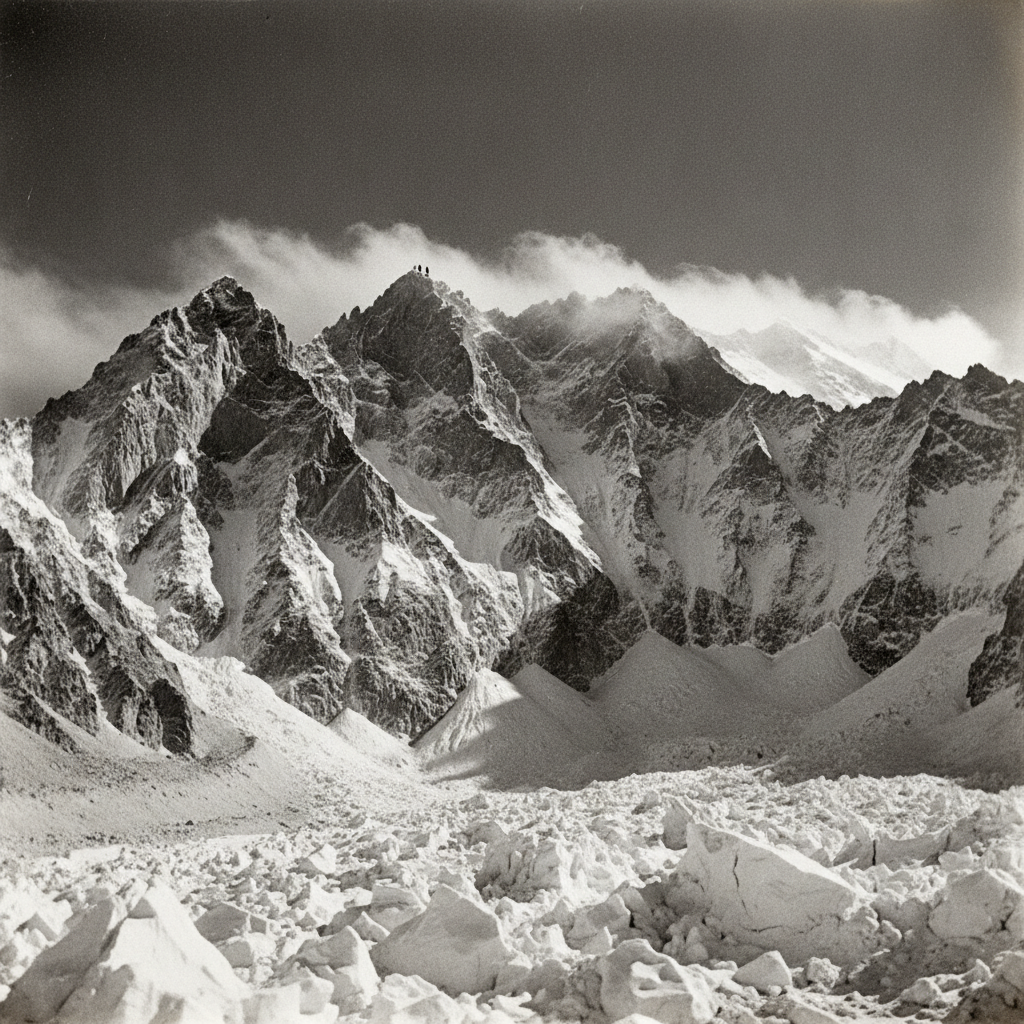
Two Dots on the Ridge: The Last Hours of Mallory and Irvine
On the morning of 8 June 1924, Noel Odell was climbing alone up the north side of Mount Everest at around 26,000 feet, without oxygen, in support of the two men somewhere above him. The mountain was wrapped in cloud. At ten minutes to one the cloud tore open.
That night he wrote in his diary that he had seen M and I on the ridge, nearing the base of the final pyramid. In the fuller account he gave later, he described a tiny black dot moving on a snow crest beneath a rock step, and a second dot moving up to join it. The mist closed again within a few minutes. Nobody has ever seen George Mallory or Andrew Comyn Irvine alive since.
Mallory was thirty seven, a schoolmaster from Cheshire, and this was his third expedition to Everest. He was Britain's most experienced Himalayan climber, and the man who had answered a New York reporter asking why anyone would go there with three words that outlived everything else he said. Irvine was twenty two, an Oxford undergraduate and a rowing blue with almost no serious mountaineering behind him. He had been picked for his hands. The oxygen sets used in 1922 had leaked, jammed and weighed more than the advantage they gave; Irvine stripped them down at base camp, cut weight from the frames and made them work.
The 1924 expedition, Britain's third in four years, was led by Edward Norton after Charles Bruce fell ill on the approach march. Norton had already reached roughly 8,570 metres alone and without oxygen before turning back, a height nobody would exceed for almost thirty years. Mallory concluded that the last chance of the season lay with the oxygen apparatus, and chose Irvine to carry it with him.
They left Camp IV on the North Col on the morning of 6 June with eight porters. That evening four porters came down from Camp V at 7,681 metres with a note from Mallory: no wind up there, and things looked hopeful. On 7 June they moved up to Camp VI at about 8,170 metres, and the last porters brought down two more notes. One said they would probably start early the following morning. The other was for Odell, asking him to watch for them on the skyline at a time Mallory wrote as 8.0 p.m., almost universally read as a slip of the pen for eight in the morning. The same note apologises for the mess in the camp and mentions that their stove had rolled down the slope. It is the last thing either of them wrote.
At two in the afternoon, an hour after the sighting, a snow squall came over the North Face. Odell climbed on to Camp VI, found the tent littered with clothing and gear, and went out above it into the weather, whistling and yodelling in case the two were close enough to hear. On 9 June he climbed alone back up to Camp VI, above eight thousand metres and still without oxygen. The tent was exactly as he had left it. He laid sleeping bags on the snow in the pre-arranged signal for the camps far below: no trace found, hope abandoned.
Everything since has turned on those ten minutes of open sky.
Odell's first account, printed in The Times, placed the dots at a prominent rock step a very short distance from the base of the final pyramid, which describes what climbers call the Third Step. When Norton edited the official expedition history, this became the Second Step. Most climbers who have since studied the timings and the ground believe Odell must have seen them far lower, on the First Step, which would put them hours behind any schedule that ends on the summit. Odell shifted his opinion repeatedly, and shortly before his death in 1987 acknowledged that he had never been clear where along the ridge the figures were. The only eyewitness to the last hours of the climb spent the rest of his life uncertain of his own evidence.
In 1933 the next British expedition found something. Percy Wyn-Harris came across an ice axe lying on the slabs about 250 yards east of the First Step and some sixty feet below the crest of the ridge. Marks cut into the shaft identified it as Irvine's. The expedition leader, Hugh Ruttledge, drew the obvious conclusion: an axe is not dropped by a climber in control.
Then, for forty years, nothing. In 1979 a Chinese climber named Wang Hongbao told a Japanese mountaineer at base camp that on the 1975 expedition he had come across an English dead at about 8,100 metres, in old fashioned clothing. He was killed in an avalanche the next day, but the story would not go away, and it produced the search expeditions of 1986 and 1999.
On 1 May 1999 Conrad Anker, with the Mallory and Irvine Research Expedition, walked onto a terrace of broken slabs at 8,156 metres and found a body. It lay face down, frozen into the scree, arms above the head and fingers dug in, as though it had been trying to arrest a slide. The clothing was old wool and gabardine and the name tapes read G. Leigh Mallory.
The injuries were readable. Severe rope mottling around the waist meant the two men had been tied together and that the rope had come tight with force. The right leg was broken above the ankle, and the unbroken leg drawn across it, which is what a conscious man does with a broken limb. There was a puncture wound in the forehead. The body had not fallen far.
The pockets held letters, a knife, an altimeter, and snow goggles. The goggles were in the pocket rather than on his face, which some read as a sign that he was moving in the dark. The photograph of his wife Ruth, which he had told her he would leave on the summit, was not on him. Neither was the Vest Pocket Kodak camera he and Irvine had borrowed from a teammate.
Twenty five years later, in September 2024, a National Geographic film team working on the Central Rongbuk Glacier below the north face came across oxygen cylinders stamped 1933. Further up the ice, Jimmy Chin, Erich Roepke and Mark Fisher found a boot melting out of the glacier with a foot still inside it. In the boot was a sock, and stitched into the sock was a name tape: A.C. IRVINE. Chin said afterwards that it had probably emerged from the ice about a week before they walked past. The remains went to the China-Tibet Mountaineering Association and a DNA sample to the British consulate, and Irvine's family, including his great niece Julie Summers, offered their own samples for comparison. The camera was not there.
Conclusions and Open Questions
The question is not what happened to them. They fell, roped together, high on the North East Ridge, and both died. The question is what they had done before they fell.
The case that they reached the summit rests on three things. Odell saw them still climbing at 12:50 and thought they were high. Mallory's goggles were in his pocket rather than on his face, which fits a man descending after dark. And Ruth's photograph, which he had promised to leave at the top, was not on the body. The weakness in each is serious. Odell withdrew his own certainty about where the dots were, and if they were on the First Step the summit was out of reach on that timetable. Goggles come off in cloud as readily as in darkness. And a photograph missing from a jacket that spent seventy five years on a windswept slope is evidence of nothing. Above all there is the Second Step, a near vertical wall that carries a Chinese ladder today. Conrad Anker, who found Mallory, has climbed it with and without the ladder, and says he does not believe two exhausted men in nailed boots, tied to a hemp rope, got up it in 1924. He has been careful never to call it impossible.
The case that they turned back, or fell on the way up, is the more economical reading. It fits the abandoned axe, the rope injury, and a body lying not far below the ridge. Its weakness is that it explains everything and predicts nothing, and does not account for why the axe lay a quarter of a mile from where Mallory came to rest.
A third argument is arithmetic rather than narrative. Even on the most generous reading of the sighting, they were hours behind Mallory's own schedule, and researchers who have reconstructed the 1924 apparatus argue that two cylinders a man left a margin too thin for a summit and a return. The weakness is that nobody knows what flow rate they were using, that Irvine had rebuilt the sets to his own specification, and that climbers of that era went on and off the gas as they pleased.
What would settle it is the camera. Kodak and later conservators have said film held frozen for a century might still yield an image, although nobody will promise it. That is the significance of the 2024 discovery: not that a foot in a boot proves anything about the summit, but that it fixes where the mountain has been depositing what it took. Whatever left Irvine's body travelled down the same funnel of ice into the Central Rongbuk basin, and the search now has a catchment instead of a face.
One caveat survives all of it. Even a photograph from the top would answer only half the question, because mountaineering counts a climb as finished when the climber comes back, and neither of them did. The 1953 ascent by Edmund Hillary and Tenzing Norgay is not in dispute either way. What is in dispute is ten minutes of visibility on 8 June 1924, and the man who gave that testimony spent sixty three years unsure of what he had seen. In a hundred and two years the mountain has returned an ice axe, a body and a foot. It has not returned the camera.