I Think I Can Make It: The Vanishing of Michael Rockefeller
Shortly after seven in the morning on 19 November 1961, a twenty-three-year-old American stripped down on the overturned hull of a small catamaran in the Arafura Sea, off the southwest coast of what was then Netherlands New Guinea. He had spent a night and most of a day clinging to the wreck beside a Dutch anthropologist named Rene Wassing. The tide had carried them steadily away from land rather than toward it. Michael Clark Rockefeller lashed two empty containers together into a crude float, said that waiting was no longer an option, and spoke the sentence that has followed the case ever since: "I think I can make it."
Wassing watched him for roughly half an hour. He later described three dots on the water, the two cans and a head, getting smaller. Then nothing. No trace of Michael Rockefeller has ever been recovered.
He was born on 18 May 1938, the fifth child and youngest son of Nelson A. Rockefeller, then governor of New York and later vice president of the United States, and of Mary Todhunter Clark. He had a twin sister, Mary. He attended the Buckley School in Manhattan and Phillips Exeter Academy, graduated cum laude from Harvard with a degree in history and economics, and served six months as a private in the United States Army.
What separated him from the rest of his generation of the family was an obsession that had nothing to do with banking or politics. In 1961 he joined an expedition of Harvard's Peabody Museum of Archaeology and Ethnology to the Baliem valley in the highlands of Netherlands New Guinea, working as a sound recordist on Robert Gardner's ethnographic film Dead Birds and taking hundreds of photographs of his own. By the time the expedition wound up in the summer, he had already decided where he wanted to go next.
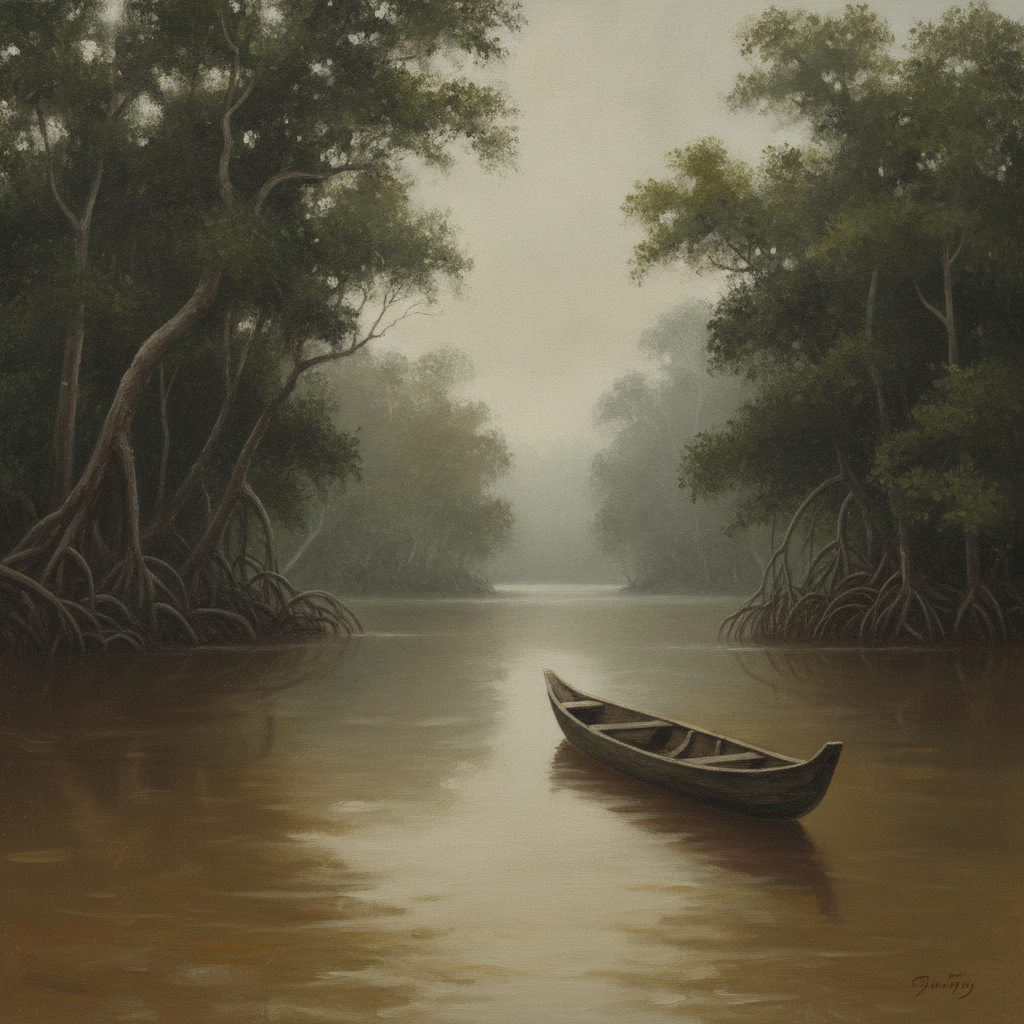
The Asmat region lies on the southwest coast: a vast tidal swamp of mud, mangrove and slow brown rivers, without roads, where villages can be reached only by water. Its people were, and are, among the most accomplished woodcarvers anywhere: towering bisj poles carved with ancestor figures, war shields, canoe prows, drums and paddles, produced inside a dense ritual and cosmological system that Rockefeller was only beginning to understand. He was a trustee of the Museum of Primitive Art, founded in New York by his father, and he returned to New Guinea in the autumn of 1961 intending to spend several months collecting Asmat carvings for it. He traded for them with steel axes, fishhooks and line, tobacco and cloth, keeping notebooks and inventories as he went. In his letters he wrote about wanting to work out the huge puzzle of Asmat art before it changed beyond recognition.
He needed a boat that could reach the villages. At the small government post of Agats he acquired a homemade catamaran from a Dutch patrol officer: two long dugout canoes lashed to a wooden platform and driven by an outboard motor. It was a river craft, not a sea craft.
On 18 November 1961 he set out in it from Agats along the coast. With him were Rene Wassing, a Dutch government anthropologist assigned to accompany him by the colonial Department of Native Affairs, and two young Asmat men remembered in the records as Simon and Leo. The route crossed the mouths of wide rivers, where an outgoing current meets the swell of the Arafura Sea and the water turns short and steep. Miles from land the catamaran was swamped, the engine drowned, and the platform rolled over.
Simon and Leo decided to swim for shore. Both made it, after many hours in the water, and raised the alarm. In a region with no roads and few radios, the news travelled slowly.
Rockefeller and Wassing stayed with the hull. The tide, instead of pushing the wreck in, drew it out. Estimates of how far they were from the mangrove line by the following morning vary widely, from about three miles in some early reports to ten or twelve in others. Wassing, who was not a strong swimmer, argued for staying put. Rockefeller made his float out of two empty cans, took a knife, and went in.
Wassing was picked up the next day, some twenty miles offshore, by a search vessel guided in from the air.
By then a very large operation was under way. Governor Pieter Platteel of Netherlands New Guinea committed patrol boats, marines, police and aircraft. Australian helicopters were flown in and unloaded at the airfield at Merauke. The United States, contacted at the highest level, made aircraft and a ship available. Papuan crews in dugout canoes worked through the creeks, the mudflats and the mangroves for days on end, and Dutch accounts of the time speak of thousands of local people joining the coastal search.
Nelson Rockefeller chartered a Boeing 707, reportedly for around thirty-eight thousand dollars, and flew out with Mary, Michael's twin sister, trailing a crowd of reporters that filled the airstrip at Merauke. For about two weeks the search ground on over swamp, sea and shoreline. Not one object was ever recovered: no body, no clothing, no glasses, no cans.
Nelson Rockefeller called it off and flew home. The official finding, entered by the Dutch authorities and accepted by the family, was death by drowning. Michael Rockefeller was declared legally dead in 1964.
The collection he had assembled did reach New York. Much of it is now at the Metropolitan Museum of Art, in a wing that carries his name. A stained glass window designed by Marc Chagall was installed in his memory at the Union Church of Pocantico Hills. His twin sister, Mary Rockefeller Morgan, became a therapist and later wrote about the particular grief of a surviving twin. Rene Wassing spent the rest of his life answering the same question from strangers. And in the Netherlands, in the United States and in Asmat itself, the file was never really closed.
Conclusions and Open Questions
The official verdict is the simplest reading of the evidence, and it has serious defenders. Mary Rockefeller Morgan has argued that her brother, however strong a swimmer he was, faced seasonal tides, powerful offshore currents and turbulent outflowing river water, and that the distance was simply too great. The weakness of the drowning theory is that it explains a disappearance but not an absence: in a search of that size, along a coast where anything afloat tends to end up in the mangroves, nothing at all was found, not even the two cans.
A second and much older set of accounts points to the village of Otsjanep. Within weeks of the disappearance two Dutch missionaries who spoke local languages, Cornelius van Kessel and Hubertus von Peij, reported hearing from villagers that Rockefeller had reached land and had been killed there. Von Peij wrote in December 1961 that four men had described to him how remains had been divided among a group from the village. A Dutch patrol officer, Wim van de Waal, made his own inquiries in 1962 and said afterwards that he had been handed a skull. The Associated Press published a version of the story in March 1962. In 1969 the American journalist Milt Machlin travelled to the region, dismissed the romantic notion that Rockefeller was alive somewhere as a captive, and concluded that the circumstantial case for a killing was strong.
The fullest modern investigation is Carl Hoffman's book Savage Harvest, published in 2014. Hoffman worked through Dutch government and church archives and lived for periods in Asmat villages, and he reported hearing accounts consistent with those collected in the 1960s. The motive described to him, and to the missionaries before him, was not appetite but obligation. In January 1958 a Dutch colonial patrol under an administrator named Max Lapre had opened fire at Otsjanep, killing several men whose names recur in the later accounts. In the Asmat understanding of that time, such deaths created a debt that had to be balanced. One theory holds that a stranger arriving alone out of the sea, from the same colonial world, could be read as the settling of it. Hoffman also argued that Dutch officials, in a territory they were about to lose to Indonesia and dealing with one of the most prominent families in America, had every reason to leave the finding at drowning.
None of this is proven. The accounts are oral, given decades apart, through interpreters, sometimes to outsiders with money and cameras, and people everywhere tend to supply the story a visitor is looking for. No physical evidence has been produced and tested. The Asmat are a living people with their own historians and their own version of 1961, which is not necessarily the version that circulates in Western books; the documented colonial violence at Otsjanep in 1958 is the part of this story that is least often told. Whatever happened after the swim should be read as testimony, not as verdict, and the people of that coast are entitled to be treated as witnesses rather than as scenery.
The open questions are stubborn. Why did an operation involving aircraft, ships and thousands of searchers recover nothing whatsoever, on either theory? What did the Dutch administration conclude internally, and where do those files now sit? Was the drowning verdict a judgement or a convenience? Could any remains still be identified, and would such an inquiry be ethical or welcome to the communities involved? And behind all of it sits the question the case keeps returning to: what a twenty-three-year-old collector, arriving with axes and fishhooks in a place his own government had shot up three years earlier, was actually walking into.