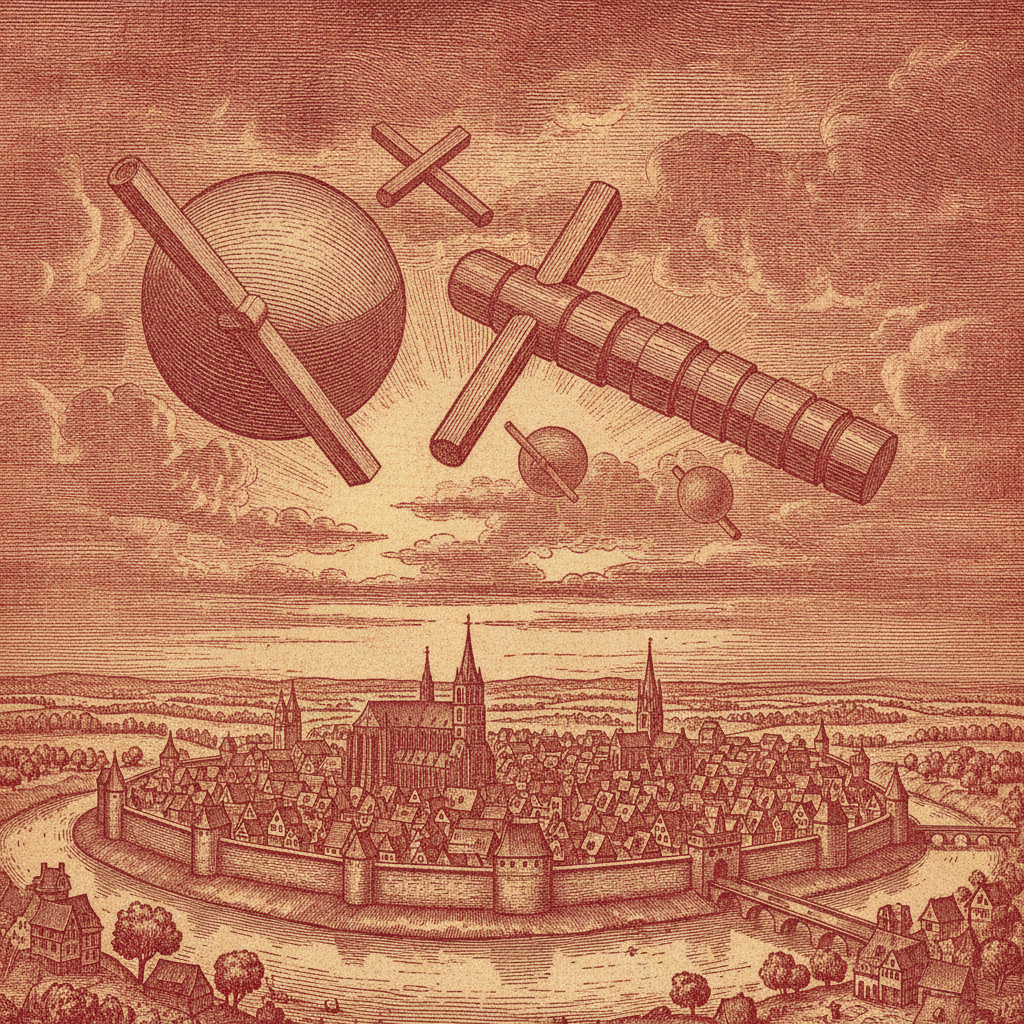
The Morning the Sky Went to War Over Nuremberg
It was not yet five o'clock in the morning on 14 April 1561 when, according to the only surviving account, the sky above Nuremberg filled with shapes. The city was one of the wealthiest and most literate in the Holy Roman Empire, a centre of metalwork, trade and printing, and its people were awake early. Where the rising sun should have climbed alone, witnesses were said to have seen globes, rods and crosses, some blood red, some blue black, some the colour of iron. The shapes were moving. To the people watching from the streets, it did not look like weather. It looked like a battle.
Everything we know about that morning comes from one man and one sheet of paper. Hans Glaser was a printmaker in Nuremberg, and within days of the event he produced a broadsheet: a single large page combining a hand coloured woodcut with a block of dense German text. The sheet measures roughly 26 by 38 centimetres. It is preserved today in the print collection of the Zentralbibliothek in Zurich, and it is the reason the episode is remembered at all. Without Glaser's press, 14 April 1561 would have passed like any other forgotten dawn.
Glaser's text is unusually specific. The spectacle, he wrote, began between four and five in the morning. First came a great many objects arranged around the sun: cylindrical shapes, which he compared to the barrels of guns or to thick reeds. Out of the ends of these tubes smaller globes came pouring, red, blue and black, arriving in clusters of three and in squares of four. Alongside them were crosses the colour of blood. There were two great crescents or half moons, several discs, and a scattering of smaller spheres.
Then, according to the account, the shapes began to fight. The globes darted at one another, Glaser wrote, striving together as if in combat, and this continued for the space of about an hour. The struggle moved back and forth between the objects, some advancing and some giving way. Afterwards they seemed to grow weak, to catch fire, and to fall from the sky toward the earth, where they wasted away as if consumed. Finally, when the sky had emptied, a great black object appeared, shaped, Glaser thought, like a spear or an enormous arrowhead.
He had no doubt what it meant. Like almost every printer of his generation, Glaser read the heavens as a text written by God. The apparition, he told his readers, was a divine warning and a call to repentance, a sign that the citizens of Nuremberg should mend their lives before judgement came. He closed with an appeal to turn to God, which was the standard ending of such a publication.
The sheet belongs to a recognisable commercial genre. Sixteenth century Europe had a booming trade in what the Germans called Wunderzeichen, wonder signs: printed reports of comets, strange births, floods, celestial lights and other portents, produced quickly and sold cheaply in the street to a public that expected the world to carry messages. Nuremberg, with its concentration of presses and engravers, was one of the main centres of this trade. Glaser himself is documented as a working Briefmaler and printer of such sheets, and this was not the only wonder he sold.
The Nuremberg sheet did not vanish into obscurity. It was later gathered into the collection of the Zurich clergyman Johann Jakob Wick, who spent decades assembling news sheets, drawings and reports of marvels into a series of scrapbook volumes now known as the Wickiana. Wick's obsession is the reason hundreds of broadsheets of this kind survive at all, and it is the route by which Glaser's page reached the Zurich library where it sits today.
Here the record becomes thin in a way that matters. Glaser's broadsheet is, in practical terms, the only witness. There is no surviving Nuremberg city council minute describing the morning, no letter from a merchant to a business partner, no diary entry, no chronicle passage, and no independent report from a neighbouring town. For an event supposedly seen by an entire population at daybreak, in a city famous for its record keeping, the surrounding silence is a documented feature of the case rather than an interpretation of it.
What the record does contain is a sequel of sorts. Five years later, in 1566, the citizens of Basel reported their own celestial display, described as large black globes moving and wheeling before the sun over several days. That report too was printed as a broadsheet, and it too ended up in Zurich. Similar sheets survive from other German cities of the same decades.
Glaser's woodcut then had a second life. It was reproduced in the twentieth century and became one of the most widely circulated images in modern speculative literature after the psychologist Carl Jung discussed it in his 1958 book on flying saucers. From there it spread into magazines, television programmes and eventually the internet, usually cropped, usually without the German text, and usually without the information that it is a printed interpretation rather than a drawing made on the spot.
That distinction is the practical core of the case. There is no evidence that Glaser was among the witnesses. Broadsheet artists routinely worked from verbal reports, and the woodcut was a manufactured product designed to be legible at a glance and to sell. The image and the text were made to be sold together, days after the fact, by a craftsman whose living depended on the result being striking.
So the documented record amounts to this: on a spring morning in 1561, a printer in Nuremberg published a detailed and dated account of an extraordinary aerial display over his city, framed as a warning from God, in a format that was standard for its time. The sheet survives. The morning does not.
Conclusions and Open Questions
Everything that can be argued about Nuremberg has to be argued through a single commercially motivated document, which is why the case has stayed open for nearly five centuries. Three main explanations compete, and one of them is considerably stronger than the others.
The explanation most atmospheric scientists find persuasive requires no spacecraft and no invention on Glaser's part. It requires ice. High in the atmosphere, thin veils of cirrus cloud consist of tiny hexagonal ice crystals. When sunlight passes through them at particular angles, especially when the sun is low near the horizon, those crystals refract and reflect the light into an architecture of bright shapes. The simplest and most familiar is the sundog, or parhelion, a luminous patch standing to one side of the sun and often faintly rainbow tinted. Sundogs are only the beginning.
In a rich display the sky fills with geometry. There are 22 degree halos, complete rings around the sun. There is the parhelic circle, a band of white light running parallel to the horizon that can appear to pass straight through the sun, and where it crosses other arcs it produces bright knots that read as crosses. Sun pillars stand above and below the sun like columns or spears. Tangent arcs curve like the horns of a crescent. Several of these appearing together, low over a city at daybreak, would allow an observer with no concept of atmospheric optics to describe globes flanking the sun, rods and tubes of light, crosses where arcs intersect, and crescents overhead. As the crystals drift and the sun climbs, the whole display shifts, reddens and fades, which a frightened crowd could read as movement, then as combat, then as shapes falling and burning out. This account fits the hour, the low sun, the colours, the crosses and the sense of dissolution, and it asks us to assume nothing more than a cold, clear, ice laden morning.
Its weakness is honest and specific. Classic halo displays are broadly symmetrical and fairly static in overall structure. They do not usually produce swarms of small globes pouring out of tubes, clustering in threes and fours and then darting about in a way that reads as fighting. Either the display was unusually complex and Glaser dramatised it heavily for sale, or the woodcut is roughly accurate and optics alone struggles with the detail.
A second reading, favoured by several historians of print, treats the sheet primarily as a product of its politics. The year 1561 sat inside a period of severe religious and political tension in central Europe, and celestial wonders sold because they carried meaning: a warning to sinners, a comment on the Catholic and Protestant conflict, or coded propaganda. On this view the sheet is best understood as a work in that tradition, built on a real but far less dramatic event. Its weakness is that it can neither be confirmed nor refuted, since it explains the document without telling us what, if anything, was in the sky.
The third reading is the modern one. Some argue that the tubes releasing smaller spheres look like carrier craft launching smaller vehicles, and that the combat resembles an aerial engagement, making this one of the earliest mass sightings of unidentified craft. Jung raised the print in 1958 and countless writers have followed. One theory holds that such events recur across centuries and are simply described in the vocabulary each age possesses. The weakness is that this reading imports the imagery of aircraft and spaceflight into a woodcut made by a man who had no such concepts and every commercial reason to dramatise, and it rests on no physical evidence whatsoever.
What remains genuinely unexplained is not the sky but the paper. Why is there no corroborating Nuremberg record? Was Glaser himself a witness, or working from hearsay? How much of the woodcut is reportage and how much is the visual shorthand of divine judgement that his customers expected? Was the Basel report of 1566 an independent event, an imitation of a successful format, or evidence of a genuine run of unusual atmospheric conditions in those years? Until another contemporary document turns up, every answer stays downstream of one sheet of paper, printed for money, by one man, in a culture that expected the heavens to speak in signs.