Rendlesham Forest: The UFO Case the US Air Force Put in Writing
It was a little after three in the morning on 26 December 1980 when a patrolman near the east gate of RAF Woodbridge looked into the darkness of Rendlesham Forest and saw lights that had no business being there. Green, red and white, they appeared to sink down through the pines as if something were settling to the ground. This was not an ordinary stretch of woodland. Woodbridge and its twin station, RAF Bentwaters, sat a few miles from the Suffolk coast on the eastern edge of England, leased to the United States Air Force and, though nobody said so openly at the time, among the most sensitive installations in NATO. The first assumption at the gate was the sober one: an aircraft had come down in the trees. A small party was sent out to find the wreckage.
Among the men who walked into the forest that night were Staff Sergeant Jim Penniston and Airman First Class John Burroughs. In the accounts he has given since, Penniston says he reached a clearing and found a small craft resting on the forest floor, dark and roughly triangular, about the size of a car, its surface hard and glassy and warm to the touch, covered in raised symbols he could not read. He says he walked around it, photographed it, and laid his hand against its flank, and that after several minutes it rose silently through the trees and was gone. Burroughs, who was beside him, has always described that night differently. His account is of lights, of movement between the trunks and of a charged stillness in the air, but not of a solid machine he touched.
When daylight came the men returned to the spot. In the frozen ground they found three depressions arranged in a triangle, along with scorch-like marks and broken branches on the surrounding trees. Plaster casts of the depressions were taken and photographs were made. A radiation meter was carried to the site and readings were logged at the marks.
Some things were never recovered. Penniston has said he shot a full roll of film in the clearing; when it was developed it came out fogged and blank. No radar track from either airfield has ever been produced. No fragment, no residue and no usable photograph survives from either night. What the Air Force had at the end of the week was a set of casts, a set of readings and the word of its own men.
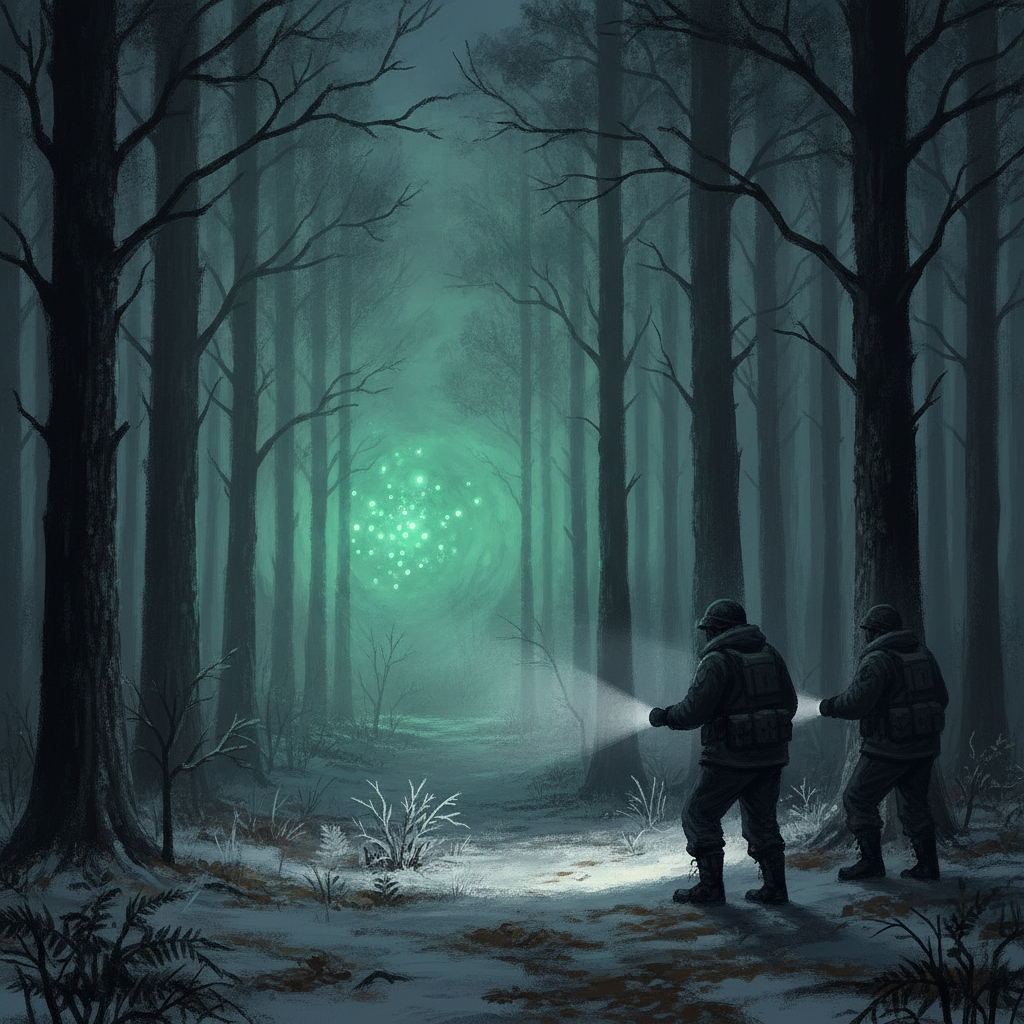
Two nights later the lights returned, and this time the senior witness was the deputy base commander himself. Lieutenant Colonel Charles Halt was at a social function on the evening of 27 December when word reached him that the phenomenon was back. Expecting to put the whole business to rest, he gathered a small team and walked into the forest carrying a Geiger counter, a starlight scope and a handheld cassette recorder into which he narrated what he saw as he saw it.
That tape survives, and it is the central document of the case. Over roughly eighteen minutes, disciplined military men can be heard growing steadily more bewildered. They call out radiation readings at the depressions. Then a red light appears among the trees, and Halt, his voice tightening, describes it: "it's like an eye winking at you," he says, adding that it seems to drip molten metal, and that it moves. Later in the recording, objects resembling stars hang in the sky to the north and to the south, and one of them, he reports, sends a pencil-thin beam of light straight down to the ground near the men. In later accounts Halt said that a beam came down close to the base's Weapons Storage Area, the fenced compound where, it is now widely accepted, nuclear weapons were kept.
On 13 January 1981, Halt did the thing that lifts Rendlesham out of the ordinary run of sighting reports. He put it in writing officially. A single typed page, headed with the deliberately flat title "Unexplained Lights," went to the British Ministry of Defence over his signature. It set out the lights of the first night, the object the patrolmen described, the three depressions, the radiation readings, the red light and the beams of the second night. The dates in the memo are consistently one day out, a slip usually attributed to the confusion of the holiday week.
The page then sat quietly in files on both sides of the Atlantic until 1983, when an American researcher obtained it under the United States Freedom of Information Act. Its publication set off a sustained run of coverage in the British press, and Rendlesham became the best known UFO case in Britain. The Ministry of Defence stated that the events were of no defence significance. It released its Rendlesham file in 2001 and, from 2008, began transferring its wider UFO archive to the National Archives at Kew, where the papers can be consulted today under their own reference numbers.
The testimony did not stop growing. Penniston's earliest written statement, made close to the events, is considerably more restrained than the account he gives now. The most extraordinary element of his story arrived only decades later: his claim that when he touched the craft he received a telepathic transmission of ones and zeros, which he wrote out as sixteen pages of binary code in a notebook, and which, when decoded, is said to yield a short message in English along with a string of geographic coordinates pointing to sites including the Egyptian pyramids. Burroughs took a different road, spending years pressing the United States government to recognise the health effects he attributed to that night, and eventually gaining access to care through the Department of Veterans Affairs. Other names attached themselves to the case over the years, among them Larry Warren, whose far larger account of a mass sighting and of contact with alien beings even sympathetic researchers have struggled to fit to the known timeline.
More than four decades on, the forest is a destination in its own right. There is a marked UFO trail through the pines and a small model of the craft as Penniston described it. Several of the men involved have died still holding to their versions. What has kept Rendlesham alive is not spectacle, because as UFO stories go it is a modest one. It is paperwork. The memo exists. The tape exists. The government files exist, catalogued and open to the public, and no one has ever shown any of them to be a fabrication.
Conclusions and Open Questions
The most economical explanation belongs to the astronomer Ian Ridpath, working with the researcher Ian Fergusson, and it is almost insultingly ordinary. A few miles east of the forest stands the Orfordness lighthouse. Its beam swept across the treeline at intervals of a few seconds, low and bright, and to men walking over uneven ground at night it would appear to bob, to hover and to pace them between the trunks. Ridpath adds a second ingredient for the first night: a spectacular fireball, a re-entering meteor recorded over southern England at around 2:50 that morning, which would account for the initial impression that something had come down in the woods. Bright stars low on the horizon do much of the remaining work for the star-like objects that hung in place for hours on the second night. The radiation readings, when examined afterwards, fall within the normal background range for the area, and depressions in soft forest ground can be left by animal diggings, a rabbit warren or fallen branches. Ridpath's account explains more of the reported details with fewer new assumptions than any rival, which is why it is now the default reading among researchers. Its weakness is a single stubborn objection from the best witness in the case. Halt has stated flatly and repeatedly that his team could see the Orfordness lighthouse and the strange object at the same time, in different parts of the sky, as two separate lights. If that is accurate, the lighthouse cannot be the whole answer.
A second line of thinking points at the base itself. Some argue that the men blundered into something of the American military's own making: a test, an exercise, a downed drone or an experimental aircraft, and that the official vagueness that followed was the ordinary secrecy of a nuclear weapons site closing ranks rather than the concealment of anything alien. The motive is real, since such a base had every reason to control the story. The weakness is that no aircraft or drone known to have existed in 1980 behaves as the witnesses described, and no document supporting the idea has ever surfaced. A darker version of the same theory holds that personnel were deliberately exposed to a psychological or electronic experiment. It explains one unevidenced thing by invoking another.
Then there is the testimony itself. Ridpath and others have questioned when Penniston's binary notebook pages were actually written, and a binary string that decodes into tidy modern English phrasing invites obvious suspicion. One theory holds that the whole case is a memory that grew: a mundane trigger on the first night, layered over by suggestion among tired men in a black forest, then embroidered over decades by the fame the case acquired. Nobody need be accused of lying for that to be worth weighing.
What remains unexplained is narrower than the legend and harder to dismiss. The tape records trained observers reacting in real time to something they could not identify, and a serving officer chose to sign a memo he was under no obligation to write. The open questions are these. Why was no radar track from two NATO airfields ever produced, in support of the sighting or against it? Where is Penniston's roll of film? Why do the men who were closest to the first night agree that something happened while disagreeing, sometimes wildly, about what it was? And can a lighthouse that had swept that treeline every night for a century explain why, on two nights in one week, experienced men who knew the local skyline walked into the trees after it?