The Name Chalked on the Wall: Who Put Bella in the Wych Elm?
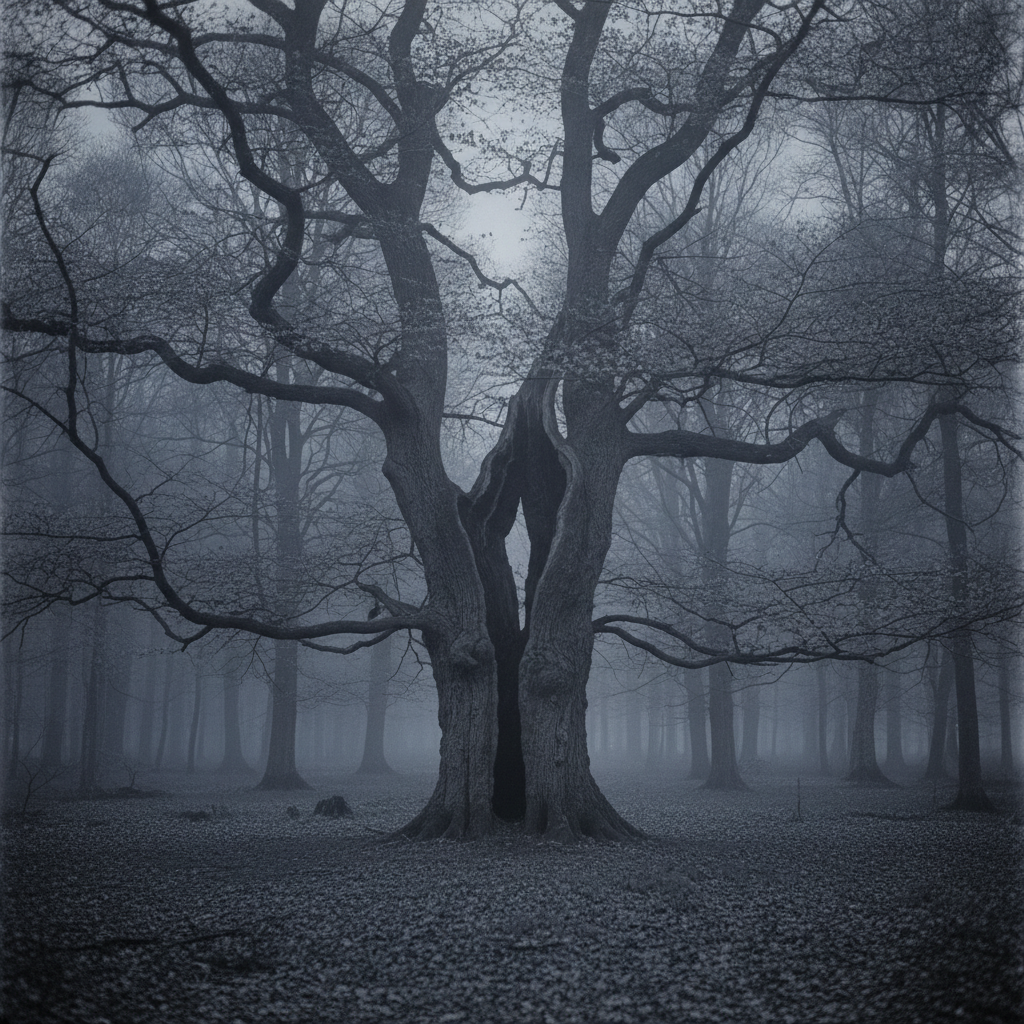
On the afternoon of 18 April 1943, four boys climbed a fence into Hagley Wood, on the Worcestershire estate of Lord Cobham, and went looking for birds' nests. Wartime England had a shorter word for that: poaching. The wood lies under Wychbury Hill, a few miles from Stourbridge, and it is thick with old growth. One tree in particular had grown strangely. It was a wych elm, cut back long ago, so that its trunk had split into a bowl of shoots around a hollow core. It was the sort of tree a fifteen year old climbs without thinking about it.
Bob Farmer climbed it. He reached down into the hollow expecting eggs and his hand closed on something round. He lifted it out into the light. It was a human skull, with hair still attached to the bone and teeth still set in the jaw.
The boys put it back. They agreed among themselves to say nothing, because they were trespassing, and because they were children in a country at war and had learned not to attract attention. By that night the youngest of them, thirteen year old Tommy Willetts, had told his parents anyway. Worcestershire police were in the wood the following morning.
They took an almost complete skeleton out of the tree. A woman, folded into a cavity barely two feet across. A blue crepe soled shoe. A cheap gold wedding ring. Fragments of a mustard coloured skirt and a striped cardigan. And a short distance from the trunk, in the leaf litter and the soil, the bones of one severed hand, lying apart from the rest of her.
The remains went to Professor James Webster, the Home Office pathologist who ran the forensic science laboratory for the West Midlands in Birmingham. His report is the spine of everything this case has ever had. The woman was around thirty five, though he allowed a range of twenty five to forty. She stood five feet tall. Her teeth were irregular and several were missing, a pattern distinctive enough that he believed a dentist somewhere in the country would recognise it on sight. She had been dead at least eighteen months, which placed her death in or before October 1941.
In her mouth Webster found a section of taffeta. She had suffocated on it.
Then came the finding that has kept the case alive for eighty three years. Webster measured the cavity, and he measured the body, and he concluded that she could not have been forced into that tree once rigor mortis had set in. She had gone in warm, within a few hours of dying, while she was still soft enough to fold. Whoever killed her was standing in Hagley Wood in the dark, under blackout, with a body in his arms and a plan for where to put it.
The shoes helped in one direction and not far. Size five and a half, crepe soled, of a type not manufactured before 1940, which agreed with Webster's timing. Beyond that the police had almost nothing to work with. Britain in 1941 was a country in motion. Bombed out families, evacuees, munitions workers billeted in strange towns, foreign servicemen, refugees. A woman could disappear from the Midlands and leave nobody behind who would think to report it.
The investigation was thorough for its day and unusually imaginative. Detectives circulated Webster's dental description to dentists across the country, which was far from routine practice in 1943. They worked through missing person files for the whole region. They checked every woman reported gone from the Midlands in the relevant window. Hundreds of leads were followed and every single one of them ended. The inquest returned the only verdict available to it: murder by some person or persons unknown.
The strangest part of the case began that winter, and it did not come from the police.
Some time before Christmas 1943, someone chalked a question on a wall in Haden Hill Road, Old Hill. Who put Luebella down the wych elm? In March 1944 a fuller version appeared in Upper Dean Street in Birmingham: who put Bella down the wych elm, Hagley Wood? Two days later a third turned up on a building in Pershore Street, shorter still: Hagley Wood Bella.
No newspaper had printed a name. The police had never released one, because they did not have one. Officers also noticed the spelling. The writer used wych, the name of the tree, and not witch, the phonetic guess a stranger would make. Someone local, someone who knew that wood, was telling the police what to call her, in chalk, at night, and would not come forward and say it out loud.
The messages never really stopped. From the 1970s onward the same question began appearing on the Wychbury obelisk on the hill above the wood, repainted whenever the weather took it off, sometimes in the corrupted form who put Bella in the witch elm. In 2020 it was altered again in red paint. In eight decades nobody has ever been identified as the author of any version of it.
Conclusions and Open Questions
Four explanations have been argued seriously, and every one of them has a hole in it.
The first is ritual killing. In 1945 the anthropologist Margaret Murray, then the best known British writer on European witchcraft, seized on the severed hand and proposed an occult motive, connecting it to the Hand of Glory of folklore. The strength of the idea is that it takes seriously the two details an ordinary murder does not explain: the hand, and the tree. Its weakness is twofold. Murray's larger thesis, that an organised witch cult survived underground into modern Europe, has since been rejected by historians almost in its entirety. And scattered hand bones are precisely what foxes and rodents produce from a body left in a wood for eighteen months. Murray's intervention also dragged the case into the unrelated killing of Charles Walton at Lower Quinton in 1945, a connection that muddied both files and rested on nothing but atmosphere.
The second explanation is the simplest one. In 1944 a Birmingham sex worker told police that a woman known as Bella, who had worked the Hagley Road, had disappeared roughly three years earlier. The strength here is obvious: the right name, the right district, the right window, and a category of victim whose absence in 1941 nobody would have reported. The weakness is that police could never trace such a woman or confirm that she had existed at all, and the account reached them only after the name Bella was already chalked on walls across the city, which makes it impossible to say whether the witness was remembering or repeating.
The third theory is espionage, and it arrived through a newspaper rather than a police file. In 1953 the journalist Wilfred Byford-Jones, writing as Quaestor in the Wolverhampton Express and Star, ran a series on the case and drew a letter from a woman signing herself Anna of Claverley. She said her former husband, Jack Mossop, had helped a Dutchman put a drunk woman into a hollow tree in Hagley Wood to frighten her, and that he was afterwards tormented by dreams of a woman looking out at him from inside a tree. Mossop died in a mental hospital before the body was ever found, which is the account's one genuinely strong point: whatever he was raving about, he could not have read it in a newspaper. Against it, the woman came forward more than ten years after his death, the Dutchman was never traced under any spelling of his name, and no document has ever been produced that puts either man in that wood.
The fourth is the most famous and the most thoroughly dead. Josef Jakobs, an Abwehr agent, parachuted into Cambridgeshire in January 1941, broke his ankle on landing and was captured within hours. He was shot at the Tower of London on 15 August 1941, the last person ever executed there. Among his possessions was a photograph of a German cabaret singer named Clara Bauerle, who he said was to be sent to England after him. Bauerle had performed in the Midlands before the war and spoke English with a local accent. Clarabella. The story is almost too neat, and it is wrong twice over. Witnesses described Bauerle as close to six feet tall, and Bella was five. And in 2016 researchers working through Berlin civil registration records located her death certificate. Clara Bauerle died in Berlin on 16 December 1942, more than a year after the woman in the wych elm had already been put inside it.
What is left is a problem of custody rather than of deduction. The remains were held in the Birmingham City Police museum at the Tally Ho! training centre until the late 1960s or early 1970s, and after that nobody can say where they went. Webster's original report and much of the case file are missing as well. A West Mercia Police review of the case was closed in 2014. In 2018 the Face Lab at Liverpool John Moores University produced a forensic facial reconstruction, which gave the country a face to look at and no name to attach to it. In 2023 the BBC appealed publicly to museums and universities to help find the bones, because a single tooth would now be enough for DNA extraction and a genealogical search of a kind that was unimaginable in 1943.
That appeal has not produced them. Until it does, the hardest fact in the case remains Webster's measurement of the hollow, which says that somebody carried her into that wood in a hurry and knew exactly where he was going. The second hardest is that within a few months a stranger was writing her name on walls in chalk. At least one of those two people knew who she was.