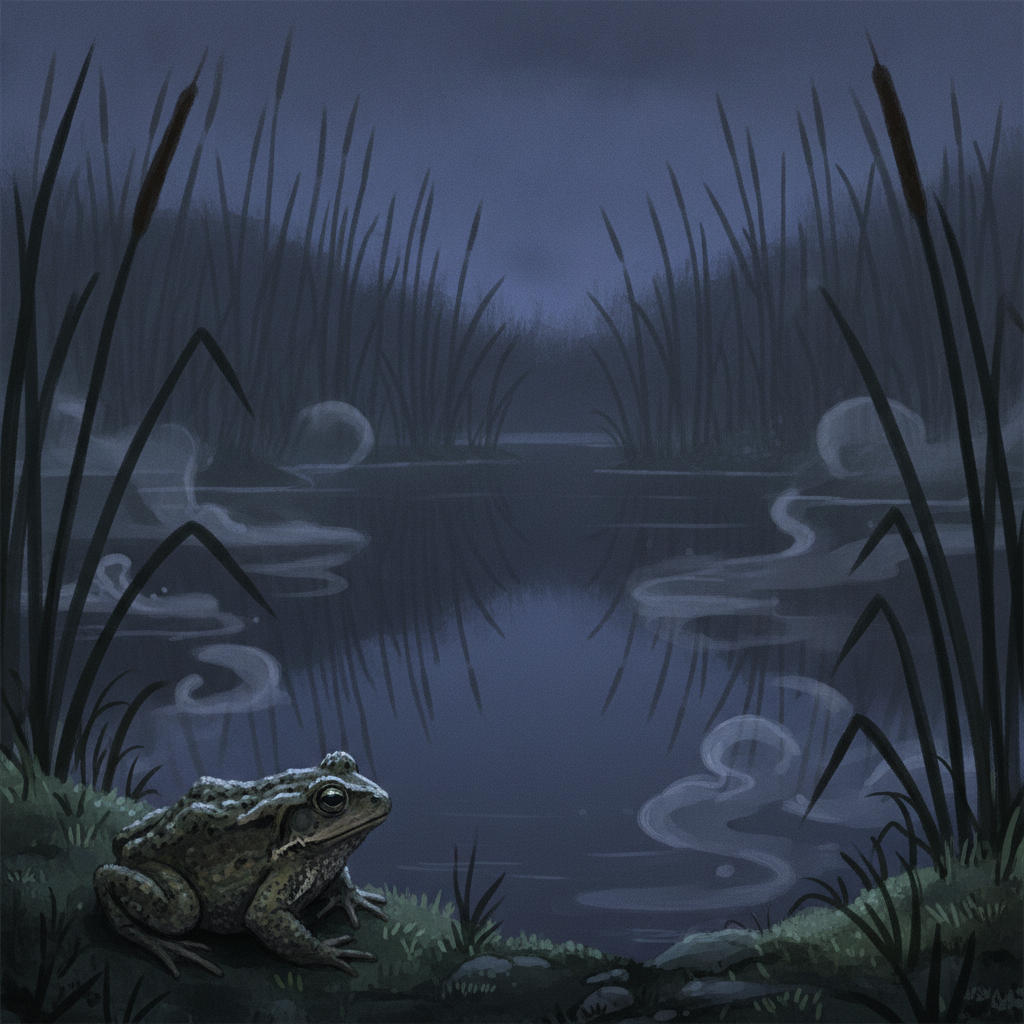
The Pool of Death: The Spring a Thousand Hamburg Toads Burst From Within
The pond lay in Altona, a green pocket of Hamburg, the kind of ordinary city district where people walk dogs and children feed the ducks. In April 2005 it became the site of one of the strangest animal deaths ever recorded in Germany, and the residents said it began in the small hours. Somewhere between two and three in the morning, when the water lay black and still, there would be a wet, muffled report, like a fist driven into wet clay. Then another. Then, on some nights, dozens more.
By first light the banks of the little pond were littered with bodies, and the bodies were not merely dead. They were turned inside out. Toads that should have fit in a child's palm had swelled to roughly three and a half times their normal size, split along the belly, and thrown their livers, lungs and coils of intestine as far as a metre away across the grass and the shallows. The skin had torn rather than been bitten. Whatever had happened to them had happened from the inside.
Over a handful of nights that spring, more than a thousand toads died this way. The neighbours gave the place a name that needed no translation: der Tuempel des Todes, the Pool of Death. It was a small, unremarkable body of water, the sort a walker would pass without a second glance, and within a week it had a nickname and a queue of camera crews on its bank.
The timing was not random in one respect at least. April is breeding season, when common toads gather at the water in their hundreds to mate, and the density of animals in that small pond was correspondingly high. Witnesses were emphatic about what they had seen. The toads were not simply found burst at dawn. Some were watched inflating themselves grotesquely and then rupturing, in a few cases while still alive, as though a pressure inside them had nowhere left to go.
Within days the story had travelled around the world. Newspapers in a dozen countries carried it, photographers came to shoot the bodies on the mud, and amphibian specialists came to work out what was killing them. At first nobody could. The animals did not look poisoned in any ordinary sense. They did not look like the victims of a plague either, because a plague tends to leave a corpse behind rather than scatter it across a metre of grass.
That distinction mattered, because mass amphibian death is not in itself unusual. A fungal disease called chytridiomycosis has swept through ponds on five continents and pushed whole species toward extinction, so a field of dead toads is no great riddle on its own. But chytrid does not inflate an animal to three and a half times its size and blow it open, and nothing in the veterinary literature of common amphibian illness produces a corpse that looks as if it had swallowed a grenade. This was a mechanical death, a death by pressure, and pressure has to come from somewhere. The investigation that followed was, in essence, a hunt for the source of that pressure.
The man who found the first hard clue was Frank Mutschmann, a veterinarian from Berlin who specialised in amphibians and reptiles. He went to Altona, collected specimens at the water's edge, and examined the ruined bodies in detail. On many of them he found something that everyone else had missed: a small, precise wound, roughly the size of a bird's beak, punched through the skin between the chest and the abdominal cavity.
And through that little hole, in animal after animal, the liver was gone. Not damaged. Not diseased. Removed. A soft organ had been extracted, cleanly, through a puncture far too small to have let the rest of the toad's insides out on its own. It was the first piece of evidence in the case that pointed at something rather than merely ruling something out.
At the end of April, Mutschmann announced what he believed had happened. Crows, he said, had learned a trick. The pond at mating time was carpeted with slow, plump, distracted toads, and the birds had discovered that the liver was a rich and reachable prize. They had learned to strike with the beak at exactly the point where it could be taken.
The rest, in his account, was the victim's own doing. A toad that is attacked and cannot flee does what toads do when threatened: it inflates, drawing in air and swelling its body to look too large to swallow. But this toad now had a hole in its body wall and no liver behind it. When it drew itself up, Mutschmann argued, the rising internal pressure met a punctured, compromised abdomen. The blood vessels and lungs gave way, the remaining organs were forced out through the wound, and the animal was destroyed by its own defensive reflex.
While that explanation circulated, the laboratory work went on, and it consisted mostly of ruling things out. The water of the pond was tested and came back unremarkable, no better and no worse than water elsewhere in the city, which weakened the obvious guess that a pollutant or a chemical spill was to blame. The remains were screened for a virus or a bacterium, some amphibian epidemic that might make an animal swell and die, and nothing was found. There were early reports that an infection might have travelled from a horse-racing facility nearby, but the laboratories identified no infectious agent to carry the blame.
Then came the detail that made the case genuinely strange. It was not only Hamburg. That same April, at a pond near Laasby in central Jutland, in Denmark, hundreds of kilometres away across the border, toads were reported bursting in the same grotesque manner. Two ponds, two countries, one spring.
By early summer the deaths had stopped as abruptly as they had begun. The Pool of Death drained back into being an ordinary pond in an ordinary park, and the toads that survived went on breeding there. When the noise died down, the official assessment of what had happened was that the case lacked a satisfactory explanation, and that verdict has never been formally revised.
Conclusions and Open Questions
The crow hypothesis, proposed by Frank Mutschmann, remains the only explanation ever built on physical evidence from the pond itself, and that is its great strength. He found real wounds of a consistent size and shape, real livers missing behind them, and he offered a mechanism that links a puncture, a defensive reflex and a catastrophic rupture in a way that is biologically coherent. Corvids are among the most intelligent birds alive, able to invent techniques and spread them through a local population, so a learned trick is not far-fetched in principle.
Its weaknesses are serious all the same. As far as the documented record goes, nobody ever filmed or clearly watched a crow take a toad's liver at that pond. The theory was reconstructed backwards, from wounds to culprit, which is how the most seductive and the most fragile explanations are usually built. When it ran around the world, an ornithologist publicly dismissed it as unlikely, and the journal Nature carried the objection under a headline asking whether the bubble had burst on the exploding-toad story. The timing is the sharpest problem: crows hunt by day and roost at dusk, yet the reports clustered between two and three in the morning. Defenders answer that the birds struck in daylight and the wounded animals lingered, then burst hours later in the cool of the night. That may be right, but it is an inference stacked on an inference, and it was never demonstrated.
The disease hypothesis has the natural advantage of explaining a mass death in one population at one moment, which is what epidemics do. Its fatal flaw is that the laboratories looked and found no pathogen, and no ordinary amphibian illness inflates a toad and detonates it.
The pollution hypothesis fits the idea of a sudden toxic event in a single pond, and some argue that a chemical or veterinary residue from the racing facility nearby could have reached the water in a form the standard tests were not looking for. Against it stand the clean water samples and the Danish echo, which is hard to blame on one contaminated site.
One theory holds that a parasite was responsible, something that attacked the liver or drove the animals to swell, which would elegantly link the missing organ to the bursting. No such parasite was ever identified in the reporting, so this remains a suggestion rather than a finding.
There is also the deflationary view, which some observers still prefer: that the deaths were more mundane than the legend, ordinary predation and decay amplified by panic and repetition. Once the world is told that toads are exploding, exploded-looking toads are found everywhere, and the Danish reports may be that effect rather than a second outbreak.
What remains unexplained is specific and awkward. Were the beak-sized holes present on all the bodies or only on some, and how many were examined closely? Why did a phenomenon blamed on a daytime bird peak at two in the morning? Why take only the liver and leave the rest of an easy meal untouched, a thousand times over, without leaving the mess a feeding frenzy leaves behind? And if Hamburg and Laasby were the same event, what ranged across northern Europe that spring to cause both?
The open question underneath all the others is whether the file was closed for the right reason. A careful man found the missing pieces and named a bird. Other careful people said the bird could not be guilty. Nobody produced a better suspect, and the case was shelved with the unusual admission that a thousand animals had died in a way nobody could fully explain.