Jerome of Sandy Cove: The Man Who Refused to Speak for Fifty Years
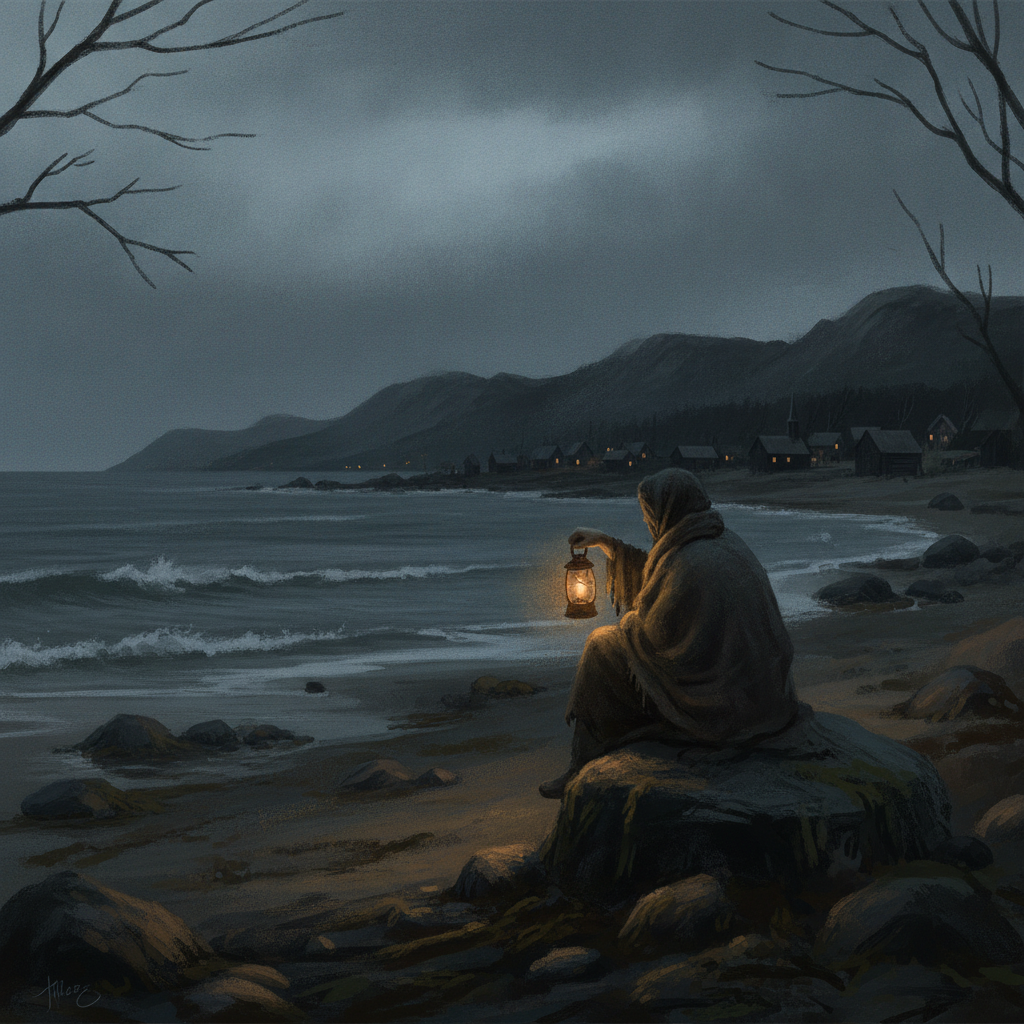
The boy was eight years old, and he never forgot it. On the morning of 8 September 1863, George Colin Albright, known to everyone at Sandy Cove as Collie, was walking the shingle beach below the cliffs of Digby Neck, the long thin finger of land that reaches into the Bay of Fundy along the western shore of Nova Scotia, when he saw a shape huddled against a rock near the tide line. It was a young man, dark-haired and well built, apparently no more than his mid-twenties, soaked through, chilled to the bone and barely conscious. The boy spoke to him. He did not answer.
When Collie's family and neighbours came down to the water, they understood at once why the stranger had not risen to meet them. Both of his legs had been cut off above the knee. They carried him up off the beach, out of the reach of the Fundy tides, and into a house where he could be warmed and fed.
The stumps told a strange and specific story. They were bandaged and only partly healed, which meant the amputations were recent but not fresh. The villagers who examined them agreed that the cutting was clean and expert, the work of a trained surgeon rather than the ragged result of an accident or a wound left to heal on its own. Somebody with skill had taken those legs off deliberately, and somebody had dressed the wounds afterwards.
Their first thought was a shipwreck, which is the first thought on that coast; the Bay of Fundy has the highest tides in the world and a long list of vessels lost in it. But there was no wreckage on the shingle, no wreck reported anywhere along that shore, and no boat found abandoned. Nobody in Sandy Cove had seen or heard a boat come in during the night.
Accounts from the time add a detail stranger still. A loaf of bread and a container of water had been left within his reach on the beach. Someone, it seems, had rowed him ashore in the dark, arranged the few comforts he had around him, and gone away again unseen.
The villagers tried to learn who he was. Pressed for his name, he mumbled a sound they heard as Jerome, and the name stuck to him for the rest of his life. On other occasions he was reported to have muttered words that resembled Colombo, perhaps the name of a ship, and Trieste, perhaps a home port on the Adriatic. Nothing could be confirmed and no thread could be followed, and no country, vessel or person was ever matched to either word. He never produced a surname, and the records that mention him give none.
Attempts were made to reach him in French, Latin, Italian and Spanish. All of them failed, or were met with silence. For close to half a century afterwards he spoke almost nothing at all. He reacted to prying visitors with visible anger, sometimes growling like a cornered animal to drive them off, and turned his face to the wall. Those who cared for him noticed one further oddity: his hands were soft, without the calluses of a man who had hauled nets or swung an axe for a living. Whatever his life had been before the beach, it had not been heavy labour.
His survival was itself remarkable. A double amputation above the knee carried a very high risk of death in the years before antiseptic surgery, and whoever performed his had done it well enough that he lived, and went on to outlast almost every adult who found him that morning.
The Baptist villagers of Digby Neck judged from his looks that he was probably a Catholic, and rather than keep a papist among themselves they arranged to move him across the peninsula to the French-speaking Acadian community around Meteghan. There he lived for about seven years in the household of Jean Nicola, a Corsican who had drifted to the region and who spoke several languages, in the hope that one of them might unlock the silent guest. Nicola's wife Julitte and his stepdaughter Madeleine helped tend him. None of the languages in that house opened him either.
When the Nicola household broke up, Jerome was taken in by Dedier and Zabeth Comeau in nearby Saint-Alphonse, and there he remained for more than forty years. A man with no legs needed constant attendance, and the province recognised the cost: the provincial government of Nova Scotia voted him a special stipend of two dollars a week towards his upkeep, a real sum for a rural family in those years. The money did not make him less of a puzzle. He was lifted, carried, washed and fed by that family for four decades, and in all that time he volunteered nothing about himself.
The arrangement had a harder side. The Comeaus are said to have charged curious travellers a fee to look at the silent castaway, so that the mystery man became something between a ward and an exhibit. Strangers came off the coach road to stare at him, and left knowing no more than when they had arrived. Word of him spread through the province and beyond it, and still nobody could say where he had come from, or fetch out of him a single sentence about it.
He grew old in that house. He died on 15 April 1912, reckoned to be somewhere between seventy-five and eighty years old, his identity as unknown in death as it had been on the beach, and he was buried that spring in the Acadian district that had sheltered him for forty-nine years. He was mourned by the people who had fed him, housed him and, less kindly, put him on show, and who in all that time had never learned who he was. His story has since been retold in books and in a 1994 film, and the beach at Sandy Cove is still visited by people who know it.
Conclusions and Open Questions
The oldest theory circulated among the villagers almost from the day they lifted him off the sand: that Jerome was a sailor, an Italian or other Mediterranean seaman, perhaps a mutineer whose legs had been taken as a savage punishment and who was then marooned to be forgotten. Its strengths are real: his southern colouring, his soft uncalloused hands, the fragments that sounded like a ship and an Adriatic port, and surgery skilled enough to suggest a ship's doctor. Its weakness is fatal: no navy or merchant service is documented as ever amputating both legs as a disciplinary penalty. It is the stuff of forecastle legend, and a legless man is no warning to a crew, only a burden no captain would carry.
A second theory, popular with local storytellers and later writers, is that a family of means quietly rid itself of a disabled or inconvenient heir, shipping him far away rather than killing him outright. It explains what the mutiny story cannot: the careful surgery, the food and water, and the wish that he should live but never be traced. Yet it is conjecture throughout. No name, no bereaved family, no ship's manifest or missing-person notice has ever been matched to him, and it skips the hardest fact of all, which is why the legs were removed at all, an act that must have preceded any scheme to send him away.
A third line of thought is medical. Some argue that damage to the brain's speech centres, the region known as Broca's area, could account for his near-total mutism, leaving a man who understood more than he could say. It fits the growling, the stray words and the fury at intruders. But it explains only the silence, leaves the legs and the origin dark, and cannot settle whether Jerome truly could not speak or simply chose not to.
The most grounded account came in 2008, when the Nova Scotia writer Fraser Mooney Jr. published a book arguing that Jerome had first appeared years earlier, across the Bay of Fundy in Chipman, New Brunswick. There, around 1859, a young foreigner reportedly fell through river ice, developed gangrene in both legs, and had them amputated by a local doctor to save his life. The people of Chipman are said to have called him Gamby, from his repeated cries of gamba, the Italian for leg. The story goes that a passing schooner captain was paid to carry the burden away across the bay to the Nova Scotia shore. Mooney pointed to official documents concerning Gamby and to contemporaries who insisted the two were one man. Its strength is that it replaces melodrama with something humanly plausible: an accident on the ice, a life saved by a country doctor, and a settlement that could no longer cope. Its weakness is that it rests on local records and decades of oral memory rather than decisive proof, and the writer Noah Richler dismissed it as speculation closer to fiction than history.
Even if every link holds, Mooney's chain pushes the mystery back only one step. Who was the young foreigner who went through the ice at Chipman, and what shore had he come from before that? What did he mean, if anything, by Colombo and Trieste? Was the silence an injury or a decision, and would either account for fifty years of it? And what do the bread and the jug of water say about whoever set him down on that beach, someone who could not bear to watch him die and could not bear to keep him?