The Beach That Swallows Whales: Why Whole Pods Keep Coming Ashore to Die
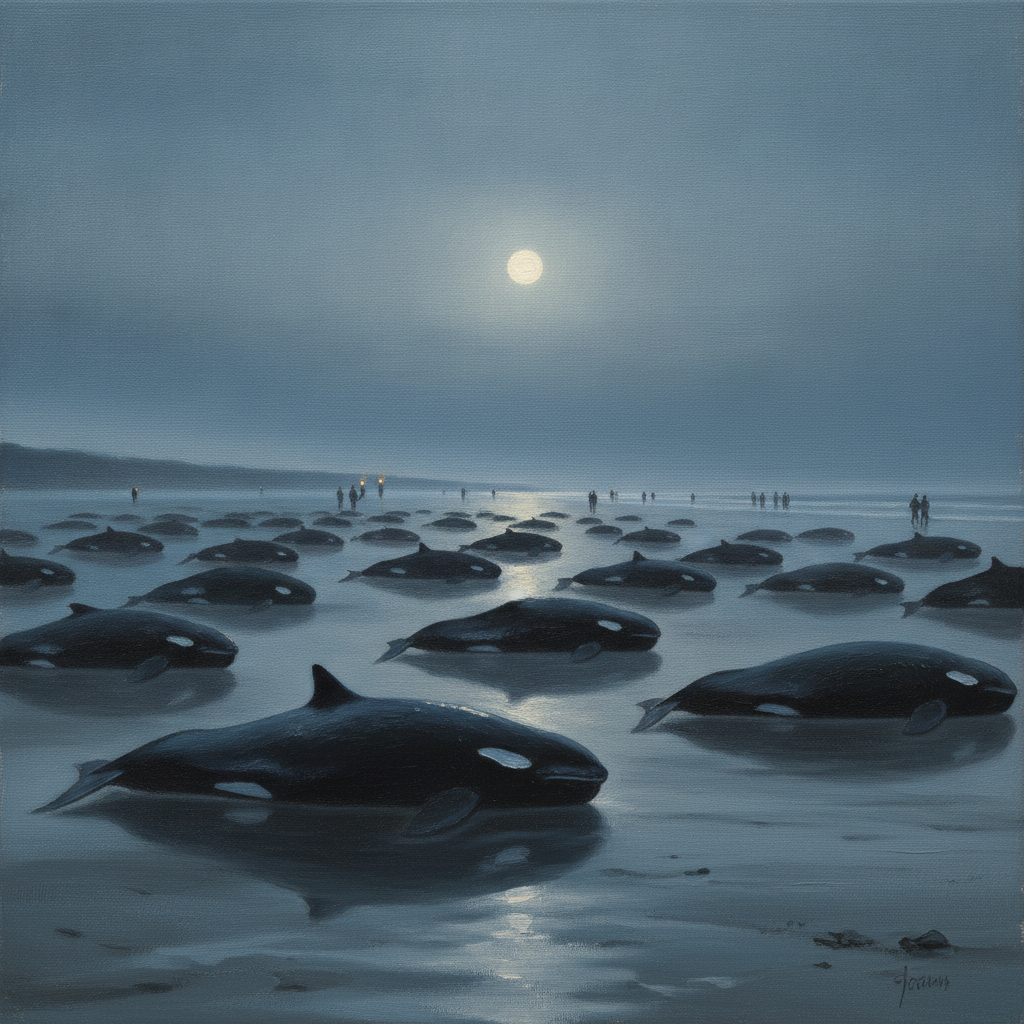
On the morning of February 10, 2017, volunteers reached Farewell Spit at first light and found the tideline covered with whales. Farewell Spit is a long, pale hook of sand at the northern tip of New Zealand's South Island, curving out to enclose Golden Bay, and during the night a pod of long-finned pilot whales had come ashore along it. Officials put the number at about 416 animals. Roughly seven in ten were already dead. The survivors lay heaving in the shallows beside the bodies of their own families, still calling.
What followed was one of the largest civilian rescue efforts ever mounted for stranded cetaceans. Around 500 volunteers waded into the cold water and formed human chains, holding the living animals upright, keeping their skin wet and their blowholes clear, waiting for the tide. At high water the teams managed to coax a hundred or more of the survivors back out to sea. The whales turned around and swam straight back onto the sand. The refloating was attempted again, and again a large share of the animals re-stranded in the same place they had just been carried out of.
Then the event doubled. Within hours of the first mass coming ashore, a second pod of roughly 200 pilot whales stranded near the same stretch of beach. Volunteers waded out and linked arms in a line across the shallows to try to keep the newcomers from reaching the sand. The combined figure for those two days pushed toward 650 animals, making it one of the largest strandings in New Zealand's recorded history. Hundreds died. The carcasses had to be punctured to release gas, tethered so they would not drift, and finally buried in the dunes.
Farewell Spit was not an unlucky first-time location. It is the most notorious stranding site in the country and has taken pod after pod across generations, to the point that local people long ago began calling it a whale trap. The reason is written into its shape. The spit is a long, gently shelving expanse of fine sand where the sea floor falls away at barely half a degree, enclosing broad tidal flats. When the tide runs out across ground that flat, the water retreats faster than a five-metre animal can follow it.
Three years later and half an ocean away, the pattern repeated on an even larger scale. In September 2020, on the remote sandbars inside Macquarie Harbour on the west coast of Tasmania, about 470 pilot whales stranded over two days. Around 380 of them died. It remains the worst mass stranding in Australian records. Wildlife officers and local boat crews worked in freezing water for the better part of a week, slinging animals off the bars and towing them clear, and there too the same futility appeared: whales guided back into open water turned and beached again beside the calls of their pod.
Kris Carlyon, a wildlife biologist with the Tasmanian government, told reporters plainly that there was nothing to indicate this was human caused. No shipping incident, no coastal works, no military activity in the area could be tied to the event. The Tasmanian stranding also fell almost on the same calendar date as another large stranding in the region two years earlier, a coincidence that responders noted at the time and that no one has been able to interpret.
The examinations conducted afterwards deepened the problem rather than solving it. Necropsies at both sites and at other mass strandings around the world have repeatedly found the same thing: animals that were physically healthy, well fed, free of injury, with no obvious disease, no starvation and no wounds to explain what they did. Whatever drives a pod ashore, in most documented cases it leaves no mark on the body.
The species involved in the very largest events is almost always the same. Long-finned pilot whales are among the most intensely social animals in the ocean. They live in tight matrilineal pods in which offspring stay with their mothers for life, they remain in constant acoustic contact with one another, and they hunt squid in deep water by echolocation, reading the sea floor through reflected sound. A pod moves and reacts as a single unit, which is what makes an event of this size physically possible in the first place.
Modern science has watched all of this closely. Researchers have fitted satellite tags to pilot whales, dropped hydrophones to record pod communication, mapped the bathymetry of the known trap sites metre by metre, and dissected hundreds of stranded animals. Governments in New Zealand and Australia keep formal stranding databases going back decades. The record shows clearly where mass strandings happen, which species they happen to, and how they unfold once they begin. What none of it establishes is a cause. In both the 2017 and 2020 events, the responsible agencies stated that the reason the whales came ashore was not known.
Conclusions and Open Questions
The explanation the public reaches for first is naval sonar, and the evidence behind it is real but narrower than the headlines suggest. After a United States Navy exercise in the Bahamas in 2000, stranded cetaceans were found with haemorrhaging around the ears, and the Navy itself later acknowledged a link. Beaked whales that stranded in the Canary Islands in September 2002, hours after mid-frequency sonar was switched on nearby, were found on necropsy to have gas-bubble lesions in their tissues, the signature of something resembling decompression sickness. The mechanism proposed by marine mammal researchers is that intense sonar panics a deep-diving whale into surfacing too fast. The weakness is that this is largely a beaked-whale story. The great pilot-whale strandings at Farewell Spit and Macquarie Harbour have occurred repeatedly with no naval exercise anywhere near them.
A second theory looks to the sky. Whales are thought to navigate partly by sensing the Earth's magnetic field, possibly through magnetite crystals in their tissues. In 2017 researchers at the University of Kiel in Germany examined a cluster of twenty-nine sperm whales that had stranded around the North Sea in 2016 and proposed that solar storms, by disturbing the geomagnetic field at high latitudes, had thrown the animals off course. The idea has a genuine physical basis, but it remains circumstantial: correlating solar activity with strandings is not the same as observing the mechanism, and many strandings occur with no solar disturbance to blame.
The theory favoured by many cetacean biologists turns on the whales themselves. If one animal, a leader, an old matriarch, or a sick or disoriented individual, blunders into the shallows, its distress calls can draw the entire pod in after it. On this reading the others do not strand because they are lost; they strand because they will not abandon one of their own, and refloated whales return to the beach because their family is still calling from it. Its weakness is that it explains the followers without explaining the leader. It tells us why the many die once the one is in trouble, not what drove the first whale ashore.
For that first turn, the least dramatic explanation may matter most. Researchers familiar with both sites argue that the gentle sand slope defeats echolocation itself: on a rocky coast the returning pulse is sharp, but on a flat sandy shelf it scatters and fades, so the shore effectively disappears from the animal's acoustic picture until it is aground. Add a falling tide and prey drawing the pod inshore and the trap closes. The objection is that this describes a place, not a trigger. Thousands of pods round these coasts and swim on. Others have proposed narrower triggers for individual events: disease, biotoxins from harmful algal blooms, whales overrunning shallow water while chasing squid, or a pod fleeing orcas. Each fits some cases and none has been shown to account for most.
What remains unexplained is the core of the phenomenon rather than its edges. No proposed cause predicts which pod will strand, or when. No mechanism has been demonstrated in the act rather than inferred after the fact. The clustering at particular beaches is well documented, but the repetition of dates is not understood and may be coincidence. Above all, no theory fully accounts for the refusal of rescue by animals that are physically capable of swimming away. Some researchers argue the honest position is that there is no single cause to find, and that a mass stranding is a chain of ordinary events, a treacherous shore, a compromised leader, a falling tide and unbreakable social loyalty, that only rarely lines up. The open questions are these: what tips one particular pod, on one particular night, past the point of return? Is the pod following a leader, or reacting to something none of our instruments record? And can a stranding ever be predicted early enough to prevent it, or will volunteers keep forming human chains at Farewell Spit knowing most of the whales in front of them will die anyway?