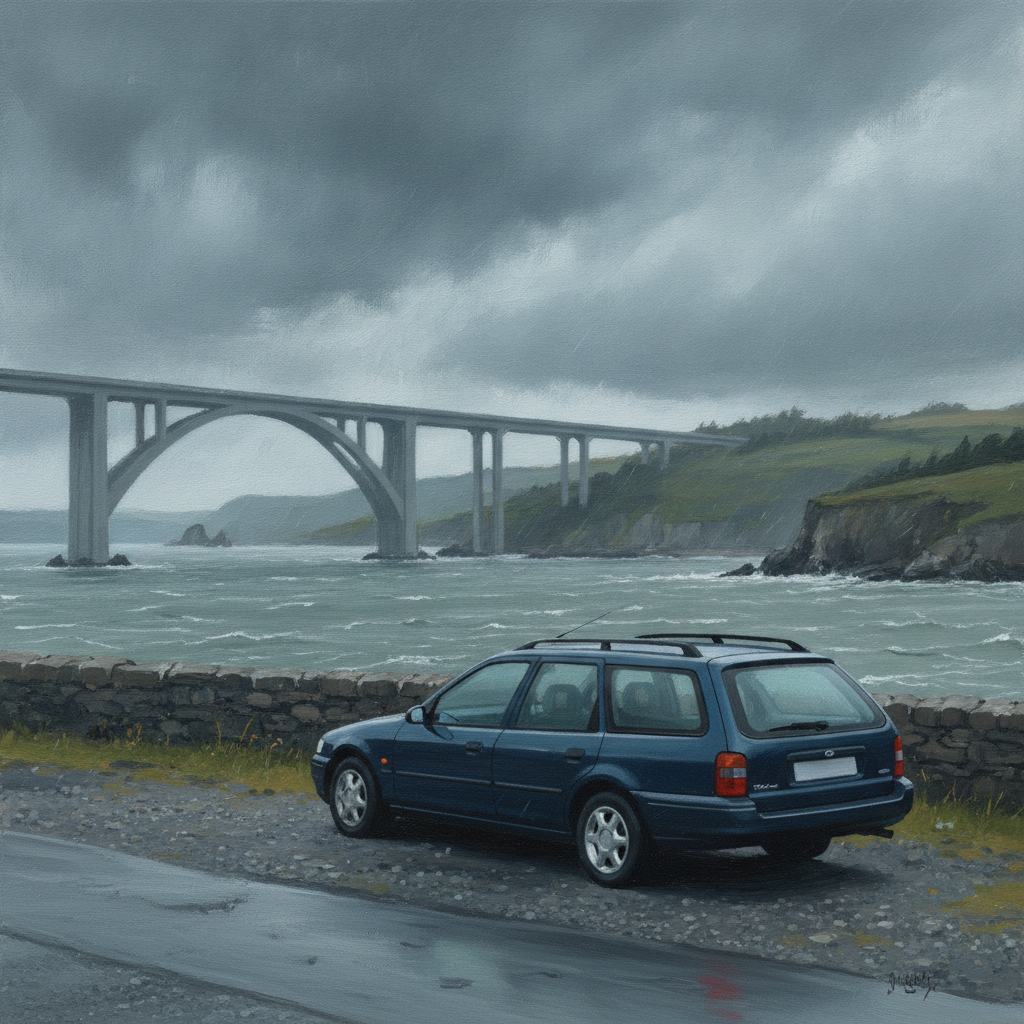
The Car at Severn View: The Vanishing of Richey Edwards
At seven o'clock on the morning of 1 February 1995, a 27-year-old Welshman checked out of the Embassy Hotel on Bayswater Road in London and walked out into the cold. He was due at Heathrow a few hours later, flying to the United States with his bandmate James Dean Bradfield to promote a record that had already unsettled everyone who heard it. He never went to the airport. He left his packed suitcase in the room, along with his toiletries, his prescription for fluoxetine and his passport.
His name was Richard James Edwards, known to a generation of British music fans as Richey. He has not been seen since, in any account that anyone has been able to confirm.
Edwards was born on 22 December 1967 in Blackwood, a former mining town in Caerphilly, south Wales, and grew up close to his younger sister Rachel. He was academically able, well read and, by the accounts of nearly everyone who knew him, gentle in person. He joined the Manic Street Preachers in 1989, initially as their driver and roadie, and became their fourth member: nominally the rhythm guitarist, though he rarely played on the records, and in practice the band's image and its principal lyricist alongside Nicky Wire.
He became nationally known through a single act. On 15 May 1991, after the journalist Steve Lamacq questioned whether the band meant what they said, Edwards took a razor blade and carved the words 4 REAL into his own forearm. The wound needed eighteen stitches. The photograph taken that night became one of the defining British music images of the decade, and it fixed a public identity on him that he spent the rest of his career living inside.
What lay underneath was documented, by him, more openly than almost any musician of the period managed. He spoke in interviews about depression, insomnia, self-harm by cutting and cigarette burns, anorexia and alcohol. In 1994, before the release of the band's third album, he was admitted first to Whitchurch Hospital in Cardiff and then to the Priory in London. The Manic Street Preachers played summer festival dates that year as a three-piece.
The album, The Holy Bible, came out in August 1994. Edwards wrote roughly eighty per cent of its lyrics, and they dealt directly with self-starvation, political violence, capital punishment and self-disgust. It is now widely regarded as one of the most important British rock records of the 1990s. At the time it sold modestly and frightened people.
His last live appearance was on 21 December 1994 at the London Astoria, a show that ended with the band destroying their equipment. Edwards smashed his guitar.
Over the two weeks before he disappeared, he withdrew 200 pounds a day from his bank account, roughly 2,800 pounds in cash altogether. In the days before 1 February he gave a friend a copy of the novel Novel with Cocaine and told her to read the introduction, which describes the author's confinement in an asylum and his later disappearance. At the hotel he wrapped a box of books and videos, decorated it, and addressed it to Jo, a girlfriend he had known for years and from whom he had recently separated.
After checking out he drove his silver Vauxhall Cavalier west, back to his flat in Cardiff. There he left his passport and his credit cards. He was reported missing when he failed to appear for the flight.
What happened over the following two weeks is assembled from fragments rather than witnesses. A Severn Bridge toll receipt linked to him was recovered. For more than twenty years it was read as 2:55 in the afternoon. The researchers Sara Hawys Roberts and Leon Noakes, whose book Withdrawn Traces was published in 2019 with a foreword by Edwards' sister Rachel Elias, reported that the receipt was printed on a 24-hour clock and therefore recorded a crossing at 2:55 in the morning, which moves the accepted timeline by half a day.
On 7 February a taxi driver said he had picked up a passenger from the King's Hotel in Newport. The passenger asked to be driven around the valleys, then to Pontypool railway station, and finally to the Severn View service station at Aust in Gloucestershire, paying a fare of 68 pounds in cash. The driver said the man's accent moved between Welsh and Cockney. Whether that passenger was Edwards has never been established.
On 14 February the Cavalier, parked at Aust services, was issued with a parking ticket. On 17 February it was recovered. The battery was flat, and there were signs that someone had been living in it. Inside were photographs Edwards had taken of his family over the Christmas period.
Severn View sits at the eastern end of the old Severn Bridge, a crossing with a long and grim history as a suicide site. The Severn estuary has one of the largest tidal ranges in the world, and bodies entering it are frequently never recovered. No body was recovered here.
In the years that followed, unconfirmed reports placed Edwards in Goa in India, in Fuerteventura and in Lanzarote. None was ever substantiated by police or by anyone who had known him.
Under English and Welsh law his family could have applied to have him declared dead from 2002. They did not. It was only on 23 November 2008 that he was formally declared presumed dead, with the legal declaration the following day recording death on or since 1 February 1995. The surviving members of the band have continued to place a quarter of the group's royalties into an account held in his name. In 2009 they released Journal for Plague Lovers, an album built entirely from lyrics he had left behind in a folder handed to them shortly before he vanished.
Rachel Elias has spent three decades insisting that the case is a missing-person inquiry and not a closed one. Thirty-one years after the morning he walked out of the Embassy Hotel, that remains the formal position.
Conclusions and Open Questions
Almost every element of this case can be read two ways, which is why it has never settled.
The conclusion most people reach, and the one many close to the band have privately accepted, is suicide at the Severn crossing. It fits the documented history of depression, hospital admission and self-harm; it fits an abandoned car at a service station beside a bridge notorious for exactly that; and it fits the total absence of any confirmed trace since. Its weakness is that it rests on geography rather than evidence. A car left at a motorway services and a toll receipt prove a journey, not an ending, and no body was ever recovered to close the question, though the estuary's tides make that far from conclusive either way.
The competing case is that he planned to disappear. Roberts and Noakes argued this in Withdrawn Traces, pointing to the sustained daily cash withdrawals, the deliberate leaving of the passport and cards, the gift of a book about a man who vanishes, and the carefully wrapped parcel left for Jo. Their strongest single contribution is the re-reading of the toll receipt, which if correct means the accepted timeline was wrong for two decades. The weakness is that every one of those actions is equally consistent with a man in crisis putting his affairs in order, and that a staged disappearance requires him to have lived for thirty-one years without a passport, without contacting his sister, and without a single verified sighting.
Rachel Elias herself has pushed back on the binary. She has said that people seem to think there are only two outcomes, that he walked off somewhere exotic or that he jumped from the bridge, when there are a great many scenarios between the two. Her point is the most defensible position available: that a missing person is missing until proven otherwise.
Between those poles sit several open theories. One holds that he intended only to withdraw for a time, and died later by accident or illness while living rough, which would explain both the preparation and the silence but is impossible to test. Another notes that the car showed signs of habitation and asks whether he was in it for days, unnoticed, at a busy services. Some argue that the taxi journey of 7 February was a different man altogether, and that treating it as canon has distorted the whole reconstruction.
What remains genuinely unexplained is narrow and specific. Who was the passenger in that taxi, and why did his accent shift? Where was Edwards between 1 and 17 February, and if he was living in the Cavalier, how did an unmoved car go unremarked for a fortnight at a motorway service station? Why were his possessions divided so deliberately between hotel, flat and car? What is the correct reading of the toll receipt, and who checked it in 1995? And why did a man who documented his own suffering in public, at length, and in writing, leave nothing behind that answers the only question anyone has asked since?