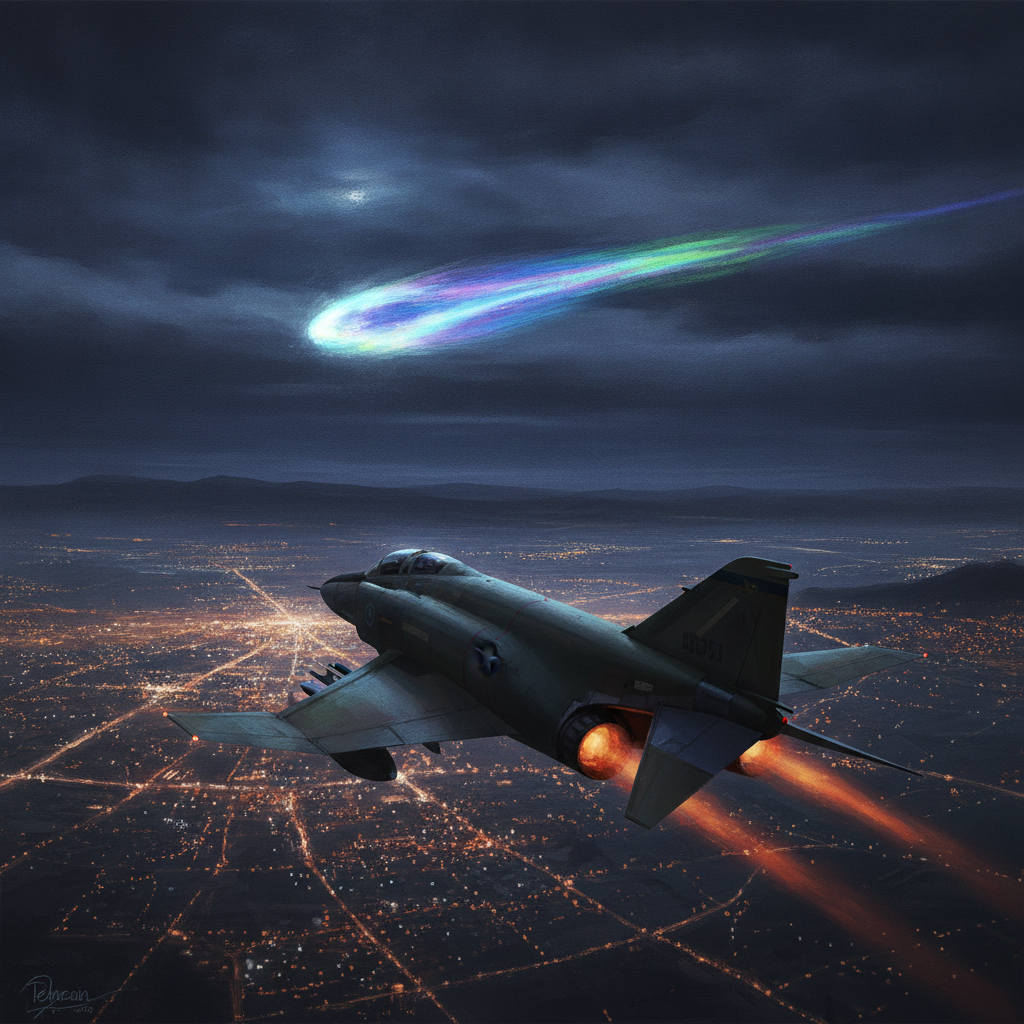
The Tehran Incident: The Night Fighter Jets Chased a Light and Their Weapons Went Dark
Shortly after midnight on 19 September 1976, the telephones in the control tower at Tehran's Mehrabad Airport began to ring without pause. The calls came from the northern districts of the Iranian capital, where residents standing on rooftops and balconies reported a brilliant light hanging over the city. They described it as flashing through changing colors and holding a position no landing aircraft could hold. The duty controller checked his boards. There was no scheduled traffic in that sector, and nothing on his display accounted for what the callers were describing.
The report climbed the chain of command until it reached General Yousefi, the assistant deputy commander of operations. His first reaction was that the callers were looking at a star and should go back to bed. The tower staff insisted otherwise, and Yousefi went outside to look for himself. What he saw over the mountains north of the city was, by his account, far larger and brighter than any star. At approximately 01:30 he ordered a fighter into the air.
The aircraft that answered was an F-4 Phantom II scrambled from Shahrokhi Air Base, flown by a young pilot recorded in the files as Lieutenant Yadi Nazeri. He climbed north toward the light and reported that it stayed ahead of him no matter how hard he pushed the aircraft. Then, as he closed to roughly 25 nautical miles, his instruments went dead. His communications failed at the same moment, both the radio link to ground control and the intercom inside the aircraft. Nazeri broke off the intercept and turned back toward Mehrabad. As the distance opened, the systems flickered and returned to normal operation.
A second Phantom was scrambled behind him, and it is this aircraft that carried the case into the historical record. Its pilot was Major Parviz Jafari, an experienced officer who would later reach the rank of general, with his weapons systems officer in the back seat. Jafari's radar operator achieved what the first crew never managed: a hard radar lock on the object. The return on the scope was enormous. Jafari later described it as having roughly the radar cross section of a Boeing 707 tanker. Visually, neither man could resolve a shape. What they had was a source of light so intense that no structure could be made out inside it.
Every time Jafari drove the Phantom in toward the object, closing to somewhere between twenty five and thirty miles, the range opened again. The object moved away across the sky faster than a tail chase could follow, holding its separation without any visible sign of the effort such speed would demand. He described intense blue, green, red and orange lights arranged in a rectangle, blinking in a sequence so rapid that all the colors appeared to be present at once.
Then a smaller, bright object separated from the main one and came directly at his aircraft. Believing he was under attack, Jafari moved to fire an AIM-9 Sidewinder. At that instant, he reported, his weapons control panel went dead and his radio dropped out with it, the same combination of failures the first pilot had described. Unable to shoot, he threw the Phantom into a steep diving turn. The smaller object followed him through the dive, then broke away and curved back toward the larger light.
Moments later a second bright object appeared to fall from the other side of the main craft and descend toward the ground. Jafari watched it come down as though landing, throwing off enough light to illuminate a wide area around it. His instruments recovered as he pulled away, and he brought the aircraft back to Mehrabad. The approach was itself unusual. A civilian airliner in the area reported a period of radio interference, and the tower briefly lost communications as the Phantom passed a particular bearing.
The following morning the crew went up again, this time in a helicopter, to locate the place where the glowing object had appeared to settle. In daylight the site resolved into a dry lake bed with nothing remarkable on it. There were no scorch marks, no wreckage and no impressions in the ground. As the helicopter circled to the west, the crew picked up a distinct beeper signal of the kind produced by an emergency locator transmitter, and the signal grew strongest near a small house. They landed and questioned the people living there, who described a loud noise and a bright light during the night.
What separates the Tehran case from thousands of other reports of lights in the sky is its paperwork. The events were compiled by the United States Defense Intelligence Agency into a document drafted by Captain Henry Shields, which drew on the debriefing conducted by Lieutenant Colonel Olin Mooy of the American military mission in Iran. The report was distributed across the upper levels of the American government, including the White House, the Secretary of State, the Chairman of the Joint Chiefs of Staff, the chiefs of the Air Force, Army and Navy, the National Security Agency and the Central Intelligence Agency.
Attached to the report was a DIA evaluation form. On it an analyst rated the information as high value and wrote that this was an outstanding report, a case that met all the criteria required for a genuine study of the phenomenon. The document later surfaced under the United States Freedom of Information Act and became one of the most frequently cited military records in the literature on unidentified aerial phenomena, largely because it is an internal intelligence appraisal rather than an advocacy document, and because it treated the account as both credible and unresolved.
Jafari continued his career in the Iranian air force and retired as a general. He gave his fullest public account of the night decades later, in November 2007, at an event held at the National Press Club in Washington. The original Iranian material that would allow independent verification, the radar tapes and any gun camera footage, has never appeared in a public archive. The case as it stands rests on the crew testimony taken in 1976, the American debriefing built from it, and the intelligence document that carried both to Washington.
Conclusions and Open Questions
The most developed skeptical explanation belongs to the American aerospace writer Philip Klass, the most persistent UFO debunker of his generation. Klass argued that the affair began with an astronomical misidentification, most likely the planet Jupiter, which was bright in that part of the sky, and that the electronic failures were ordinary malfunctions in aging, heavily worked aircraft flown by crews under acute stress in darkness. The strength of the argument is real. A bright celestial body does stay ahead of a pursuing jet indefinitely, because it cannot be overtaken, and F-4s of that period did suffer electrical faults. Its weakness is equally real. Jupiter does not release smaller objects that chase an aircraft, and the argument does not explain why the failures on two different jets coincided with the moments of closest approach.
The investigative writer James Oberg and others have emphasized a mundane detail from the follow up flight. Mooy himself noted that the beeper picked up near the dry lake bed was consistent with an aircraft emergency transponder, possibly one shaken loose from a C-141 by turbulence over the mountains, a known nuisance in that region. That deflates the most physical piece of evidence in the file, the apparently landed object. It says nothing about the radar lock, the sudden increases in range or the dead weapons panel, and it assumes the ground signal and the aerial light were the same thing, which was never established.
A third line of explanation points to the calendar. Several meteor showers were active in mid September, and a bright fireball can fill a night sky with fast, startling points of light. That may well cover part of what the civilians on the rooftops saw. It does not address a radar tracked object that reportedly changed position in response to an approaching fighter, or a weapons panel that failed at the moment a trigger was pressed.
At the other end of the range, some argue that the object was a secret aircraft, American or Soviet, being tested or flown over Iranian territory, and one theory holds that the electronic failures point to a deliberate defensive system of non human origin. Both remain open speculation. No aircraft known to have existed in 1976 had the performance described, and no evidence has ever been produced for either claim beyond the incident itself.
Two problems in the record deserve to be stated plainly. Jafari gave his most detailed public account thirty one years after the event, and testimony tends to sharpen with retelling, so the vivid 2007 version and the terse 1976 report are not the same document, although nothing suggests he was anything other than a serious officer describing what he believed he saw. And the absence of the Iranian radar tapes means that the single most objective element of the case, the lock itself, cannot now be independently examined.
What remains unexplained is the core of it. Why did two separate aircraft on the same night report the same specific failure of avionics and communications on approach, and recovery on withdrawal? What physical mechanism could selectively disable a fighter's electronics at twenty five miles while leaving the engines running? How could a radar return the size of a tanker leave nothing visible in the air and nothing at all on the ground the next day? Half a century of scrutiny has not closed the file. In the official record, Tehran carries no solution. It remains what the analyst called it: outstanding, and open.