The Battle of Los Angeles: The Night a City Fired at an Empty Sky
At 2:25 in the morning on Wednesday, 25 February 1942, the air-raid sirens began to wail across Los Angeles County.
Within minutes the whole city went dark. Street lights were switched off. Thousands of air-raid wardens left their beds and ran to their posts. People pulled their curtains shut and sat in the dark, listening.
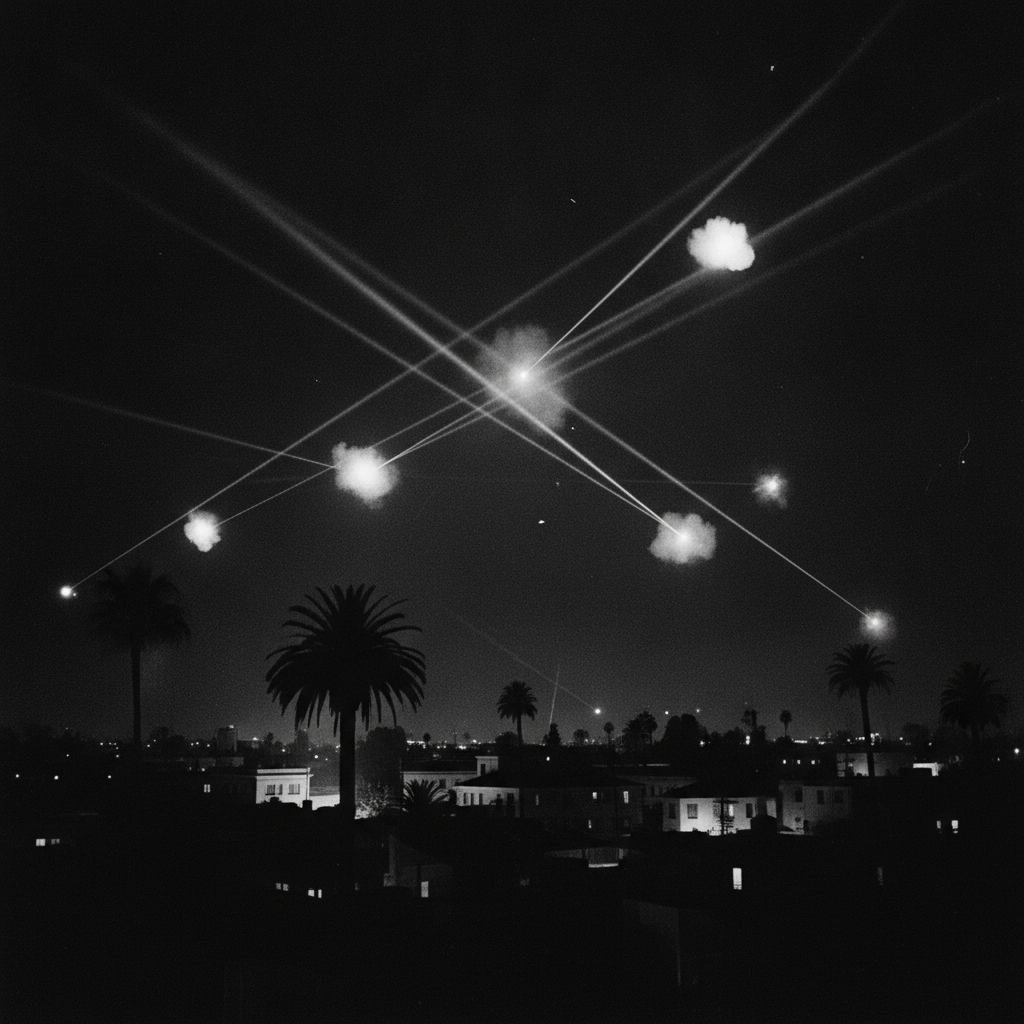
Then the searchlights came on.
At 3:16 the guns opened fire.
For the next hour, anti-aircraft batteries along the coast and in the city fired into the sky. Shells burst in the searchlight beams. Machine guns joined in. From the ground it looked and sounded like a real air battle, the first ever over the mainland of the United States.
At 4:14 the firing stopped.
At 7:21 the all-clear sounded, and the lights came back on.
By then more than 1,400 shells had been fired. Not one bomb had fallen. Not one enemy plane had been shot down. Not one wreck was ever found.
This is the event that became known as the Battle of Los Angeles. The question it left behind is simple: what were the guns shooting at?
Why the city was ready to believe
To understand that night, you have to know what the weeks before it felt like.
Japan had attacked the American naval base at Pearl Harbor, in Hawaii, on 7 December 1941. The United States was suddenly at war. The West Coast, facing the Pacific, felt like the front line.
In December 1941 and in the weeks after, Japanese submarines attacked merchant ships off the coast of California.
Then, on the evening of 23 February 1942, a Japanese submarine surfaced off the coast near Santa Barbara, further up the coast from Los Angeles. At 7:15 pm it fired its deck gun at an oil field on the shore.
The damage was small, about 500 dollars, and nobody was hurt. But it was the first time an enemy had shelled the American mainland in the war. The fear was enormous.
On 24 February, naval intelligence warned that an attack on California could come within 10 hours.
That evening, people reported flares and blinking lights near the factories that built planes for the war. An alert sounded at 7:18 pm. It was lifted at 10:23 pm.
The city went to bed nervous. 4 hours later the sirens sounded again.
What the gunners and the crowds saw
The guns belonged to an army coast-artillery brigade. They fired heavy anti-aircraft shells, each weighing about 5.8 kg, and machine-gun rounds. 9 searchlight beams swept the sky and crossed over the coast.
Army fighter pilots were put on alert. Their planes never took off.
Thousands of people watched from rooftops, porches and streets. Afterwards they described what they had seen, and here the trouble begins.
Some saw a single object. Some saw a formation. Some saw "swarms" of planes. The numbers ran from 1 to several hundred.
Some said the objects were very high, more than 6,000 m. Others said they were only a few thousand metres up.
Some said they moved very slowly. Others said they were faster than 320 km/h.
Some said they were planes. Some said they were balloons.
Years later, the official history office of the United States Air Force summed up the reports in one phrase: they were "hopelessly at variance."
The photograph
On 26 February the Los Angeles Times printed a dramatic photograph. It showed searchlight beams meeting at one point in the sky, with a bright patch where they crossed.
To many people, that bright patch looked like a solid object, held in the beams while the shells burst around it.
The photograph had been retouched before it was printed. In 1942 this was routine: newspaper artists painted over prints to make them sharper in print. Where the beams met, white paint had been added.
Decades later, that painted spot became the main piece of "evidence" that the guns had been firing at a large unknown craft. Today we know that part of what readers see in that picture is paint.
The cost on the ground
What came down was real, even if what went up is still disputed.
Shell fragments fell on the city. They damaged houses and cars.
People died. The most common account says 5 civilians: 3 were killed in car crashes in the blackout and the chaos, and 2 died of heart attacks. Some other sources give different numbers and causes, and the official air force history speaks of "at least one" heart attack. The total is not settled. What is settled is that nobody was killed by an enemy.
There was another cost. Some residents accused their Japanese-American neighbours of signalling to the enemy planes with lights. According to later accounts, about 20 Japanese-Americans were arrested. No evidence was ever found that anyone had signalled to anything.
This happened only 6 days after the president signed the order that led to the mass removal of Japanese-Americans from the West Coast. The fear of that night fed straight into it.
2 answers from 1 government
On the same day, the Secretary of the Navy held a press conference. He called it a "false alarm" caused by "war nerves." There had been no planes.
Then the Army spoke. On 27 February the Secretary of War made public an army report that said the opposite. As many as 15 planes might have been over the city. They might have been commercial aircraft flown by enemy agents to spread panic. He gave his own figure for the shooting: 1,430 rounds between 3:12 and 4:15 in the morning.
The Navy said nothing was there. The Army said something was. The public could see the 2 services contradicting each other.
Newspapers smelled a cover-up. One local paper wrote about a "mysterious reticence" in the official explanations. A member of Congress from Santa Monica, a city on the coast beside Los Angeles, called for an investigation. Rumours spread: of a secret enemy airfield in Mexico, of planes launched from submarines, even of a staged raid meant to push war factories inland.
What was found later
**Here is where the documented record of that night ends: no plane, no wreck, no bomb and no enemy pilot was ever found. Everything after this point is an attempt to explain it.**
In 1949, a history published by the army's own coast-artillery association said the firing was started by a weather balloon released at about 1 am. Once the guns began, it said, "imagination created all kinds of targets."
In 1983, the official air force history office studied the event again. It concluded that a balloon carrying a red light had been seen over Santa Monica at 3:06 am, and that this set off the first guns. After that, it said, the shell bursts lit up in the searchlights looked like planes to the next battery, which fired at them, and so on along the coast.
Its final judgement was "war nerves," probably triggered by a lost weather balloon and made worse by stray flares and the bursts of nearby guns.
There was one more piece of evidence, and it came from the other side. After the war ended in 1945, the Japanese government stated that it had not flown any aircraft over Los Angeles.
So the story can be closed in 2 lines. Something in the sky started the shooting. The shooting itself then filled the sky with targets, and the targets were never there.
Conclusions and Open Questions
There are 3 main explanations. Each is attributed to the people who proposed it.
**A weather balloon, and then panic.** This is the air force history office's view, and the army coast-artillery history before it. It fits the Japanese denial, the total lack of wreckage and the wildly different reports. The weakness: the 2 accounts do not agree on when the balloon went up, 1 am or just after 3 am. And no balloon from that night was ever recovered and identified.
**Real aircraft, flown by enemy agents.** This was the Army's view in February 1942, in the report made public by the Secretary of War. The weakness: no such plane was ever found, no airfield was ever identified, and nobody was ever charged. The Army itself later accepted the balloon explanation.
**An unknown craft.** This is the view of later writers on unidentified flying objects, based mainly on the retouched photograph and on witnesses who described a large, slow object held in the searchlights. The weakness: the key photograph was painted over before it was printed, and the official history describes the witness reports as hopelessly contradictory. There is no physical evidence at all.
What is still open is smaller than the legend, but real. Exactly what the first gunners saw at 3:06 or 3:16 was never recorded in a way that settles it. The 2 official versions of when the balloon was released do not match. And even the number of people who died that night is still given differently from source to source.
What is not open is the lesson. A city that had been told an attack was coming fired more than 1,400 shells at an empty sky, and the only people who died that night were its own.