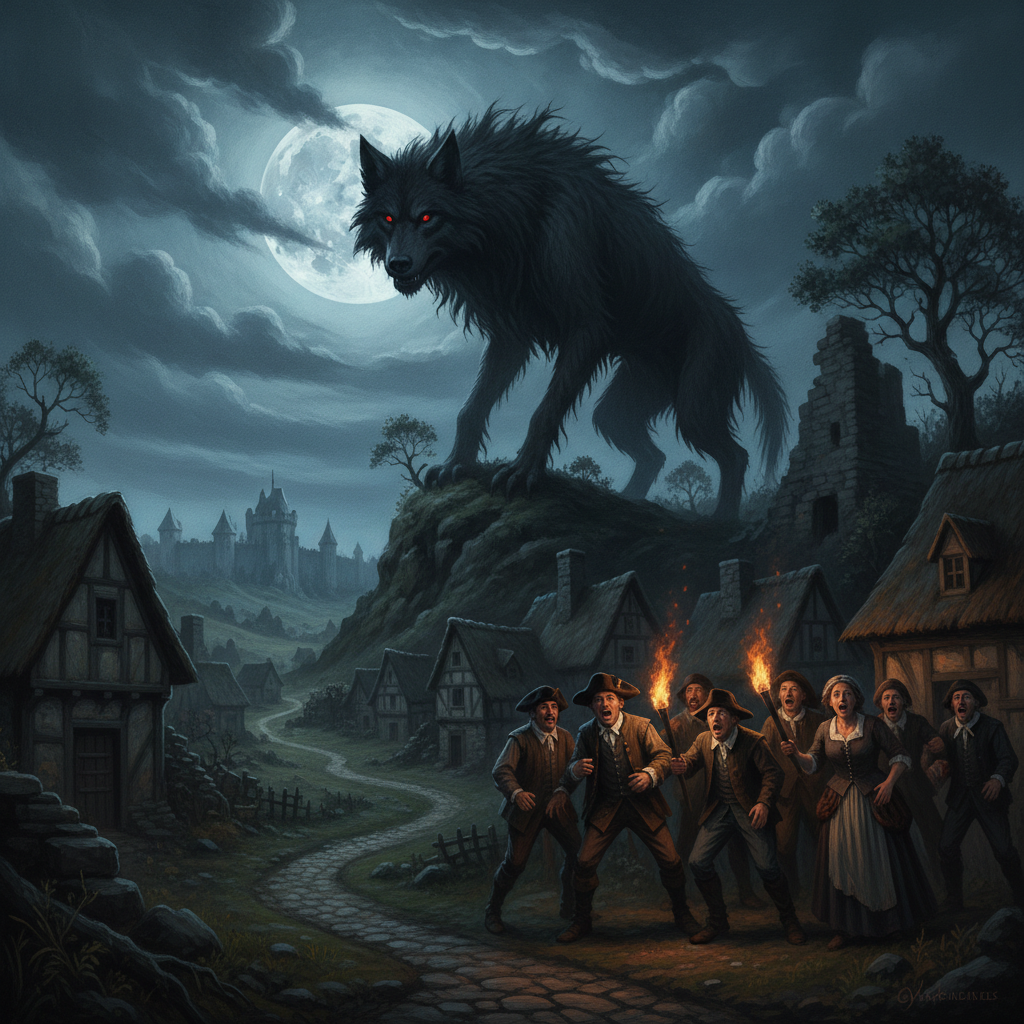
The Beast of Gevaudan: Three Years of Terror That France Never Explained
In the summer of 1764 the province of Gevaudan was one of the poorest corners of France. It occupied the granite highlands of the Margeride, in what is now the department of Lozere and the southern edge of Haute-Loire: a country of thin soil, high pasture, scattered hamlets and long winters. Its people lived from cattle, sheep and goats, and the animals were watched by whoever could be spared from the fields. That usually meant children, and it usually meant they were alone.
On 30 June 1764 a fourteen year old girl named Jeanne Boulet was killed near Langogne. The parish register recorded that she had been killed by the ferocious beast. She is counted as the first victim of what France would soon call la Bete du Gevaudan. Within weeks there were more. By the autumn the attacks had spread west and north across the Margeride, and a pattern had formed that would hold for three years: the victim was almost always alone, almost always herding livestock, and almost always a woman, an adolescent or a child. The animal went for the head and throat.
Survivors and witnesses were questioned by parish priests, local officials and army officers, and their descriptions were strikingly consistent. They spoke of an animal about the size of a calf or a young bull, higher at the shoulder than a wolf, with a reddish or tawny coat, a dark band running down the spine, a broad chest, a very large flat head with small upright ears, and a long thick tail. Many insisted it did not move like a wolf. Nearly all of them said the same thing about its behaviour: it was not afraid of people.
The response began locally and escalated quickly. Parish militias were formed and armed peasants swept the woods. In the autumn of 1764 Captain Jean-Baptiste Duhamel arrived with a detachment of dragoons and organised large beats through the winter, at times driving thousands of villagers across the snow in a single line. Poisoned baits were laid. Wolves were shot, sometimes dozens in a season. The attacks did not stop.
On 12 January 1765 the affair acquired a hero. At the hamlet of Villaret, near Chanaleilles, a group of children herding cattle was attacked. Jacques Portefaix, aged twelve, kept the group together and led them in beating the animal off with staves and improvised pikes, forcing it to release a boy it had already seized. The story reached Versailles. Louis XV ordered rewards for the children, granted Portefaix a pension and paid for his schooling, and instructed that the beast be destroyed.
Royal attention turned a rural emergency into an international news story, arguably one of the first of its kind. The Courrier d'Avignon, edited by Francois Morenas, ran the case as a serial of short factual dispatches in the faits divers form that was then new. The Paris papers picked it up, and the story travelled to London and beyond. A royal bounty was posted, six thousand livres and later more, a sum beyond anything a Gevaudan farmer could imagine.
In February 1765 the crown sent professionals. Jean-Charles Marc Antoine Vaumesle d'Enneval, a wolf hunter from Normandy said to have killed some twelve hundred wolves in his career, arrived with his son Jean-Francois and a pack of bloodhounds. They spent months in the highlands, quarrelled with local authorities, and killed nothing that stopped the attacks. They were recalled in June.
Their replacement was Francois Antoine, gun-bearer to the king and lieutenant of the royal hunt, a man in his seventies who came with soldiers, dogs and full royal authority. He worked methodically through the summer, shifting his base as reports came in.
On 11 August 1765, near Paulhac, a young woman named Marie-Jeanne Valet was attacked while crossing a stream and drove the animal off by wounding it in the chest with a bayonet mounted on a staff. Antoine reported the incident himself and called her the maid of Gevaudan. A statue at Auvers commemorates her.
On 20 September 1765, in woods belonging to the royal abbey of Chazes, Antoine shot a very large grey wolf. It stood about eighty centimetres at the shoulder, measured roughly one metre seventy in length and weighed around sixty kilograms, exceptionally large for a French wolf. Witnesses brought to view the carcass said its scars matched wounds they had inflicted on the beast, and human remains were reported in its stomach. The animal was skinned, stuffed and carried to Versailles, where it was presented to Louis XV. Antoine was rewarded and sent home. In October he killed what were said to be the wolf's mate and young. As far as the court was concerned, the affair was closed.
It was not. In December 1765 the killings resumed in the country around La Besseyre-Saint-Mary, and they continued through 1766 and into 1767. This second wave, which cost some thirty to forty more lives, drew almost no attention outside the province. The king had already been shown a dead beast, the newspapers had moved on, and officials understood that reopening the case was unwelcome. The Margeride was left to deal with it itself.
They did. On 19 June 1767 the Marquis d'Apcher organised a large hunt on the slopes above the Sogne d'Auvers, on the flank of Mont Mouchet. Among the several hundred men in the line was a local farmer named Jean Chastel. He shot the animal. The attacks stopped, and they never resumed.
The following day a formal report was drawn up and signed by, among others, the royal notary Roch Etienne Marin. It described an animal that seemed to be a wolf but was, in its own words, extraordinary and very different in its figure: an oversized head, unusual body proportions, and a coat whose colouring did not match the wolves of the region. Human remains were again reported in the stomach. The carcass was then carried north in midsummer heat toward Versailles. By the time it arrived it had decomposed badly and it was disposed of. No part of the animal survives. There was no dissection by a naturalist, no bones kept, no skin preserved.
The accounting has never been settled either. A detailed study published in 1987 counted 210 attacks with 113 deaths and 49 people injured, 98 of the dead partly eaten. Other historians, working directly from parish registers and discounting entries that are ambiguous, put the toll closer to one hundred dead. Those registers are the hardest evidence that survives, and in one respect they are unambiguous: the dead were overwhelmingly women, adolescents and children, people who worked outdoors, alone and unarmed.
Three years, roughly a hundred graves, two royal expeditions, an international press campaign and two animals shot and declared to be the beast. What no one ever produced was a body that a naturalist examined and named.
Conclusions and Open Questions
The mainstream historical reading today is that there was no single monster. Jay M. Smith, in Monsters of the Gevaudan (2011), argues that Gevaudan suffered a severe wolf problem in a place where unarmed children herded alone, and that the singular Beast was assembled afterwards by the press and by a monarchy that badly needed a visible victory. Jean-Marc Moriceau, who has catalogued wolf attacks across France over three centuries and counts thousands of deaths, places Gevaudan at the extreme end of a real and recurring phenomenon rather than outside it. The weakness of this reading is that it explains the social panic better than the physical testimony, and it does not explain why the killings stopped so precisely in June 1767.
A second theory holds that the animal was a wolf-dog hybrid, or several of them. Hybrids can be larger, differently coloured and far less wary of humans than wild wolves, which fits both the descriptions and the behaviour. Its weakness is simple: with no remains to test, it can be neither confirmed nor refuted.
Some argue for an exotic animal, a striped hyena, a young lion, or a beast escaped from one of the private menageries that European nobles then kept. This would account for the strangeness witnesses reported. Against it stands the absence of any record of such an escape, the difficulty of an imported animal surviving three Margeride winters while evading thousands of hunters, and the fact that the 1767 report, for all its oddities, described teeth consistent with a member of the dog family.
A darker line of argument, associated most prominently with Michel Louis, is that a human being was involved: an animal kept, trained or protected by someone, with suspicion pointed at the Chastel family. Supporters note the family's poor local reputation, the claim that one son kept animals, and the neatness with which the killings ended the moment Jean Chastel fired. As a theory it remains entirely circumstantial. No contemporary document accuses them of anything of the kind.
What is genuinely unexplained is narrower than the legend but real. Antoine's wolf of Chazes was an unusually large animal, yet the killings resumed roughly three months after it was shot. Chastel's animal ended them, yet it was never examined by anyone qualified to identify it, and modern reviewers have questioned the reliability of the 1767 report that describes it. The victim profile matches predation on the smallest and most isolated targets, but the repeated boldness in daylight, close to villages and in the presence of adults, is unusual for wolves in the historical record.
The open questions are these. Was there one animal, a pair, or a shifting succession of them across three years? Why did the attacks pause between September and December 1765, and what does that pause say about Antoine's kill? Would the stuffed wolf sent to Versailles, long since lost, have answered it? And can the parish registers of Lozere and Haute-Loire still yield a firmer count than the one we have? The Beast of Gevaudan is not an unsolved crime for want of witnesses. It is unsolved because the one piece of evidence that mattered was allowed to rot on a cart in the summer of 1767.