Documented

Fifty Thousand Men and a South Wind: The Lost Army of Cambyses

2026-08-07 · Vanished Without a Trace · 8 min read

In 525 BCE the Persian king Cambyses II, son of Cyrus the Great, invaded Egypt. He defeated the Egyptian forces at Pelusium in the eastern Delta, took Memphis, deposed the pharaoh Psamtik III and added the richest kingdom of the ancient Mediterranean to the Achaemenid Empire. The conquest was quick and largely conventional. What happened next is the part nobody has been able to close.

Our single ancient source for the episode is Herodotus, writing roughly seventy years after the events in Book Three of his Histories. According to him, Cambyses planned three campaigns from Egypt: one against Carthage, abandoned when his Phoenician crews refused to sail against their own kin, one southward against the Ethiopians, and one against the Ammonians, the people of the oasis we now call Siwa, deep in the Western Desert.

Siwa mattered because of what stood in it. The Oracle of Amun at Siwa was one of the most respected prophetic sanctuaries in the ancient world, consulted by Greeks and Egyptians alike, and it would later be visited by Alexander the Great. Herodotus says Cambyses sent a force with orders to enslave the Ammonians and burn the oracle of the god.

The number he gives is fifty thousand men. They set out from Thebes, on the Nile in Upper Egypt, with guides. Seven days into the desert they reached a place Herodotus calls Oasis, the Island of the Blessed, which is generally identified with the Kharga Oasis and which he says was held by Samian Greeks of the Aeschrionian tribe. That is the last point in the march where the historian can name a location. After that, in his words, nobody knows anything about them except the Ammonians themselves and those who repeat what the Ammonians say.

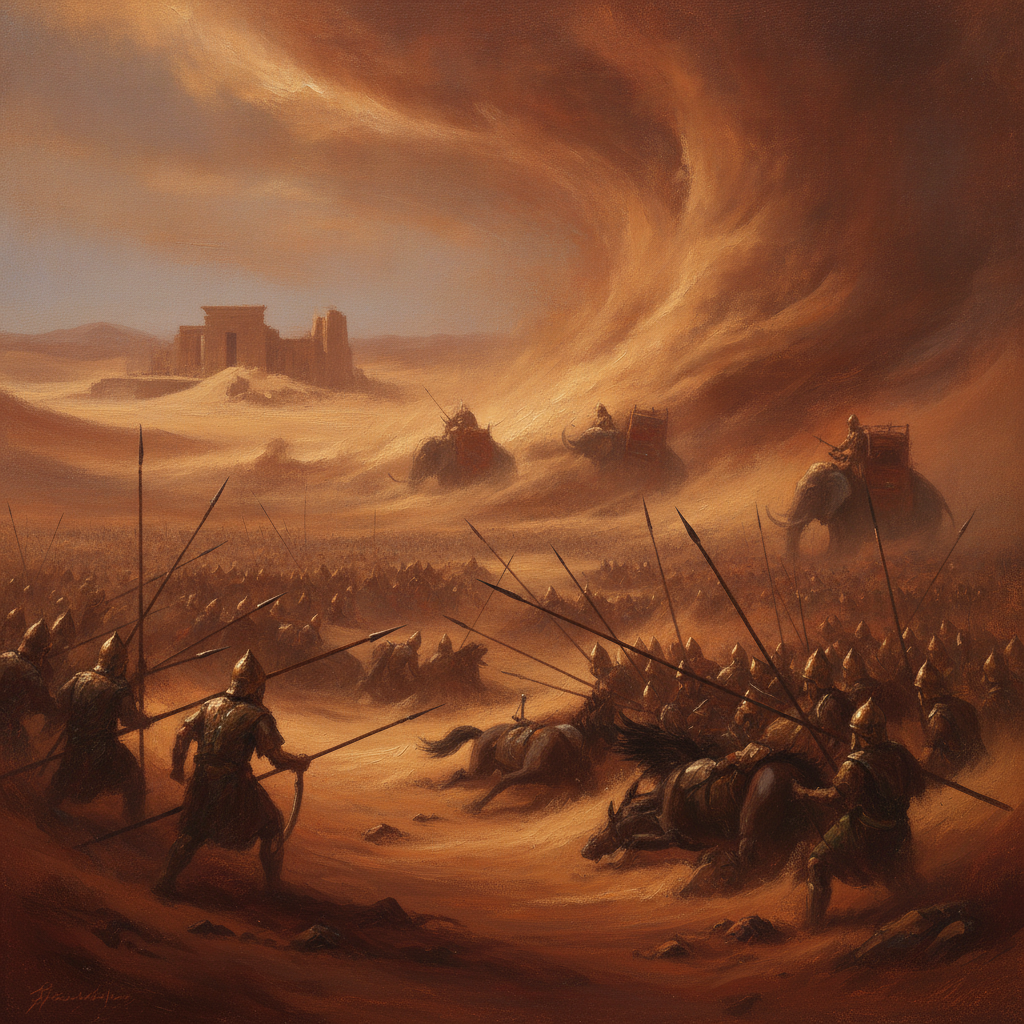
The account that reached him from Siwa is short and vivid. The army had left the oasis and was crossing the sand roughly midway between Kharga and Siwa. They stopped for their midday meal. While they were eating, a great and violent south wind rose, driving whirling columns of sand over them, and they disappeared entirely. That is the whole of it. Herodotus describes no survivors, no wreckage, no search. He simply records that the men were buried and that the Ammonians told the story.

The context matters. Herodotus presents Cambyses as a king who lost his judgement in Egypt, mocking Egyptian religion, killing the sacred Apis bull and dying of an accidental wound to the thigh, in the same place where he had struck the god. The disappearance of an army sent to destroy a famous oracle sits comfortably inside that moral frame. Whether Herodotus reported fact, propaganda, temple tradition or all three has been argued ever since.

The southern expedition failed as well. Herodotus says Cambyses marched toward the Ethiopians without adequate supplies and turned back before reaching his objective. Cambyses died in 522 BCE while returning from Egypt to deal with a revolt at home. Darius I eventually took the Persian throne and spent his first years putting down rebellions across the empire, Egypt among them.

The Western Desert where the army is supposed to lie is one of the harshest environments on earth: hundreds of kilometres of gravel plain, limestone plateau and the eastern edge of the Great Sand Sea, with migrating dune belts and almost no water. An army moving on foot with pack animals would have been at the outer limit of what desert logistics could support even in a good season.

Searching for the army became a recognised pursuit in the twentieth century. The most expensive attempt was mounted by the American journalist Gary S. Chafetz in 1983 and 1984, backed by Harvard University, the National Geographic Society and the Egyptian authorities, with a budget of around a quarter of a million dollars. The team included some twenty Egyptian geologists, filmmakers, an ultralight aircraft and ground penetrating radar. They located roughly five hundred tumuli and recovered bone fragments. The bones were dated to around 1500 BCE, about a thousand years too early to belong to Cambyses. The expedition ended badly for Chafetz, who was arrested over the importation of the aircraft, later donated to an Egyptian museum.

In the summer of 2000, a geological team from Helwan University working with petroleum prospectors reported finding textiles, metal fragments and human remains in the desert near Siwa. The Egyptian Supreme Council of Antiquities said the material would be investigated. No published archaeological follow-up establishing what the material was has appeared.

The best known claim came in November 2009 from two Italian brothers, Angelo and Alfredo Castiglioni, archaeologists and documentary filmmakers with long experience in the Egyptian and Sudanese deserts. Working between the Dakhla Oasis and Siwa, they announced they had identified human bones, bronze weapons including arrowheads, a silver bracelet and an earring beneath a large natural rock shelter, along with what they interpreted as water jars and stone shelters marking an alternative desert route. Their argument was that the Persian force had not taken the obvious road but had tried to approach Siwa from an unexpected direction, and that a khamsin, the hot sandstorm wind of the region, caught them on the way.

The response from Egypt was immediate and hostile. Zahi Hawass, then head of the Supreme Council of Antiquities, called the claims unfounded and misleading and said the brothers had no authorisation to excavate there. The findings were presented through a documentary film rather than a peer reviewed publication, and no independent excavation report has confirmed the material as Persian or as sixth century BCE.

Ad

Then, in June 2014, the question was reframed rather than answered. Olaf Kaper, an Egyptologist at Leiden University working with the excavations at Amheida, ancient Trimithis, in the Dakhla Oasis, presented a different reconstruction at a Leiden congress on political memory in the Persian Empire. Kaper had deciphered the full royal titulary of Petubastis III, an Egyptian rebel leader who declared himself pharaoh, carved on temple blocks at the site. The blocks show that Petubastis III controlled Dakhla and was claiming pharaonic authority there.

Kaper's proposal is that the army of Cambyses was not lost at all. Its objective, he argues, was the rebel base in the oasis region, and it was ambushed and destroyed there by the forces of Petubastis III, who went on to reconquer a substantial part of Egypt and have himself crowned in Memphis. Darius I put the revolt down about two years later, and on this reading the sandstorm was a convenient cover: a defeat by Egyptian rebels was erased and replaced by an act of god, a version that circulated locally and eventually reached Herodotus.

Neither claim has settled the matter. Between Kharga, Dakhla and Siwa there is still no confirmed Persian battlefield, no confirmed mass grave, no securely dated Achaemenid military equipment in quantity. The largest missing-persons case in ancient history remains exactly that.

Conclusions and Open Questions

Four positions are live, and each has a hole in it.

The literal reading takes Herodotus at his word: a real force was buried by a real storm. Its weakness is physical. Sandstorms kill, but they do not permanently entomb tens of thousands of men, animals and metal fittings without leaving a scatter. Desert sand moves; dunes migrate and expose what they covered. A century of aerial survey, satellite imagery, oil prospecting and vehicle traffic across the Western Desert has not produced the debris field that fifty thousand casualties would eventually surrender.

The reduction reading, favoured by many historians, holds that something happened but on a far smaller scale. Herodotus routinely reports enormous figures for Persian forces, and fifty thousand is likely a literary number rather than a muster roll. A detachment that ran out of water or lost its guides would be catastrophic for those involved and nearly invisible to archaeology. The weakness here is that it explains the silence by shrinking the event until it can no longer be tested.

The Castiglioni claim offers physical objects, which is what everything else lacks. Its weakness is process. Announcing bones and bronzes through a documentary, without an excavation permit, without stratigraphic recording and without independent dating, does not produce evidence that other archaeologists can evaluate. Until the material is properly excavated, published and dated, it remains an assertion about objects rather than a demonstrated link to 524 BCE.

Kaper's reconstruction is the most economical of the four, because it requires no miracle and it rests on an inscription that certainly exists. Its weakness is inference. The Amheida blocks prove that Petubastis III ruled as pharaoh from the oasis. They do not mention Cambyses, they do not mention a Persian army, and they do not record a battle. The link between the rebel king and the missing force is a historical argument built on plausibility and on what Darius I had reason to suppress, not on a text that says so.

What is unexplained is easy to list and hard to attack. No burial ground, weapons cache or campsite of the right date has been securely identified anywhere along the plausible routes. No Persian administrative document mentions the loss of a force of any size in Egypt. Herodotus attributes the story to the Ammonians, the intended victims, who had an obvious interest in a version where their god destroyed an invading army without a battle.

The open questions follow from that. If Kaper is right, where is the battlefield in or near Dakhla, and why has nothing of it been found? If the literal account is right, why has no dune ever given up an Achaemenid arrowhead in context? Was the target Siwa, as Herodotus says, or the oasis rebels, as Kaper argues? And is it possible that the army was smaller, turned back, or was quietly absorbed into the garrisons of Egypt, with the sandstorm supplying a memorable ending to a story that had no ending at all?

The desert has kept far smaller secrets badly. It has kept this one perfectly, which is itself an argument that the thing we are looking for may not be the thing that happened.


Share this story:

Reader comments (0)
Only active subscribers with verified payment can post comments. Subscribe — first month free