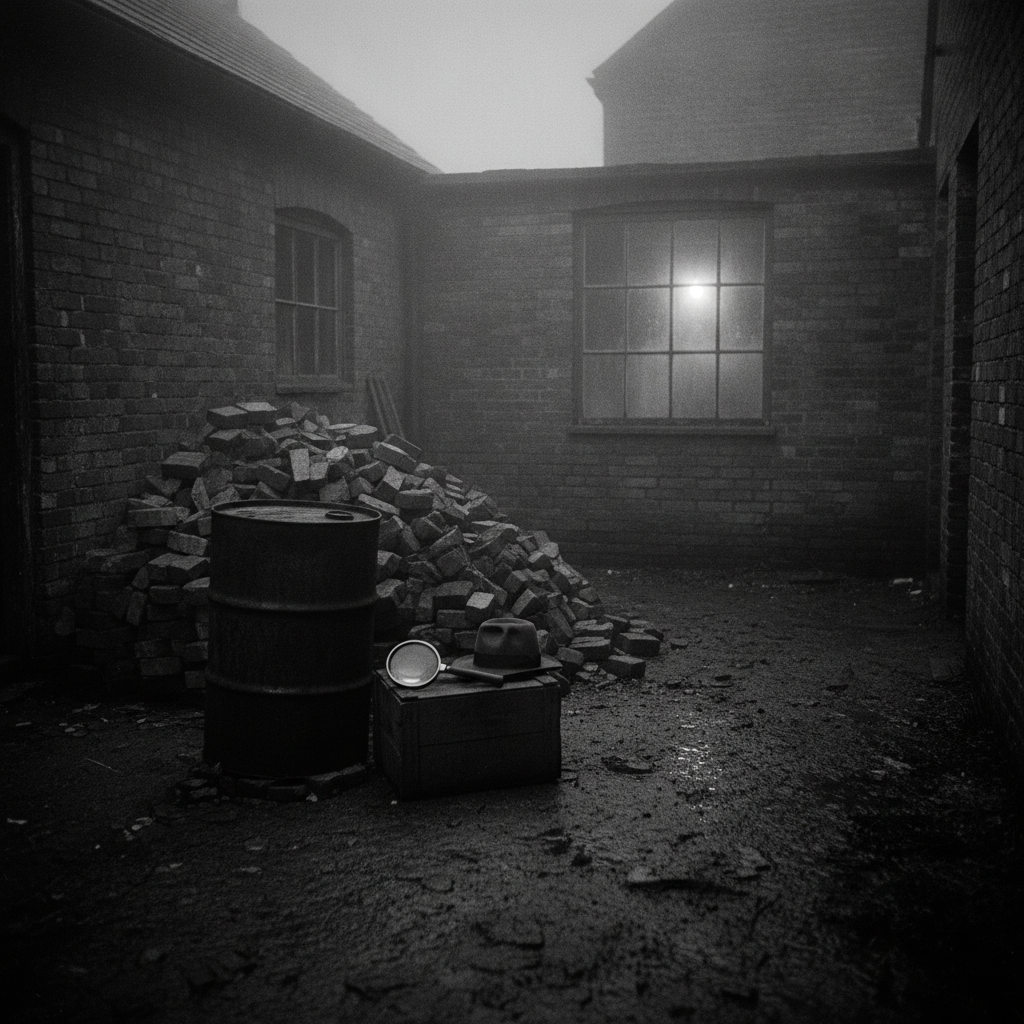
The Acid Bath Murderer: The Man Who Believed No Body Meant No Case
On Friday 18 February 1949, Olive Durand-Deacon got ready for an afternoon out.
She was 69 years old, a widow with money of her own, and she lived in a quiet residential hotel in west London. Many of the guests there were older people who had lived in the same rooms for years. They ate their meals at small tables in the same dining room, and they knew each other's habits.
She had an idea for a small business. She wanted to make artificial fingernails, and she thought she needed someone who understood materials and machines.
At the next table sat a man who said he was exactly that. He was 39, well dressed and polite. He told the other guests he was an engineer and an inventor, with his own workshop in the country. His name was John Haigh.
He offered to take her to see the workshop. It was in Crawley, a small town about 45 km south of London.
That afternoon she put on her black Persian lamb coat. She wore her rings, her earrings, a necklace and a small crucifix. She carried a red plastic handbag. She left with him in his car.
That evening her closest friend at the hotel waited for her at dinner. Her chair stayed empty. She did not come back that night, or the next.
According to the confession he gave 10 days later, she was dead by the late afternoon of that same Friday. He said he shot her in the back of the neck inside a small storeroom in Crawley, took her valuables, and lowered her body into a steel drum of sulphuric acid.
**Everything about what happened inside that storeroom comes from one source: the killer himself. What the police could prove came from somewhere else, and that is the story of this investigation.**
This is the case the British newspapers called the Acid Bath Murderer. The man who did it believed he had found a way to kill without ever being convicted. He believed that if there was no body, there could be no murder case. The investigators had to prove a murder with almost nothing left to prove it with. This is how they did it.
The man at the next table
On Saturday morning, the day after she vanished, the man from the next table came to her friend with a worried face.
He said Mrs Durand-Deacon had never turned up at the place where they had agreed to meet. He said he had waited for her and then given up.
It was a strange thing to volunteer. Nobody had asked him yet.
On Sunday 20 February, the friend decided to go to the police. The man offered to drive her there himself. He came along to a police station in west London, sat beside her, and helped her give the details.
He was calm, helpful and very talkative. He answered questions before they were asked.
That was his first mistake.
The policewoman who did not like him
The report was taken by a woman police sergeant. In 1949 there were few women in the British police, and missing persons reports were often handed to them.
She listened to the friend. Then she listened to the man. The friend was frightened. The man was smooth.
She did not like him. She could not point to one thing he said that was false. It was his manner: too eager, too polished, too keen to be part of the story. She wrote down her doubts.
That instinct would have meant nothing on its own. But it made the police do one simple thing: they looked him up in the criminal records.
The answer came back quickly. The helpful engineer had 3 convictions for fraud and theft, and had served several prison sentences. He had forged documents, sold property that did not belong to him, and used false names.
Now detectives were interested.
At the start, nobody was talking about murder.
An old woman who does not come home can have many explanations. She might have gone to relatives. She might have fallen ill in the street and been taken to hospital. She might have lost her memory. The detectives checked the ordinary explanations first, because the ordinary explanations are usually right.
They questioned the man. He gave a statement. He told the same story every time: she never came to the meeting, he waited, he left. A few days later, the police went back to the hotel and took another statement from him. It matched.
A fraud record does not make a man a killer. There was still no body, no witness, and no sign of violence anywhere.
The detectives needed to see the place he had been talking about. The workshop.
The storeroom in Crawley
On 26 February, 8 days after she vanished, detectives went to Crawley.
The workshop turned out to be a small storeroom on a side street. It was not a factory. It was little more than a shed. The man did not own it. He used it for what he called his experiments.
The detectives got the door open and went in.
Inside they found large glass bottles of sulphuric acid. They found a rubber apron and a gas mask. They found a stirrup pump, a hand pump of the kind used for putting out small fires, which could move liquid from a bottle into a drum without the person touching it. They found steel drums.
They also found a revolver.
And they found a leather case of documents. Inside it was something small and very important: a dry cleaner's receipt for a Persian lamb coat.
There were also papers in the case that belonged to other people. They came from 2 families, 5 people in all. None of those people had been seen for years.
The detectives now had a missing woman who had worn a Persian lamb coat, a man who said he never saw her that day, and that man's receipt for a Persian lamb coat.
Following the coat and the jewels
The receipt came from a dry cleaner in a nearby town, about 15 km from the storeroom. It was dated 19 February, the day after she vanished.
The detectives went to the shop. The coat was there. It was hers.
At the same time they followed a second trail. They traced a jeweller in another nearby town, where a man had brought in women's jewellery to be valued, and later sold it. The man matched the description. The jewellery matched the pieces she had been wearing when she left the hotel.
So the detectives could now show 3 things. She had left with him. He had lied about not seeing her. And within a day of her disappearance, he was handling her coat and her jewels.
What they still could not show was that she was dead.
The question about the hospital
On 28 February, 10 days after she vanished, the man was brought to the police station in west London.
For a while he sat with a detective inspector, waiting. Then he asked a question that surprised everyone in the room.
He wanted to know what the chances were of anyone ever being released from the state hospital for the criminally insane. That is the secure hospital where people found guilty of crimes but judged insane were sent, instead of to prison or to the gallows.
The inspector said he would not discuss that.
The man said that if he told the truth, nobody would believe him. Then he told them.
According to the police record of his words, he said: "Mrs Durand-Deacon no longer exists. She has disappeared completely and no trace of her can ever be found again. I have destroyed her with acid. You will find the sludge that remains at Leopold Road."
He meant the street where the storeroom stood.
He went on. He confessed to 5 more killings between 1944 and 1948. He also claimed 3 other victims whose names he did not give. And he said something new: that he had cut into the neck of each victim and drunk a glass of their blood.
Then he said the thing that explains everything he did. He believed that because the body had been destroyed, he could not be convicted of murder.
He was wrong. It was a well-known misunderstanding of an old legal phrase, "corpus delicti". The phrase means "the body of the crime". It does not mean the body of the victim. It means the proof that a crime took place. A murder can be proven without a body, if there is other proof that the victim is dead and was killed.
But the police still needed that other proof. A confession can be withdrawn. A man who asks about the insane hospital before he confesses may be planning his defence. The detectives had his words. Now they needed her.
The pathologist in the yard
On 1 March, the government pathologist came to the yard behind the storeroom. A pathologist is a doctor who examines the dead to find out who they were and how they died.
The man had said he emptied the drum onto the ground outside. In the yard there was a heap of rubble and earth, soaked with a thick greasy sludge.
The pathologist knelt down and began to look. Within minutes, he picked up something the size of a cherry stone. To anyone else it would have looked like a pebble.
It was a human gallstone.
Gallstones are small hard lumps that form inside the body, in the gallbladder, near the liver. They are made largely of fat and are covered in a fatty coating. That coating resists acid far better than flesh or bone does. The killer had not known that.
It was the first piece of proof that a human being had been dissolved in that yard.
Over the following days, the sludge and the earth were dug up and taken away to be examined in a laboratory, piece by piece.
The list of what came out of it is the core of the case:
About 13 kg of human fat.
3 human gallstones.
Pieces of bone from a human foot, and fragments of a pelvis, badly eaten by acid.
A lipstick case.
The handle of a red plastic handbag.
And a set of false teeth: a full upper denture and a partial lower one, made of acrylic.
The false teeth were the key.
Acrylic, the plastic used for dentures, is not dissolved by sulphuric acid. And dentures are made one at a time, for one mouth. They are as personal as a fingerprint.
The detectives found her dentist. The dentist checked the records and found that 2 years earlier, the practice had made her a full upper denture and part of a lower one, in acrylic.
The dentures from the sludge were compared with the dentist's records. They matched. The dentist identified them as hers.
The pathologist later summed it up in a sentence that is still quoted. He said the remains were identified as surely as if her body had never been in an acid bath.
Now the investigators had what the killer had been sure they could never have. They had physical proof that she was dead, that she had died in that yard, and that her body had been destroyed there.
The other 5
The papers in the leather case led the detectives backwards in time.
The earliest victim, killed in 1944, was a man of 33 who had once employed the killer. A year later, in 1945, the killer murdered that man's elderly parents. He then used forged documents to take over their houses and money. For years he told anyone who asked that the family had moved away.
In February 1948, the killer murdered a doctor aged 52 and his wife aged 41. He had met them when they were selling a house. He took their property too, and he took their revolver. It was the same revolver the detectives found in the storeroom.
In every case, he used the same method. He killed them, dissolved the bodies in acid, and then used his skill as a forger to take what they owned.
This explains the motive. He was not a man overcome by madness. He was a con man who needed money, and he had found what he thought was a perfect system.
He was charged only with the murder of Olive Durand-Deacon. It was the one case where the investigators had a body, or what was left of one.
The trial
On 18 July 1949, his trial opened at the county court of Sussex, the county south of London. Crowds gathered outside. The case had been in every newspaper for months.
The prosecution presented a simple story: murder for money. The coat at the cleaner's, the jewels at the jeweller's, the gallstones, the dentures, the dentist.
The defence did not really argue that he had not done it. It argued that he was insane. His lawyers pointed to his claims about drinking blood, and called a psychiatrist to say that his mind was deeply disturbed.
Under questioning, the defence's own psychiatrist agreed that the man probably knew that what he was doing was wrong. Under the law of the time, that was the test. A man who knows his act is wrong is not legally insane.
The trial lasted 2 days. The jury went out on 19 July and came back in less than 20 minutes. Different accounts give 15 or 17 minutes. The verdict was guilty.
He was sentenced to death. On 10 August 1949, at 8 o'clock in the morning, he was hanged at a prison in London. He was 40 years old.
What the investigation actually proved
Look back at the chain.
A friend who would not stop worrying. A policewoman who did not like the way a man talked. A records check. A receipt in a leather case. A coat at a cleaner's. Jewels at a jeweller's. A man who asked about the insane hospital before he confessed.
And at the end, a pathologist on his knees in the mud who knew what a gallstone looks like.
Any one of these alone might not have been enough. Together, they took apart the one idea the whole crime was built on: that without a body, there is no case.
Conclusions and Open Questions
The verdict is not in doubt. He confessed, the physical evidence matched, and the court convicted him. But some questions around the case have never been fully answered.
**Did he really drink his victims' blood?** Evidence for it: only his own word, repeated consistently after his arrest. The problem: he first asked about the insane hospital, then told the story. The defence's own psychiatrist agreed he knew right from wrong. The police found no evidence that it happened. Many who studied the case concluded it was invented to support an insanity plea. But nobody can prove what he did alone in that storeroom.
**Were there really 3 more victims?** Evidence for it: he said so in his confession. The problem: he never gave names, and the police found no missing people, papers or remains to match. The most common view is that these, too, were added to make him look mad. It cannot be proven either way.
**Was he insane, or only cold?** One view: the rehearsed confession, the forged documents and the years of careful fraud show a calculating man who knew exactly what he was doing. The jury agreed. The other view, raised by some doctors at the time: a man who does this over and over may be sick in a way the legal test of 1949 did not measure. That debate is about how the law defines madness, and it continues in courts today.
**What really broke the case?** Some accounts give the credit to the policewoman's instinct. Others to the receipt. Others to the gallstone. The honest answer: without the policewoman, nobody would have checked his record. Without the receipt, there was no link to her property. Without the pathologist, there was a confession and no body. It took all of them.
**What was never found?** Of the 6 victims he was known to have killed, only one was ever identified from physical remains. The other 5 rest on his confession and on the documents he kept. He was never tried for them.
What is certain is this: he was sure that destroying a body would destroy the case. A handful of gallstones and a set of false teeth proved him wrong.